

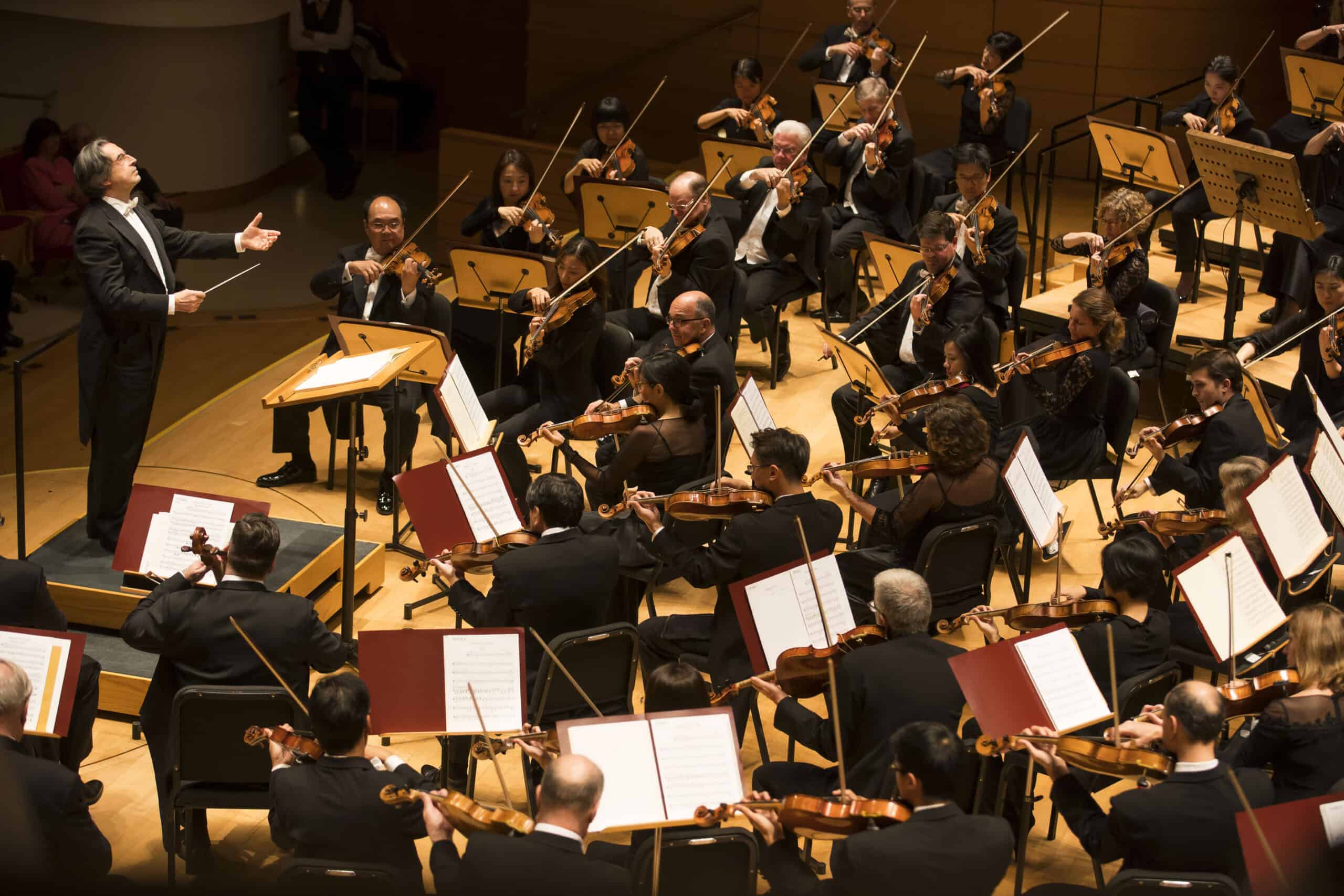
If you want to hear renowned international orchestras, then you can certainly visit Bozar. And you will also see conductors with great names at work. At the end of 2023, Jordi Savall came here and to start 2024, it was now Riccardo Muti, both in their eighties but far from written off. With his Chicago Symphony Orchestra (CSO), he starts a new European tour in Brussels and it has been a while since that happened. Not to be missed then, these are invariably exceptional events. On the programme this time is a new piece by minimalist Philip Glass, who is now also 86. The title: The Triumph of the Octagon. The work had its premiere only at the end of September in Chicago and now a European premiere in Brussels.
It was a commission to Philip Glass from the CSO orchestra to honour their Riccardo Muti upon his appointment as emeritus music director for life. Muti told Glass about the mysterious medieval Castel del Monte in his Italian Puglia and how impressively mysterious he found that castle as a small boy, with its eight octagonal towers and floor plans. The story stuck with the composer and he wrote an equally surprising and mysterious composition about it.
An enthusiastic 'bravo' for the maestro from the audience and there was Riccardo Muti. Slick hair as always, firm stride, all business and immediately at work with that new Philip Glass. Soft strings start first with harp, then oboe, clarinet and also flute and gradually those recognizable Glass sounds come through. A flowing and repeated rhythmic pattern, broadly spread out like the expansive yet quiet arm movements of the conductor. Halfway through the tempo accelerates, swelling until it suddenly and unexpectedly comes to an end. Surprising, that is, such a very short Italian story about that wondrous castle. Not even 13 minutes long, thoroughly minimalist then.....
With Mendelssohn's Italian Symphony comes repertoire work. With a determined gaze and economical movements, Muti continues to conduct his orchestra. But yes, such a professional team needs little more than a raised eyebrow to respond correctly to those changes in dynamics in that delightful opening section, that allegro vivace, that oh so popular and worn-out piece, but that oh so perfectly and this time elevated performance. Forget radio, CDs, streaming or anything else, go for "live" instead! You can follow all those different score layers so much more intensely and see them, distinguish all those sections, hear all those constantly changing dynamics. And then that swirling andante, followed by those colourful horns in the moderato. What did Mendelssohn find so imperfect about the whole composition that he kept tinkering with it so that it was only published after his death? That finale, that presto cannot be more cheerful. How sparkling is that entrance and how purely all those musicians play, both soft where necessary and loud where needed. And Riccardo Muti is living proof that a conductor doesn't need to be a circus artist and that an orchestra can also be kept in check with economical gestures.The concert thus encompassed multiple musical time periods. After Mendelssohn and Glass there was Prokofiev, his fifth symphony. Solid symphonic work written in 1944 when the war was still on and first performed when victory was near. The andante is full of brass and an extensive percussion section that work together with sometimes dark and then cutting strings. Less heavy, merrier follows the second part with that typical Prokofiev idiom of a hammering rhythm where a lyrical passage then glides through. In the finale a cheerful orchestra trots quietly towards a third acceleration where everything culminates in a thunderous triumph.
Under loud applause, Riccardo Muti rightfully congratulates all the desks and also that large group of excellent cellists. A restrained encore is welcome after all that festive noise. He chooses the "Intermezzo" from Manon Lescaut and thus wants to pay tribute to his compatriot Puccini, who died here in Brussels a hundred years ago.
WHAT: Philip Glass, The Triumph of the Octagon; Felix Mendelssohn-Bartholdy, Symphony No.4, op.90 "Italian"; Sergei Prokofiev, Symphony No.5, op.100.
WHO: Chicago Symphony Orchestra, cond. Riccardo Muti
WHERE: Henri Le Boeuf Hall, BOZAR, Brussels
WHEN: Thursday 11 January 2024.