

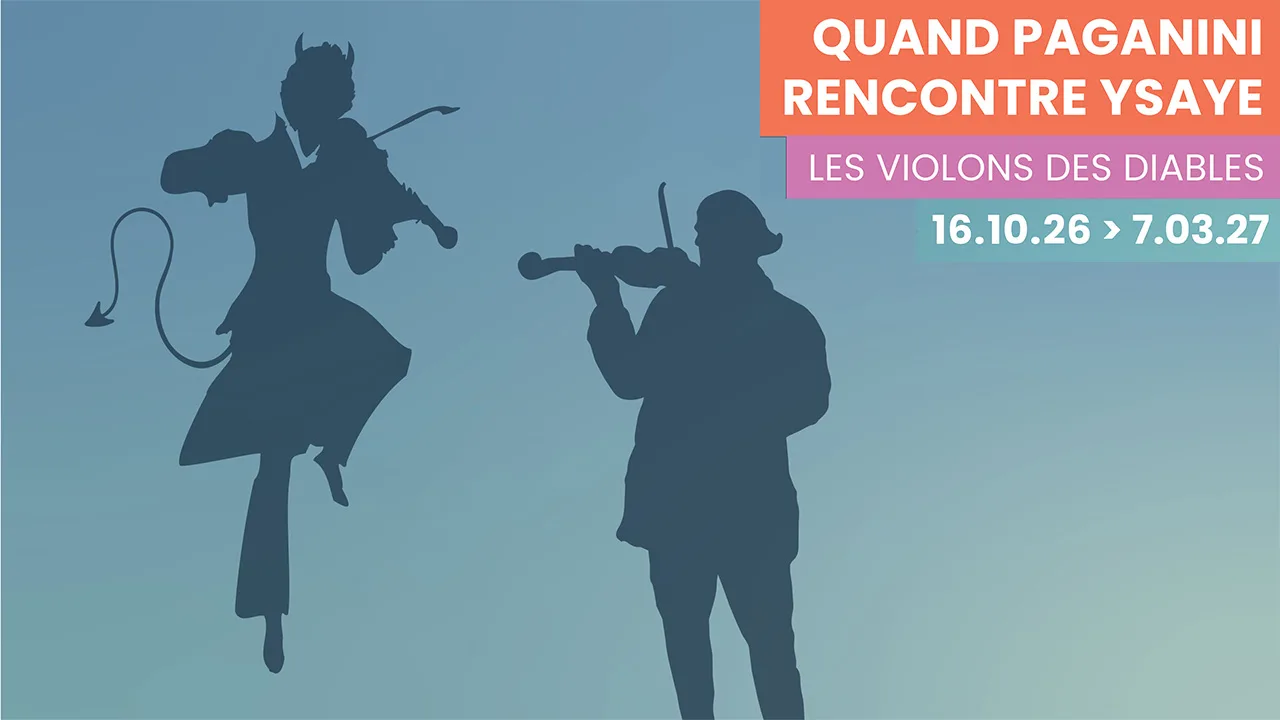
He had a slender figure, a gaunt face, and played so astonishingly that his contemporaries could hardly think of any other explanation: Niccolò Paganini (1782-1840) must have made a pact with the devil. His exceptional virtuosity, theatrical presence and mysterious reputation made him an early superstar of classical music. But who was the man behind the legend? The exhibition Wanneer Paganini Ysaÿe ontmoet. De violen van de duivels at the Grand Curtius in Liège invites you to discover this for yourself. You get to know Paganini as a composer, guitarist and teacher, and discover how his musical legacy continued to influence the Liège violin school.
From Genoa to Liège: a legacy in motion
Paganini's story does not end with his own masterful violin playing. His acknowledged pupil Camillo Sivori carried his teacher's musical legacy across Europe. Later, that virtuosity also resonated with Eugène Ysaÿe (1858-1931), the Liège violinist who further expanded the possibilities of his instrument. In the foreword to his Tien preludes, Ysaÿe refers to the significance of Paganini's music and the genius expressed in it.
The exhibition makes that musical kinship tangible. It shows how Paganini, Sivori and Ysaÿe each in their own way shaped the history of the violin: from the virtuosity that made Paganini famous to the artistic renewal with which Ysaÿe developed the tradition further.
Treasures that tell a story
Curator Patrick Dheur has brought together remarkable loans from Italian, Belgian and French collections. Some objects immediately capture the imagination; others introduce you to lesser-known aspects of music history.
- Paganini's personal guitar. The instrument was built in Naples by Gennaro Fabricatore and bears Paganini's authenticated signature. He used the guitar to compose and to make music in intimate circles. In this way the instrument sheds a different light on a musician who is best known as a violin virtuoso.
- An album full of memories. Sivori's album from 1842 contains dedications, sketches and scores, including signatures by Fétis and Vieuxtemps. It offers a remarkable window onto the musical network in which the virtuosos of that period moved.
- Paganini in pictures. The portrait by Giuseppe Isola, painted during Paganini's lifetime, shows the historical figure behind the myth. A terracotta figurine by Dantan the Younger adds a more playful, caricatural touch.
- The art of the bow. Fourteen historical bows by, among others, the Tourte family, John Dodd and Louis-Simon Pajeot illustrate how instrument making and playing technique influenced each other. Also notable is the Sartory bow that Queen Elisabeth gave to Ysaÿe in 1929, with an engraved dedication to her beloved master.
- From historical to contemporary. The sculptural instruments of violin maker Gauthier Louppe show how instrument making continues to evolve. The award-winning viola Gaudiade and the cello Phénix combine craftsmanship with new artistic possibilities. Contemporary composers have also been inspired by these instruments.
Those who wish to dive even deeper into Liège's musical history after the exhibition can visit the permanent collection. The Espace César Franck houses, among other things, the keyboard of the organ of Sainte-Clotilde and Franck's Erard half-grand piano. In addition, the Studio Eugène Ysaÿe brings an Art Nouveau salon by Serrurier-Bovy back to life. César Franck dedicated his famous violin sonata to Ysaÿe on the occasion of his wedding. The proximity of both spaces makes that musical bond literally visible as well.
An exhibition you can also listen to
An exhibition about music need not stop at looking. That is why a series of concerts and lectures accompanies the route. The programme includes both historical discoveries and contemporary interpretations. All Liège activities begin at 8 p.m.
- 21 November: the young Italian pianist Giulio Ginobi performs the recital Herinnering aan Paganini at the Musée de La Boverie, with works by Chopin and Scarlatti and the legacy of virtuosity as its theme.
- 5 December: Giuseppe Nova (flute) and Michele Trenti (guitar) present a concert around Paganini's manuscripts in the Salon Paganini.
- 12 December: musicologist Danilo Prefumo explores in the Salon Paganini the influence of the French school on Paganini, and the influence of Paganini on the European violin schools of the nineteenth century.
- 15 January: the Paganini Ensemble Vienna, with violinist Mario Hossen, looks back in the Grand Auditoire Montefiore on Paganini's Viennese breakthrough in 1828.
- 30 January: Paganini Inspiration presents new works for flute and guitar in the auditorium of the Grand Curtius, with guest composer Andrea Talmelli.
- 13 February: Jérôme Akoka takes listeners in the Salon Paganini to the golden age of the bow.
- 20 February: the Royal Chamber Orchestra of Wallonia performs music by Ysaÿe, Franck, Grétry and Lekeu in the Grand Auditoire Montefiore, complemented by a Belgian premiere by Patrick Dheur.
- 6 March: Marie Cornaz of the Royal Library of Belgium concludes the series in the Salon Paganini with a lecture on Ysaÿe and Paganini.
The exhibition also resonates beyond Liège. On 28 and 29 October, Mario Hossen and Patrick Dheur will bring the historic violin Il Sivori, once owned by Paganini, to life at the Palazzo Tursi in Genoa, during the Paganini Festival.
Families can also discover Paganini's world. From 19 to 23 October, the workshop week In the footsteps of Paganini takes place for children aged 6 to 12. On 31 October, a devil's parade winds through the museum, followed by a Halloween film evening. On 8 November there is a guided tour for children, and on 15 November a themed guided tour for a general audience.
Liège as an international music city
That this exhibition takes place in Liège is no coincidence. On 31 October 2025, the city was recognised by UNESCO as a Creative City of Music, building on a rich musical tradition. The European Paganini Route, which received recognition as a Cultural Route of the Council of Europe in May 2026, also underlines the international significance of this heritage.
With When Paganini Meets Ysaÿe, the Grand Curtius brings a musical legacy to life. The exhibition shows how Paganini inspired generations of violinists and how Ysaÿe further renewed that tradition. A meeting between two virtuosos that you not only want to see, but above all want to hear.
Practical information
What: When Paganini Meets Ysaÿe. The Violins of the Devils
When: 16 October 2026 to 7 March 2027
Where: Grand Curtius, Féronstrée 136, 4000 Liège
Opening hours: daily from 10 a.m. to 6 p.m., closed on Tuesdays and on 1 January, 1 May, 1, 2 and 11 November and 25 December
Tickets: 10 euros; visitors aged 65 and over pay 6 euros. Free for visitors under 26 and for everyone on the first Sunday of the month.
Concerts and lectures: 15 and 10 euros respectively; reservation only via Rendez-vous musicaux liégeois.
More information: www.grandcurtius.be