

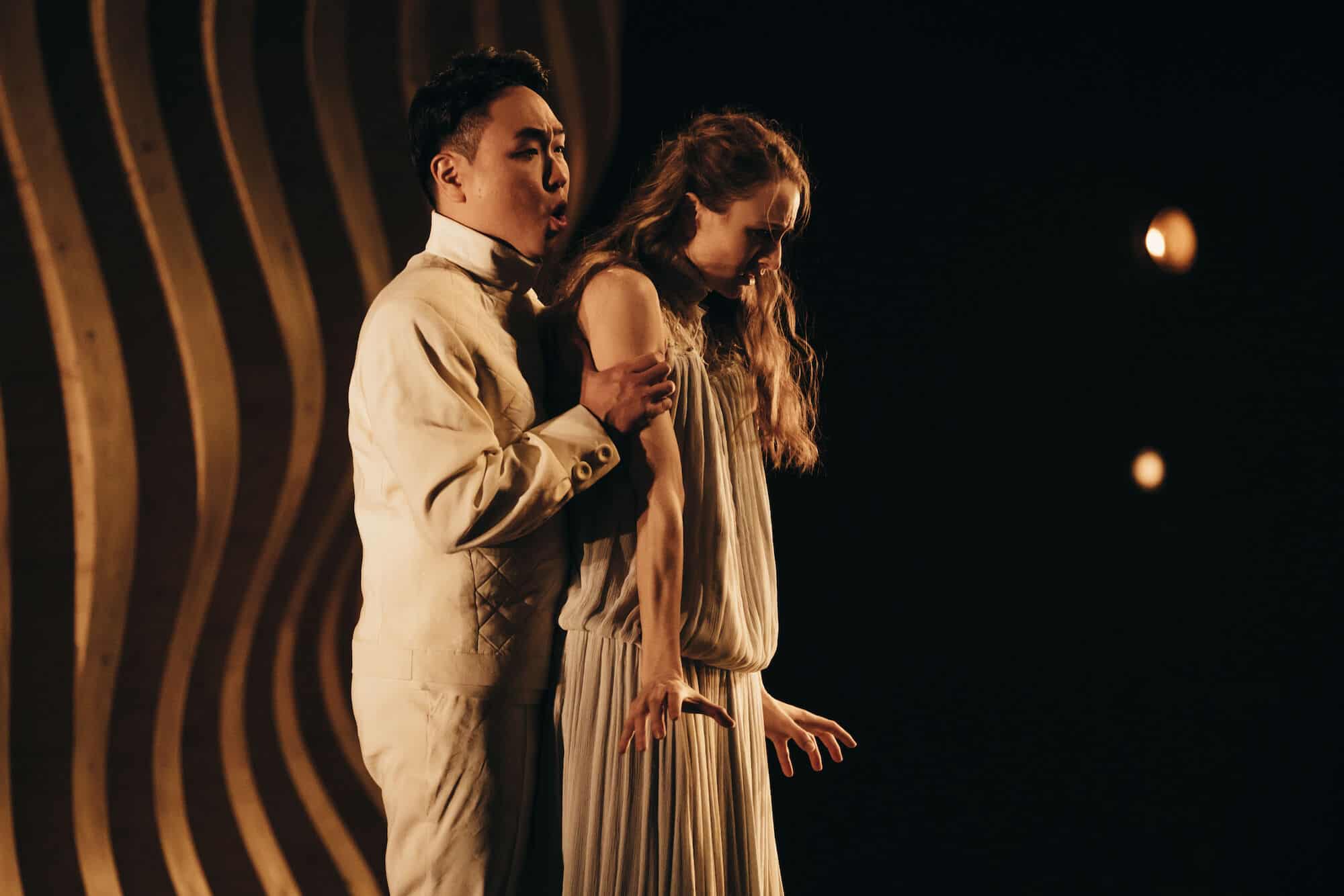
It has been a long time since a production of Opera Ballet Vlaanderen has seen everything fall so beautifully into place: direction, scenography, choreography and musical performance. Rusalka by Antonín Dvořák is an exemplary case in the production currently on view in the direction of Alan Lucien Øyen and conducted by Giedre Šlekytė.
The imposing yet austere set is not only very beautiful but also functional. It perfectly suits depicting the environment of nature. The magnificent light wood construction is suggestive of the waves of the lake where Rusalka and the water spirit make their home. Moreover, thanks to its remarkable versatility, it offers countless possibilities for depicting the confrontations between the characters in all their variations. A striking example of this is Rusalka's confinement in the second act when she feels set aside by the prince. The "doubled" characters are equally versatile. The singers of Rusalka, the prince and Vodník – the water spirit – are each mirrored by a dancer. In contrast to what we saw earlier in Debussy's Pelléas et Mélisande at Opera Ballet Vlaanderen (February 2018), here the choreography does not make the visual unnecessarily busy and far-fetched, but with refined and carefully considered movements it reinforces the emotions of what the character experiences and sings at that moment. The dance does not distract from the story and psychology, but on the contrary makes it more gripping. Perhaps it has to do with the fact that director Alan Lucien Øyen is also the choreographer and thus determines his choreography from the dramaturgy.
Successful nymph
The story is a fairy tale without a happy ending. Antonín Dvořák wrote his opera to a libretto by Jaroslav Kvapil. Kvapil was inspired by the Undine legends and by the play by Gerhard Hauptmann: Die versunkene Glocke. Undine is a young girl born at the bottom of the sea in a crystal palace. A storm casts her ashore in a fisherman's hut, where she is raised in memory of the fishermen's daughter, who mysteriously disappeared in the waves. Undine waits for the love of a man so that in her new existence she may gain a soul, something that the creatures of nature lack. One day she meets a handsome knight who has lost his way in the forest. They marry and the knight takes her to his castle. But he betrays her and Undine returns to the realm of water.
Dvořák gave his opera the title Rusalka – which means nymph. He is delighted with the romantic atmosphere and completes his opera in just 7 months. Dvořák's connection with nature and its magical aspects had already been expressed in his symphonic poems: The Water Spirit, The Noon Witch, The Golden Spinning Wheel and The Wood Dove. The opera was created on 31 March 1901 at the National Theater in Prague and enjoyed a success that exceeded all expectations.
Female stars
The direction subtly returns to the original story that inspired Kvapil. The performance begins with a mysterious figure who abandons a child in the waves and in the final part of the performance Rusalka meets a little girl, as if upon her return to her natural element she finds the disappeared child again. A subtle aspect in the opera that moreover brings the mysterious nature of the fairy tale into its own right. In his program notes, Øyen also explains this image with a reference to old sources in which water spirits drown illegitimate children. I saw the performance with Tineke Van Ingelgem as Rusalka and she identifies herself beautifully with the character of the nymph. Throughout the story she portrays both the yearnings of the nature spirit that wants to escape the binding to the water element, the passion for the realistic and earthly prince, the sorrow of being cast out and being doomed to the water again. She excels in expressing the fragility of the nature spirit in all its nuances. The director has nicely contrasted her character with the cool rival (skillfully portrayed by Karen Vermeiren) and the proud hag Ježibaba, who is in cahoots with the callous and indignant Water Spirit.
In the captivating poetic score of Dvořák, the orchestra of Opera Vlaanderen is conducted in a magnificent way by the young female conductor Giedre Šlekytė. From the very first melodies that evoke the fairy-tale atmosphere of the undulating lake, you hear that she has the music in her fingers and can convey it to her musicians. In the exciting and dramatic moments she conducts with intensity, without exaggeration. The recurring motifs stick in your head. Together with Tineke Van Ingelgem, she ensures that the production can be presented at an excellent female level. In her conversation in the program of Olav Grondelaers on Klara, Tineke Van Ingelgem said that Rusalka is a dream role for her, among other things because of the mixture of vulnerability and strength. I can safely say that she also performs the role like a dream! Her beautiful soprano voice is clear, reaches the high notes effortlessly and always remains impeccably pure without sharp edges. Of course, the song to the moon is a highlight, but I find her long aria almost even more beautiful as a lament at the end of the opera, in which she sings the disappointment with so much sadness and yet resignation. The other singers were also very well cast, with a chilling bass for Vodník, a somewhat neutral but beautifully lyrical tenor as the Prince, and a Ježibaba who conveys her witch character both physically and vocally convincingly. A performance that is absolutely worth recommending to experience this poetic opera by Antonín Dvořák.
- WHAT: Rusalka || Antonín Dvořák (1841-1904)
- DIRECTION: Alan Lucien Øyen
- VOICES: Tineke Van Ingelgem, Mykhailo Malafii, Goderdzi Janelidze, Maria Riccarda Wesseling, Karen Vermeiren
- ORCHESTRA: Symfonisch Orkest en Koor Opera Ballet Vlaanderen conducted by Giedre Šlekytė
- WHERE: Opera Ballet Vlaanderen Antwerpen
- WHEN: Saturday 14 December 2019 – further performances until 31 December 2019. Subsequently in Gent from 9 January 2020 to 23 January 2020
- PHOTO: © Filip Van Roe