

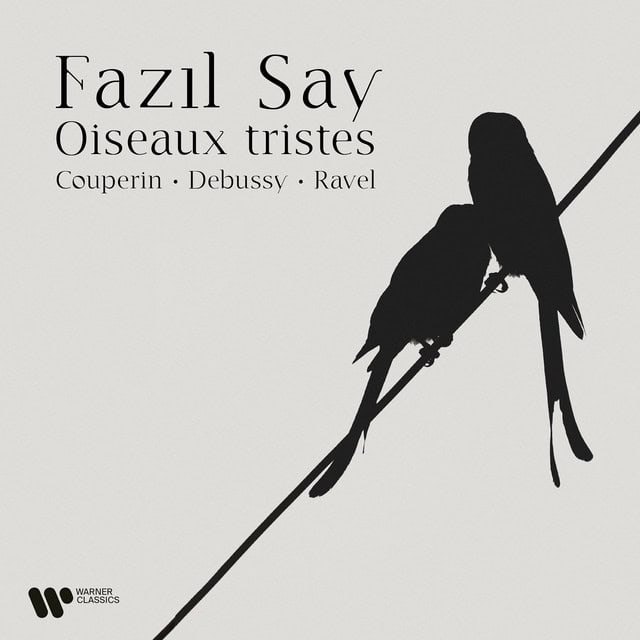
I am not always unreservedly happy with the creative achievements of composer and pianist Fazil Say (Ankara, 1970). And while the fact that in 2012 he was prosecuted by a Turkish prosecutor after Say had publicly stated he was a 'proud atheist' and had also taken aim at Islamic rituals received ample media coverage, for the music lover this is of little or no relevance.
The present latest album from his hand, which was given the fitting title Oiseaux tristes (after the identically named second part from Ravel's Mirors), did make a certain impression. Gradually during this recital I gained a strong sense that Say felt truly deeply connected with this music and left no room for eccentricities or other 'distracting manoeuvres' in his imaginative interpretation. Making music in its purest form, that was clearly what it was about for him. This brings me directly to my only substantive criticism: that purity is considerably undermined by Say's disturbing groaning. The strictly clear recording leaves no detail unlit in this respect either, and the better the playback equipment, the more distracting it becomes.
Speaking of that recording: there is nothing to fault in the rendering of the sonority and tonal colours of this concert grand, but I would have preferred to perceive somewhat more (acoustic) space around the instrument. As if the microphones were placed fractionally too close. Which also explains the clearly audible groaning of the pianist (on electrostatic headphones even so disturbing that I soon gave up on it).
For the purists, this recital will undoubtedly be somewhat hard to swallow, for whoever is devoted to the harpsichord in the music of François Couperin (in this case Livre IV, Ordre XXI, in E minor) is not only confronted with a (robust) grand piano sound, but also with the adaptations that Say deemed necessary for it.
This is French repertoire from beginning to end and in this Say proves himself an interpreter of great stature: these are certainly performances that do not fall short of those by the greats in this repertoire, both from the (distant) past and the present. Doubly unfortunate then, that groaning…