At the last minute, De Munt celebrates the two hundredth anniversary of Jacques Offenbach's birth (1819-1880) with a performance of his only opera Les Contes d'Hoffmann.
Offenbach is best known as the inventor of operetta. He wrote around a hundred of them, many of which have stood the test of time. He thereby achieved great fame in Paris and the rest of Europe. But was his desire to go down in history not only as an operetta composer but also as a composer of at least one serious opera the reason that towards the end of his life he began work on his magnum opus Les Contes d'Hoffmann?
Offenbach would not live to see the premiere in February 1881. He passed away four months earlier, before he could complete the score. This caused considerable confusion posthumously. Because there was no authorized score, everyone did as they pleased, entire acts were sometimes cut or added. In recent years, however, music archaeologists have been gaining more control over the matter and we can now speak of a reasonably definitive version.
Despite this chaotic transmission, Hoffmann has managed to maintain itself effortlessly in the repertoire, thanks to a good story, refined orchestration and a few immortal melodies that everyone can easily sing along with.
De Munt offers us a staging by the universally acclaimed director Krzystof Warlikowski and his team, in which set and costume designer Malgorzat Szczesniak has been a reliable fixture for years.
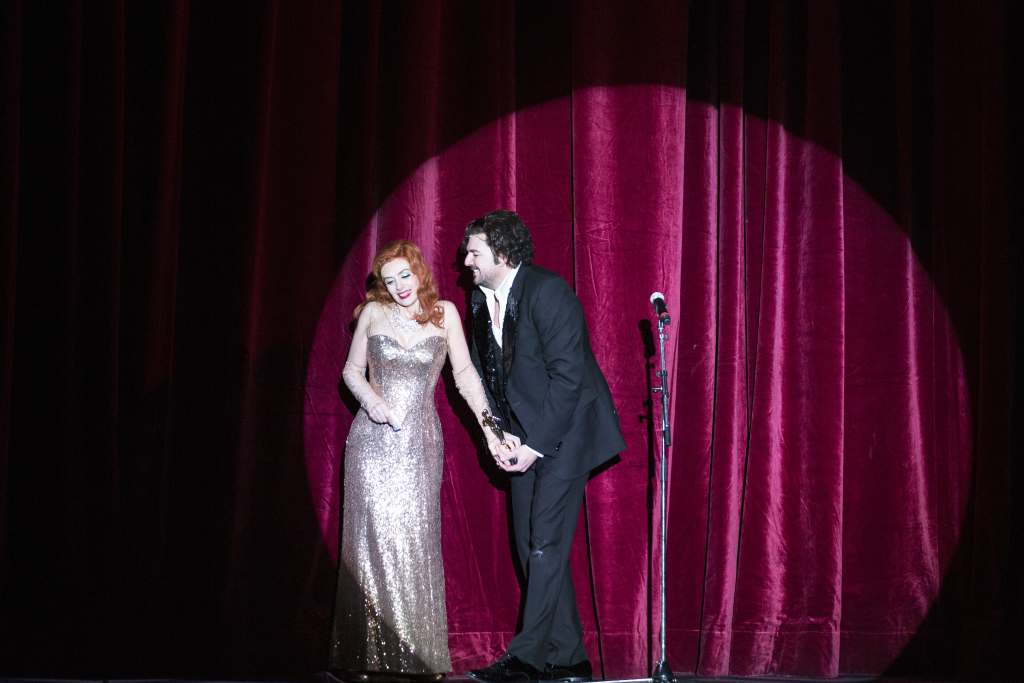
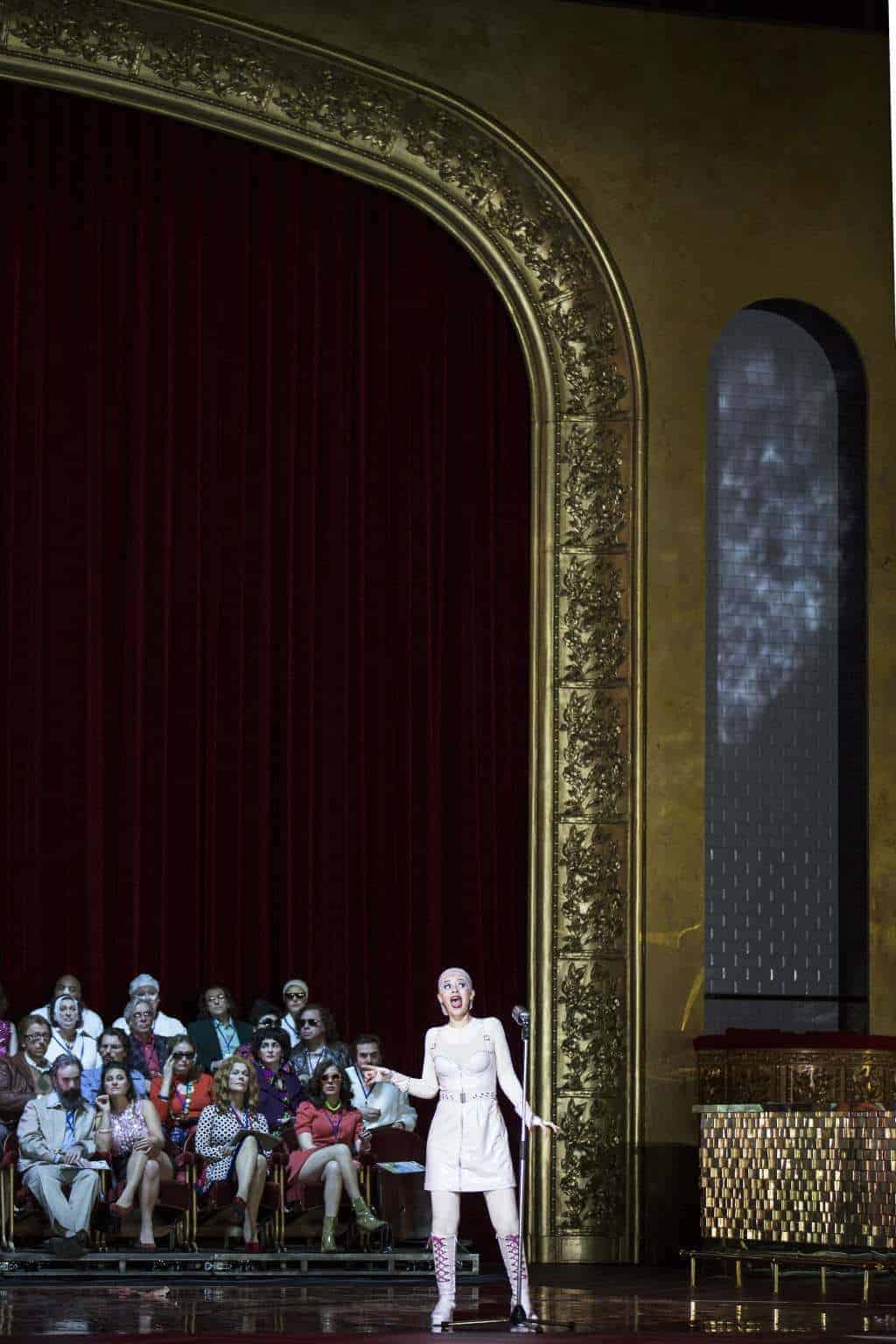
Warlikowski is fascinated by film, especially from the golden age of Hollywood. It is therefore no surprise that he relocates the story to a film set, where Hoffmann not only recounts his own three love stories as the lead actor and narrator, but also as a director stages the story of his life. The effect of the Droste cocoa boxes. Warlikowski leaves no visual means untried in order to alienate the spectator. Everything currently possible in terms of image technology is employed, but he also tries to mislead the audience by intervening in the action. For example, by closing the curtain and staging an Oscar ceremony in the last entr'acte.
It all begins overwhelmingly: a busy film set with soloists, numerous extras, and a choir positioned behind a huge video screen. Microphones and cameras everywhere. It looks impressive, but also creates confusion and chaos. The projected images distract attention from what it is really about: barfly Hoffmann who is about to tell the three stories of his failed loves, surrounded by dubious characters. Add to that the fact that you occasionally want to look at the surtitles and it will be clear that this is multitasking for the advanced.
It was evident from the somewhat hesitant start, with the occasional less sharp entry, that the conductor, choir and orchestra needed time to adjust.
As time goes on, the performance becomes somewhat more calm. We see how Hoffmann's love for the doll Olympia ends in disappointment. French soprano Patricia Petibon takes on the four women in Hoffmann's life. She brings Olympia to hilarious life in the aria 'Les oiseaux dans la charmille', but perhaps a bit too comically. Is that to hide the fact that she struggles to hit the coloratura notes for which this aria is so famous (and notorious)?
But even when in the third and fourth acts the atmosphere definitively shifts and drama makes its entrance, she fails to fully convince as languishing Antonia – you miss the emotion – and as femme fatale Giulietta. Bringing this demanding role to a good end is a feat in any case, but Petibon is not always equally accurate. Does she have the right voice type for Offenbach's vocal trapeze work?
The exalted alcoholic alias befuddled Hoffmann is portrayed by the well-acting American tenor Eric Cutler, who with his somewhat thin voice struggled to hold his own against bombastic Gabor Bretz, who took on the four bad guys. And how! Bretz delivered an impressive performance. With him, the villains are truly evil. He also has a special stage presence. He is one of those soloists who fill the entire stage, even when standing somewhere far back in a corner. Bass-baritone Sir Willard White, an éminence grise, is one of these as well, as is Sylvie Brunet-Grupposo, who beautifully portrayed her admittedly small role as the voice from the grave of Antonia's mother. Michèle Losier was in her element in her double role as Hoffmann's muse and companion Nicklausse.
Nothing but praise for the choir of De Munt. With their energetic performance, they brought the much-needed verve to the production.
And in the pit? There, it seemed, one played it safe. It sounded somewhat crude here and there. It didn't really shine. It seemed as if conductor Altinoglu had difficulty getting his musicians on the edge of their seats. The refined orchestration that characterizes this score did not show (yet) to great effect as a result. But there are fortunately ten more performances to grow into it!
Warlikowski's hypermodern approach leads not only to alienation but also to irritation. Again and again the question emerges: how far may you actually go in the performance of an opera from 1881? What does all this technology add to such a work?
Applying such an approach to a written text or play, such as Shakespeare, usually poses no problem. Thoughts can be conveyed in many different ways. But with opera it is different. The form is fixed there. The composer has clearly indicated how he meant it all. And then there is always the music that reflects the spirit of the times and evokes a certain atmosphere. Offenbach is no exception to this.
Where is the line between Offenbach directed by Warlikowski or Warlikowski's new production set to music by Offenbach? And why does Warlikowski choose to use Offenbach's music and not engage a contemporary composer to create an entirely new Hoffmann? That would be true innovation!
Whereas in classical music over the last fifty years much effort has been made to bring performance practice closer to the original and the composer's intentions, it seems that opera is moving in the opposite direction, with productions distancing themselves ever further from the original. But does that old music fit with those modern images? For me, that is where the greatest alienation lies. Judging by the success of this production, the audience has no problem with it.
When I caught myself this morning in the shower softly humming that moving aria "Elle a fui, la tourterelle", I could come to no other conclusion than that Offenbach has effortlessly won the day.
In about a hundred years people will still be humming his arias in the shower, but who was that Warlikowski anyway?
- WHAT: Les Contes d'Hoffmann by Jacques Offenbach
- WHO: Orchestra and choir of De Munt, conducted by Alain Altinoglu
- PERFORMANCE SEEN: 10 November 2019, Muntschouwburg Brussels
- PHOTOS: © Bernd Uhlig