

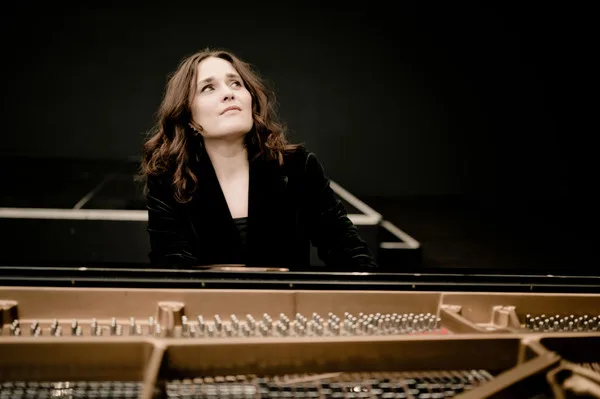
In 2007, Anna Vinnitskaya won the Queen Elisabeth Competition in Brussels, a victory that gave her international career a decisive turn. Almost twenty years later – on Friday, September 11 – the pianist returns to the city where her international career began – this time to perform Schumann's Piano Concerto with the Belgian National Orchestra. In conversation with Werner De Smet for Klassiek Centraal, she looks back on that eventful period, on her teacher Evgeni Koroliov, and on what still keeps her in balance today.
For Vinnitskaya, Brussels is inextricably linked to the beginning of her international career, but the memories are far from unambiguous. "On one hand there was that enormous, unexpected success, on the other the immense pressure and responsibility I felt after the competition," she says. Yet warmth also prevails: she still maintains friendships from that time, including contact with her former host family. And then there is performing in BOZAR itself, the hall where the final took place back then: "That certainly means a lot to me."
"It can break you"
The Queen Elisabeth Competition was Vinnitskaya's last competition. The experience taught her that you must prepare not only for possible failure, but also for victory: "The success was so unexpected that it took me time to process it." Her advice to young musicians is unequivocal: "You have to be very resilient to participate in competitions, whether you win or lose – it can break you." Then it became clear to her that she would never participate in a competition again.
She also retains a strong memory of the Belgian National Orchestra. Back then she performed Prokofiev's Second Piano Concerto with the orchestra under the direction of Gilbert Varga and still remembers exactly how much support she felt from the musicians and the conductor: "It was wonderful to feel that the orchestra was behind me."
Schumann as chamber music
Now Schumann's Piano Concerto is on the programme. Interestingly, she says she doesn't perform Schumann very often: "I don't really know why." Yet the music continues to surprise her again and again: "Every time I perform, I discover something new. Especially the first movement is so beautiful and tender – Schumann's soul is literally poured into it."
While the concert is often described as a dialogue between piano and orchestra, Vinnitskaya nuances this image: for her, this dialogue arises mainly with individual voices and soloists within the orchestra: "That makes the experience more like chamber music with orchestra." The constant alternation between lyricism, intimacy, exuberance and melancholy in the work requires, according to her, not a contrived balance, but attentive listening and full presence: "Then it takes no effort at all to achieve that balance."
Moreover, her interpretation is never fixed. "At each concert, without exception, my interpretation changes," she says. This is not only due to her own approach as a performer, but also due to the conductor and orchestra she works with. "I am always open to the input of the other musicians; that's why you can never experience the same thing twice, and that would be boring anyway."
The programme brings Schumann together with Anna Thorvaldsdottir's Aeriality and Mahler's First Symphony. Vinnitskaya is not yet familiar with Thorvaldsdottir's work, but she is particularly looking forward to Mahler's First. It is one of her favourite Mahler symphonies, perhaps even her favourite. She is particularly struck by the strong connection with nature. This also evokes memories of Schumann for her: "At the beginning it feels as if you're in a forest – I see many parallels with Schumann; in the first movement, for example, the solo clarinet reminds one of forest sounds."
From profession to life philosophy
Anyone asking about the source of Vinnitskaya's musical identity inevitably arrives at Evgeni Koroliov, with whom she studied and whom she describes as her most fundamental influence: "He is the reason I became who I am now; he remains a great role model for me." The contrast she draws is telling: "Without him I would be a professional musician; now I live the music." When she still lived in Russia, playing piano was for her simply a possible career, not a life philosophy – she only gained that awareness through Koroliov and Johann Sebastian Bach.
She tries to pass on that depth in turn as a piano teacher, a role she has fulfilled for many years. Teaching has also influenced her own way of making music: "In the past I played everything very intuitively. Since I've been teaching and verbally explaining to students exactly what they should and shouldn't do, I think much more deeply about the music." Intuition remains the starting point, but her playing has also become more analytical – something she sees as a gain.
When asked about the greatest challenge of her career, she answers: "With all the travelling, the stress and the varied repertoire, the greatest challenge is probably staying true to myself and the music."
And although her repertoire is already impressively broad, there is one composer high on her wish list, Bach: "A composer I love more than anyone. Only I haven't yet found how to take as much pleasure in playing him as in listening to him."
Walking and family
Between tours, it is especially her family that keeps her grounded — the annual family vacations she calls the highlights of her year. Moreover, walking has become increasingly important to her in recent years as a source of relaxation.
At the end of the interview, she is presented with one final, personal question: what would she want to tell the Anna Vinnitskaya of 2007, the young pianist who had just won the Queen Elisabeth Competition? Her answer is as simple as it is reassuring: "Don't worry — everything will be fine, and even if it isn't, it's not the end of the world."
More info: https://www.nationalorchestra.be/nl/kalender/vinnitskaya-schumann