

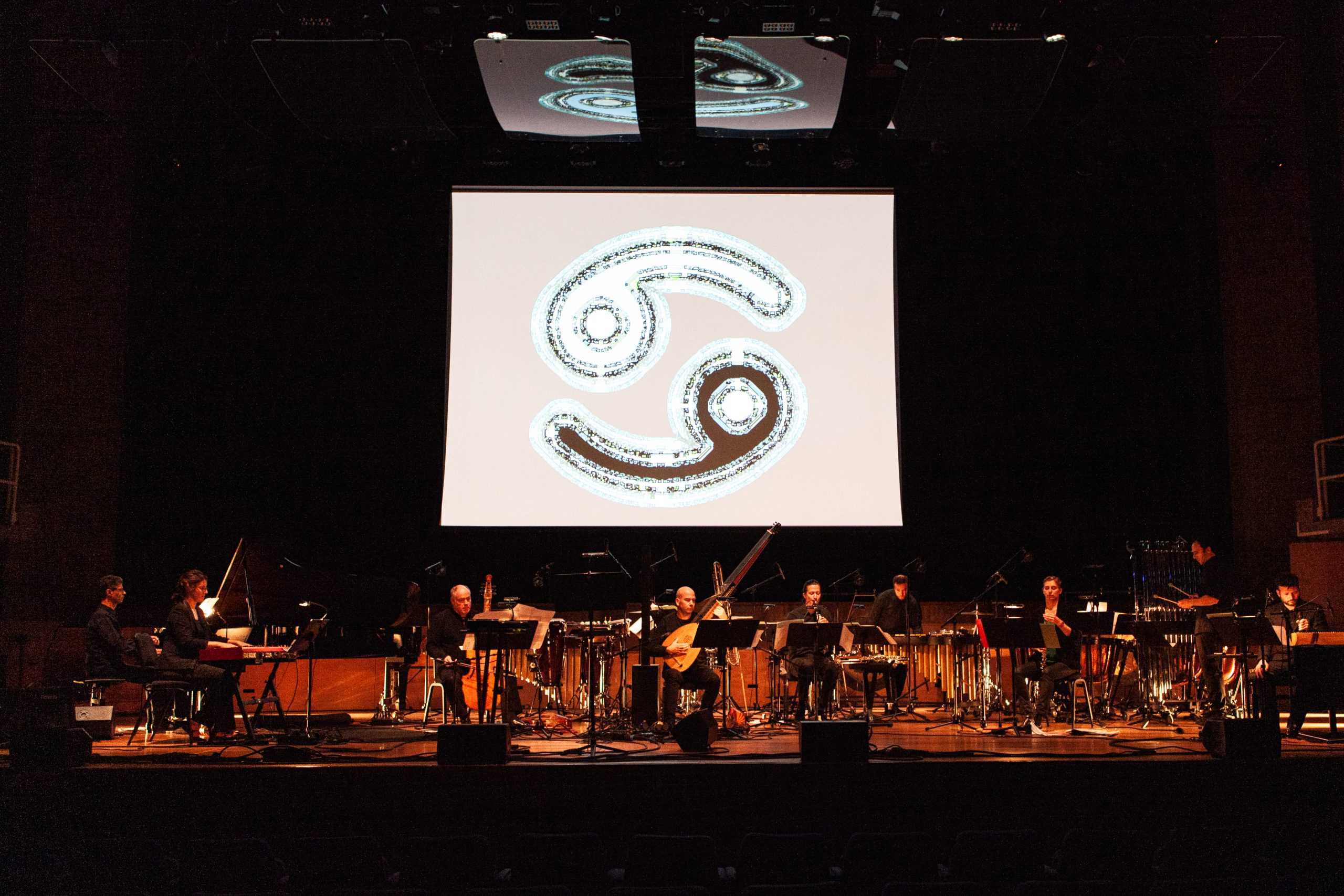
The annual Festival 20.21 kicked off last Monday in Leuven with a tribute to the way Johann Sebastian Bach developed the musical idiom. In the opening concert BACHC®AB, his Musikalisches Opfer formed the common thread along which the interweaving of present and past was spun.
The name of the concert is a play on words with the composer's name and a reference to the so-called crab canon, a compositional technique in which two musical lines can be played both forwards (front to back) and backwards (retrograde). Crabs are known for their ability to move forwards, backwards and sideways, hence the reference.
The musicians of Zefiro Torna and Ensemble Variances deliberately chose to build their programme around Bach. Ein Musikalisches Opfer is sometimes regarded as a musical self-portrait in which Bach serves as the benchmark of counterpoint, master of the fugue and virtuoso pianist. With the first of five Bach canons it became clear that this special way of composing goes far beyond technical ingenuity alone. In this canon the first voice plays from the beginning while the second voice starts at the end at the same moment and plays towards the beginning. The result is a manipulation of time and space, a suggestion of infinity in which the listener struggles to distinguish head from tail. From the world of the canon it is a small step to related forms of infinity. The concert programme therefore also made room for compositions referring to circles, labyrinths, palindromes, wave movements and improvisations. All of this often leads to calming and mysterious effects.
The eternal fascination with the labyrinth is addressed in the anonymous ballad En la Maison Dedalus. In this three-voice piece the labyrinth serves as a metaphor for the unattainability of a beloved. The two lower voices chase each other but never coincide. Soprano Annelies Van Gramberen gave a sober yet effective performance, with a minimum of vibrato and restrained gestures.
The symbolism of the circle also contributes to the sense that beginning and end are not always perceptible. Danse en cercle, a solo for timpani, is a tribal dance of North American Indians by Thierry Pécou, the driving force behind Ensemble Variances. The timpani draw their power not only from pulses but also from unexpected tone colours. Timpanist Elisa Humanes pulled out all the stops. With exhilarating rhythm, a firm attack alternating with nuanced interval leaps and glissandi, she gave her instrument flavour and colour.


Present and past also come together in the bars where composers are inspired by other art forms, for example poetry. Ancient Voices of Children by the American composer Henry Crumb is based on poems by Federico Garcia Lorca about life, death, love and nature. In De dónde vienes, the soprano's vocalise consists of phonetic sounds. Van Gramberen was convincing in technique and expressive power.
The Swiss composer and oboist Heinz Holliger was represented in this programme with his Studie über Mehrklänge from 1971. In this piece he experiments with the technical possibilities of the oboe, such as polyphony on an instrument that is in principle monophonic, and the playing of extremely long sustained motifs. Kristien Ceuppens was not only able to sustain a theme for a long time through circular breathing, but also managed hyper-fast passages. Sometimes she even expanded from a two-note interval into a triad. She showed how a virtuoso can give free rein to this instrument, which is known to be difficult.
The palindrome (a word that reads the same backwards, such as 'kok' and 'meetsysteem') surfaced in Miraris Mundum by Thierry Pécou. The subtitle of the piece reads: Esope reste ici et se repose. The piece is mirrored in every respect at all levels. On the use of the palindrome in music, Pécou said in an interview: "The structuring rules of the palindrome are interesting as long as they are not an end in themselves but retain a poetic scope and dimension." Here too Van Gramberen played the leading role in a dreamy and richly textured interpretation.

The Dutch composer Louis Andriessen was represented with two pieces: Langzame Verjaardag (2007) and Inanna's Descent (2000). Langzame Verjaardag is a canon in unison with an open instrumentation in which the musicians themselves decide when to come in. Soprano Van Gramberen delivered a balanced vocalise that, through a lightly dosed vibrato, here and there culminated in a lament. Thanks to the finely stylised video images that Anne-Mie Van Kerckhoven had made for the composer, it also unintentionally felt like a tribute.
A journey in downward and upward motion is the subject of Inanna's Descent. The piece, for female voice and small ensemble, depicts the descent of the celestial goddess Inanna into the underworld, where she is humiliated and killed. After her father manages to bring her body back to the upper world, she comes back to life. The story symbolizes the cycles of nature in which chaos, order, life and death follow one another. Andriessen achieves this through beautiful contrasts, such as the innocent opening of the piccolo and a dialogue between bongos and tom-toms. Annelies Van Gramberen's singing was expressive here, her delivery at times incantatory, which raised the question of whether the composer might have had a different voice type in mind.
The programme featured six variations on the "royal theme" from Bach's Musikalisches Opfer, five canons and the Ricercar 6. The canon series traditionally began with lute and harpsichord, but from the second canon onwards it expanded with a marimba, two violins, cello, clarinet and increasing complexity. The icing on the cake was the closing piece Ricercar a 6, in which the main theme was revisited, this time with six voices, including marimba, xylophone, vibraphone, various reed instruments and a punchy final cadence on the bass clarinet. The latter, short and powerful, proved to be the apotheosis of a concert in which metaphors and rituals were presented in a fresh and well-honed way.
WAT: BACHC®AB
WIE: Zefiro Torna, Ensemble Variances, Annelies Van Gramberen [soprano], Anne-Mie Van Kerckhoven [video art], Jurgen De bruyn [concept], Katelijne Schiltz [research]
GEHOORD: Festival 20.21, Leuven, 26 September 2022
tickets & info © Kathleen Michiels © Helena Gaudeus © Helena Gaudeus © Helena Gaudeus © Kathleen Michiels © Kathleen Michiels


