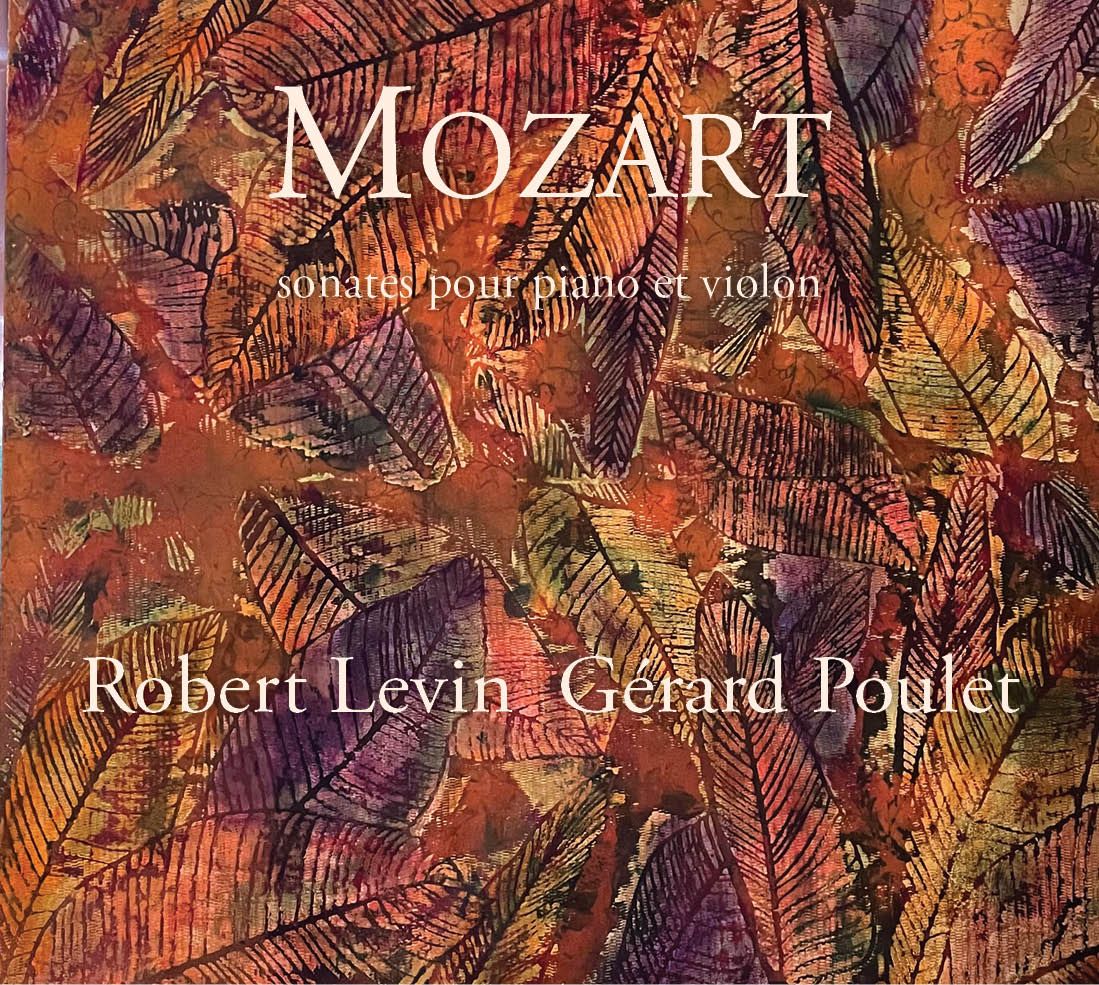
Mozart (1756–1791) can have the piano and violin tease, challenge and unexpectedly build on each other's ideas. In the Sonata in A major, K. 526, and the Sonata in E-flat major, K. 380, a lively musical dialogue unfolds in which both instruments take the lead in turn. On this CD from the French label Le Palais des Dégustateurs, pianist Robert Levin and violinist Gérard Poulet seek a balance between those voices. Their programme also contains a special surprise: alongside the two completed sonatas, a fragment of an unfinished composition by Mozart is heard, followed by a possible continuation written by Levin himself.
Robert Levin has devoted himself intensively to Mozart both as a pianist and as a musicologist. Besides performing Mozart's repertoire, he has concentrated on completing compositions that Mozart left unfinished. Levin and Poulet previously collaborated on an album of unfinished works by Mozart for violin and piano. This release follows on from that, but combines the reconstruction with two completed sonatas.
Playfulness and restraint
The Sonata in A major, K. 526, dates from 1787 and belongs to Mozart's late contributions to the genre. In the opening movement, Molto allegro, the playful musicality of Levin and Poulet stands out. The musical lines connect smoothly and neither of them constantly pushes forward. The enjoyment with which they approach this music gives the movement an infectious lightness.
The Andante strikes a very different tone. The piano enters searchingly, after which the violin joins with a clear sound. Levin and Poulet build the movement carefully, with much attention to calm and restraint. The controlled approach gives the music a certain intimacy, but in my view it does not always bring the tension to the surface.
In the concluding Presto the tempo is considerably faster. The musicians keep the momentum going and give their parts sufficient independence. At times the violin tone sounds somewhat sharp and less warm. As a result, the violin does not always blend as smoothly with the piano. This tonal colour is noticeable at first, but becomes less pronounced over time.
Between nuance and liveliness
In the Sonata in E-flat major, K. 380, it is mainly Levin's refined articulation and subtle nuancing that attract attention in the opening Allegro. Initially the piano takes a prominent place, but gradually Poulet also gets more room to develop. Levin's playing gives the music relief and keeps the musical lines clear.
The Andante con moto has a restrained character. Levin gives the ornamentation ample space and weaves it carefully into the musical line. Despite the calm tempo, the music keeps flowing. In the concluding Rondo, the syncopations give the music a playful rhythmic character. Levin and Poulet gradually build towards the end, so that the closing bars are convincingly rounded off.
Mozart's beginning, Levin's continuation
The most remarkable item on the programme is the fragment K. Anh. 47, an unfinished composition in G major of which only a beginning in Mozart's hand has survived. The music starts briskly: first the piano sounds, then the violin takes over, after which both instruments continue together. The lively opening ends abruptly and leaves open the question of how Mozart would have continued the work himself.
This is followed by the version completed by Robert Levin. In it the violin is given an expressive role, while the piano part is richly developed. The completion offers a possible continuation of the surviving fragment, but remains naturally a reconstruction and not a rediscovered original. By hearing Mozart's original beginning and Levin's completion one after the other, the listener hears not only Mozart's musical initiative but also one possible realisation of what might have followed.
The recording was made in May 2015 at La Goillotte in Vosne-Romanée. The sound is predominantly clear and evokes the atmosphere of an intimate salon. Piano and violin are well balanced and both receive sufficient space, although at times the recording sounds somewhat direct.
The combination of two completed sonatas with the unfinished fragment and Levin's completion gives this CD its own character. Especially for those curious about how a pianist-composer might complete such a surviving beginning, that last item is an extra reason to listen.