

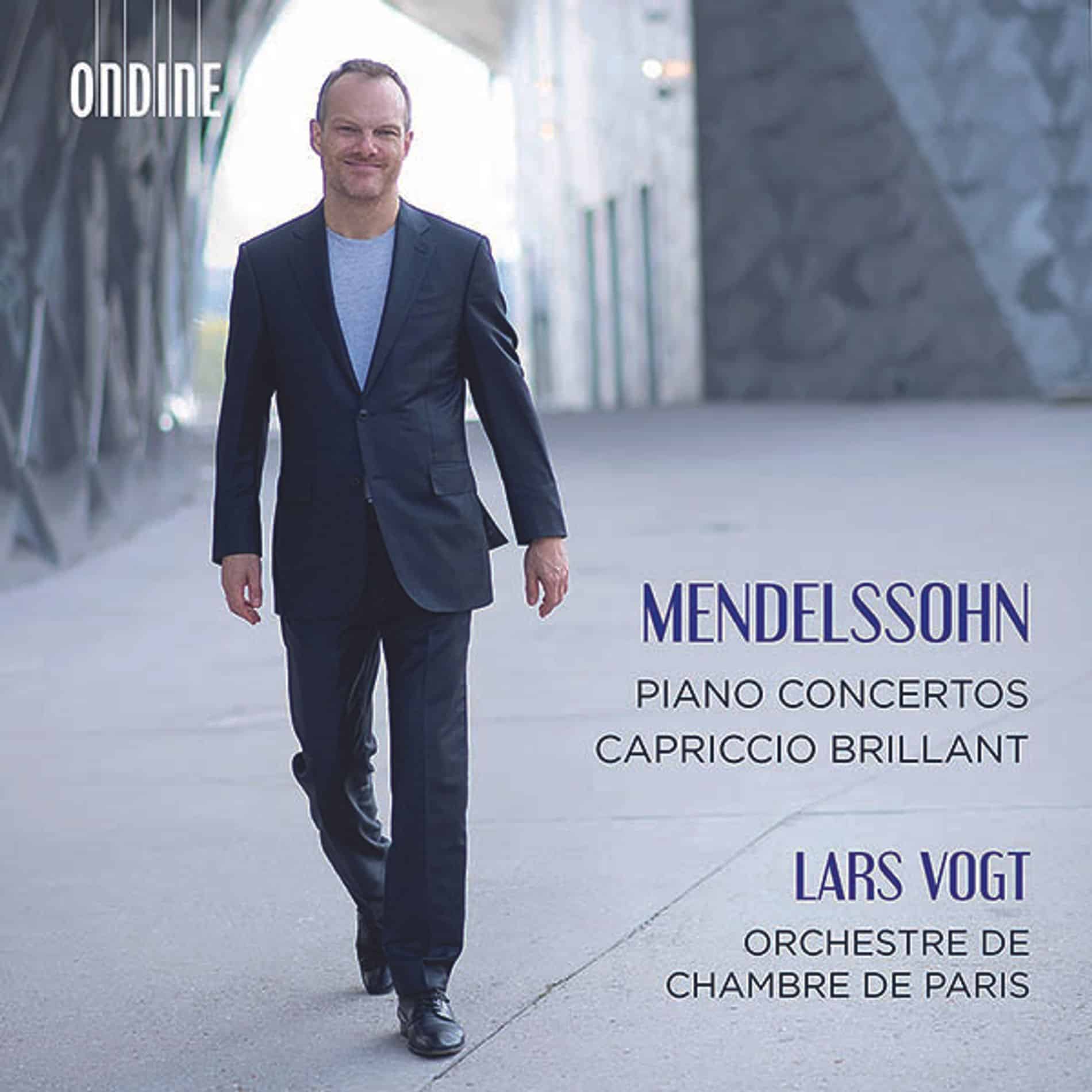
Mendelssohn: Piano Concerto No. 1 in G minor, op. 25 - No. 2 in D minor, op. 40 - Capriccio brilliant op. 22
Orchestre de Chambre de Paris conducted by Lars Vogt (piano)
Ondine ODE 1400 • 52' •
Recording: November 2021, Philharmonie de Paris, Le Studio
In 2020 Lars Vogt was appointed music director of the Orchestre de Chambre de Paris. His performances with the orchestra were so successful and he made such an impression on the orchestra members and management that his contract was extended until 2025 relatively shortly thereafter, in 2021. But already in September 2022 the orchestra had to search for a replacement because Lars could no longer perform: he was in the final stage of the illness that would claim his life shortly afterwards, on 5 September, only 3 days before his 52nd birthday.
In November 2021, when his illness had not yet manifested, he recorded three works by Mendelssohn with the orchestra, in his role as pianist and conductor: both Mendelssohn piano concertos, supplemented by his Capriccio brilliant. This fit into a trend: soloists venturing into conducting, with striking, relatively recent examples being violinists Renaud Capuçon and Daniel Hope, and clarinetist Andreas Ottensamer. In the past, during the Baroque and Viennese Classical periods, this was the most normal thing in the world: the soloist and the conductor united in one person, but with the rise of Beethoven this changed, increasingly involving strictly separate worlds, exceptions—which have always existed—notwithstanding. Even today, no one bats an eye at this symbiotic relationship of soloist and conductor, even in works such as Prokofiev's Third Piano Concerto, Beethoven's Fifth Piano Concerto or both piano concertos by Brahms (Lars performed and conducted the Second Piano Concerto in concerts, but also recorded it, with the Royal Northern Sinfonia - he was its music director from 2015 to 2020 - a very successful 2020 production).
The Mendelssohn album is the first and therefore, sadly, also the last that he made with his Paris ensemble. It was not easy for me to listen to it with dry eyes, because these interpretations speak with such sparkle and energy that it is barely conceivable that less than a year later Lars would no longer be here, and that in November 2021 he was only a few months away from his first chemotherapy session.
What fascinating nuances these performances contain! And with what ease the dialogues between piano and orchestra unfold, the interplay of colours that emanates from both the solo instrument and the orchestra. This is truly chamber music-making at the highest level, there is genuine and natural 'conversation', a 'recipe' that the Orchestre de Chambre de Paris has applied with equally much verve in Haydn's Paris Symphonies.
Vogt also proves himself here to be a pianist in a thousand, his playing filled with subtlety and precision, extremely expressive, alternating between passionate and lyrical, with that touch of rubato that makes this music irresistible. Without any doubt, these performances rank among the finest that the medium has to offer. The beautiful recording also contributes a fair share to this.