

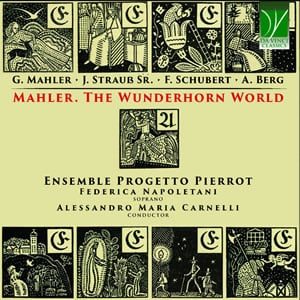
Mahler – The Wunderhorn World , so reads the title of this album (you will find here the table of contents), the project of the Italian conductor Alessandro Maria Carnelli with as primary source of inspiration the monograph he wrote about Arnold Schoenberg's Verklärte Nacht: Il labirinto e l'intrico dei viottoli (The labyrinth and the tangle of paths). He is here discussed in English.
Schoenberg, like Mahler, was fascinated by the connection between music and the locations where it comes to sound. During his research, Carnelli discovered that Mahler focused in particular on the chamber music aspect with regard to the performance of his own lieder from the so-called Wunderhorn collection. He had even conducted a number of them in what was then known as the Small Hall (now the Brahms Hall) of the Vienna Musikverein, a space suitable only for at most a chamber orchestra; and thus unsuitable for the much larger orchestral ensemble that some of his lieder required. It is logical that Carnelli wondered what adjustments Mahler must have had in mind for performances in that Small Hall at the time. All the more so since Carnelli himself had been pondering for some time what a comparable approach might be appropriate.
Meanwhile, another concert project was underway: that of Schoenberg's Pierrot lunaire by the ensemble that partly bears the same name: the Ensemble Progetto (Italian for Project) Pierrot. For him, this was not only about streamlining the original, but also about a different context.
Therefore, the present programme also includes space for Johann Strauss Sr., but also for Franz Schubert, the motivation for which goes back to the connection between the Austrian musical tradition and the music of Gustav Mahler. As examples of this continuum, the characteristic stylistic figures in Schubert and the waltzes of the Strauss family, which recur in Mahler's music, serve; but so typical of him that their origin remains hidden even to the attentive listener.
The 'streamlining model', often in the form of a transcription or arrangement, has set many a critical pen in motion over the decades, but in the interwar period - in a time devoid of radio and gramophone - there were countless small ensembles working with thus streamlined orchestral works and operatic fragments. They were heard in the most diverse public venues, including in restaurants, on a café terrace, or in the pavilion of some spa resort.
Carnelli goes considerably further than transcription. He lets the various pieces interlock or attach them to each other, either directly or with the help of narrow-band, tonally related transitions. The image is one of inventive overlaps and crossfades that evoke a musical panorama of what precedes and what follows, framed in an unbroken stream that not only symbolizes Austrian musical continuity but also gives it practical significance.
It yields fascinating parallels through the blurring boundaries, cross-pollinations and cross-connections, in this world of the old-German 'wonderhorn', the collection of folk poetry, published by Achim von Arnim and Clemens Brentano between 1805 and 1808 under the title Des Knaben Wunderhorn - Alte Deutsche Lieder. The world of romantic, often even passionate folk lyrics, with Mahler as one of the leading composers (Schumann and Brahms had preceded him in this) who ingeniously forged the art song from these anonymous old sources.
That Berg is also represented on this album seems equally a logical choice based on the idea that the same connection holds: that between Mahler and Berg, both seen within the given timeframe and musically: Mahler's Rheinlegendchen unfolds from just a single note, as does Berg's Schilflied, which in turn recalls the beginning of many developments in the Strauss family waltzes. One hears how one intervenes in the other.
Both lieder, Schilflied and Die Nachtigall, are steeped in late-romantic sensuality, part of the Sieben frühe Lieder (1905-1908, wrongly regarded as a cycle, first for high voice and piano, published by Berg in 1928 in the version for high voice and orchestra).
The path Carnelli has taken for this album is thus not that of exclusively converting 'large' to 'small' or from one instrumental ensemble to another. In order to properly understand the entire concept as well as the process associated with it (and hopefully experience it in practice), it is best to let Carnelli himself have the floor:
'The continuity between Mahler and the musical tradition is [...] also linked to the texts, to key words, and to the themes that he deeply adopts: Schuberts' Romance illustrates this effectively, with a text that parallels Wo die schönen Trompeten blasen. It is well known that there is a continuity from Mahler to Berg, but I believe that the spatiotemporal leap occurring here between a Mahler symphony and a Berg Lied, united by the same spirit of dance, makes it tangible (track 11-12), as does the similarity of the beginnings of Rheinlegendchen and Schilflied: both unfold from a single note, and the beginning of Schilflied seems like a slow-motion version of that of Rheinlegendchen, which in turn recalls the start of many sections of the Strauss family waltzes.'
'Within this perspective I was compelled to include certain episodes from the first four [of Mahler's] symphonies that are known to dialogue with the world of the Lieder, and that here almost appear in cross-fading, utilizing points that, like pivots, allowed me to enter and exit from one piece to another. The osmosis between Lied and symphony begins already with Symphony No. 1 and continues with the reuse of Lieder from the Wunderhorn in Symphonies No. 2,3 and 4: a practice here represented by movement No. 3 of Symphony No. 3, the instrumental version of Ablösung im Sommer, and by Des Antonius von Padua fischpredigt and Urlicht, which have migrated into Symphony No. 2 (the Predigt becomes an instrumental Scherzo in translation).'
'The project was gradually enriched with new discoveries of thematic references between the pieces, many of which have not yet been identified in Mahler studies: some are here highlighted by direct juxtaposition, as in Blicke mir and Das irdische Leben (track 2-3) - but a fragment of Blicke mir will reappear to show a further affinity with Symphony No. 3 (track 13, 1'49) - or between Wo die schönen Trompeten blasen and Wer had dies Liedel erdacht? (track 9-10). These two lieder demonstrate that the references also involve the texts: here, indeed, the 'green heath' (grüne Haide) is a symbol of joyful freedom in one, a foreboding of death in the other.'
'Immediately after, we find another thematic reference between Wer hat dies Liedel erdacht? and Symphony No. 4 (track 10-11). Here, I have also connected and brought closer two parallel points of Symphony No. 4, and I have inserted a hint at a point in Symphony No. 1 (0'20) that is extremely similar and that then returns fully at the beginning of track 15. Symphony No. 3 and the Ballet music from Rosamunde intertwine particularly (track 13-14), in fading, from Mahler to Schubert, and then back again (but forward in time!) to Mahler.'
'The last thematic circuit is that between movement No. 2 of Symphony No. 1 and 'Des Antonius von Padua fischpredigt' (track 15-16), which I have linked, in the abrupt transition from the major key of the symphony to the minor of the 'Des Antonius...', with a tribute to the famous motto of Symphony No. 6, in which the major chord unexpectedly becomes minor.'
'This osmosis led me to create a specific version of Schubert's Romance: from the extreme suspension of the fragment of the Symphony No. 1 (track 5) the unaccompanied voice alone emerges, intoning the beginning of the Romance, almost a song that from afar, from silence - according to fundamental modes in the Mahlerian poetics - attempts to answer the questions of the symphonic fragment that precedes it.'
This multifaceted album introduces the listener to that so special connection between tradition and future, but also to dialogue, the three so characteristic properties of Mahler's music. Properties that also connect his music with both the world of the poets and that of Robert Schumann.
Arnold Schönberg wrote it already: 'Kunst kommt nicht von können, sondern von müssen.' But also: 'Musik ist nicht irgendeine Art von Unterhaltung, sondern die Darstellung musikalischer Ideen durch einen Musiker-Dichter einen Musiker-Denker; diese musikalische Ideen müssen den Gesetzen der menschlichen Logik entsprechen; sie ist ein Teil dessen, was der Mensch apperzipieren, beurteilen und ausdrücken kann.' Carnelli, the 'Musiker-Denker', proves after his Schönberg project once again its great significance in Mahler - The Wunderhorn World. This project radiates pure vocal and instrumental beauty in a 'Geistesraum' of bewitching proportions. Also a particular compliment to soprano Federica Napoletani who has the right voice type for this music and excels in text representation and intimate, but also naïve lyricism.
Undoubtedly with a view to cost saving, the song texts are not printed in the CD booklet, but they are available on the Da Vinci website (click here).