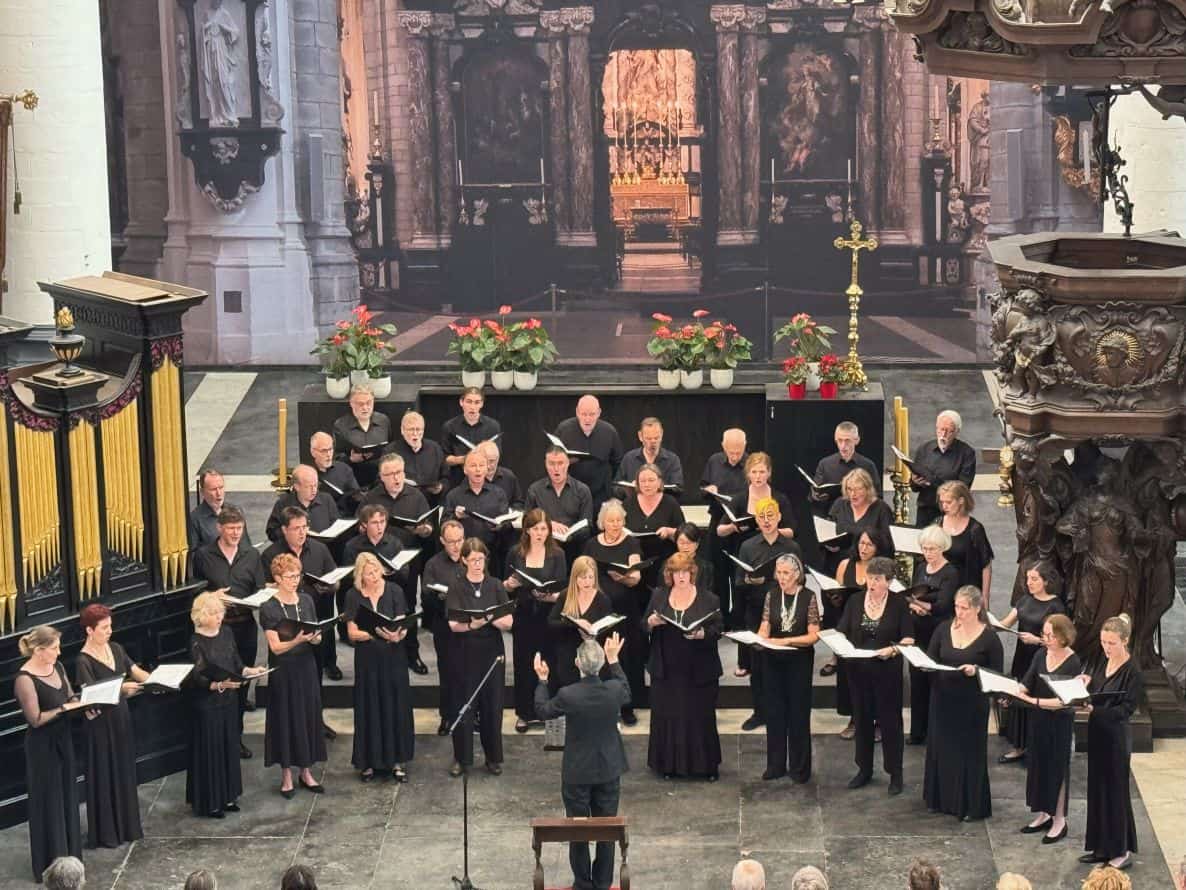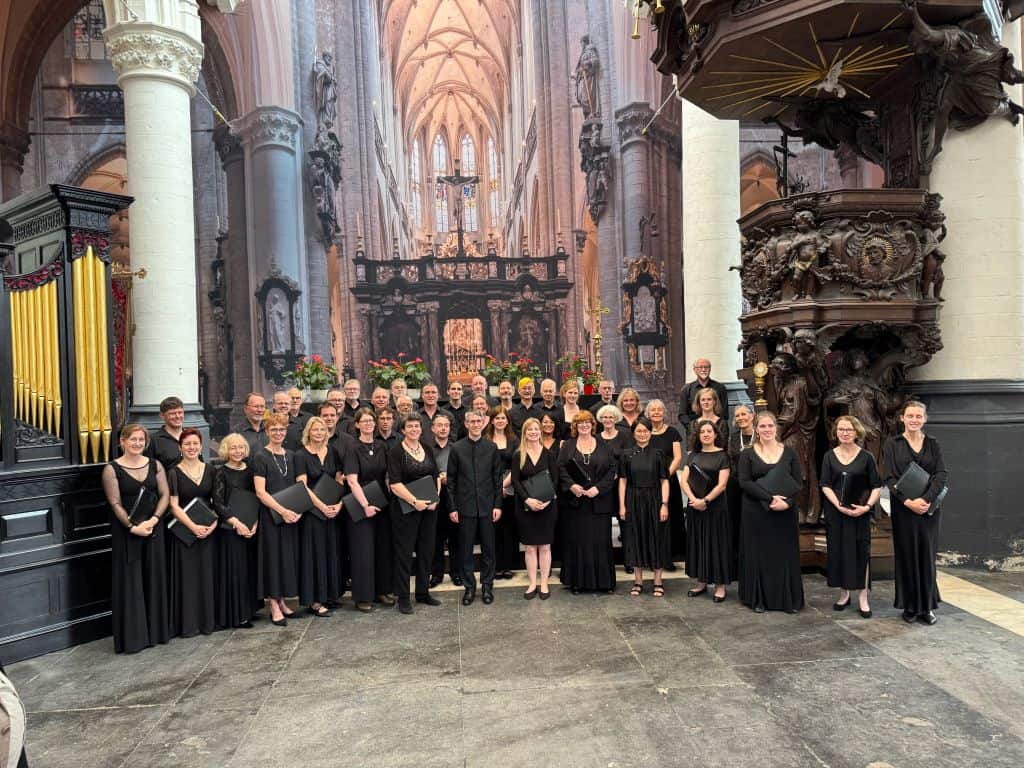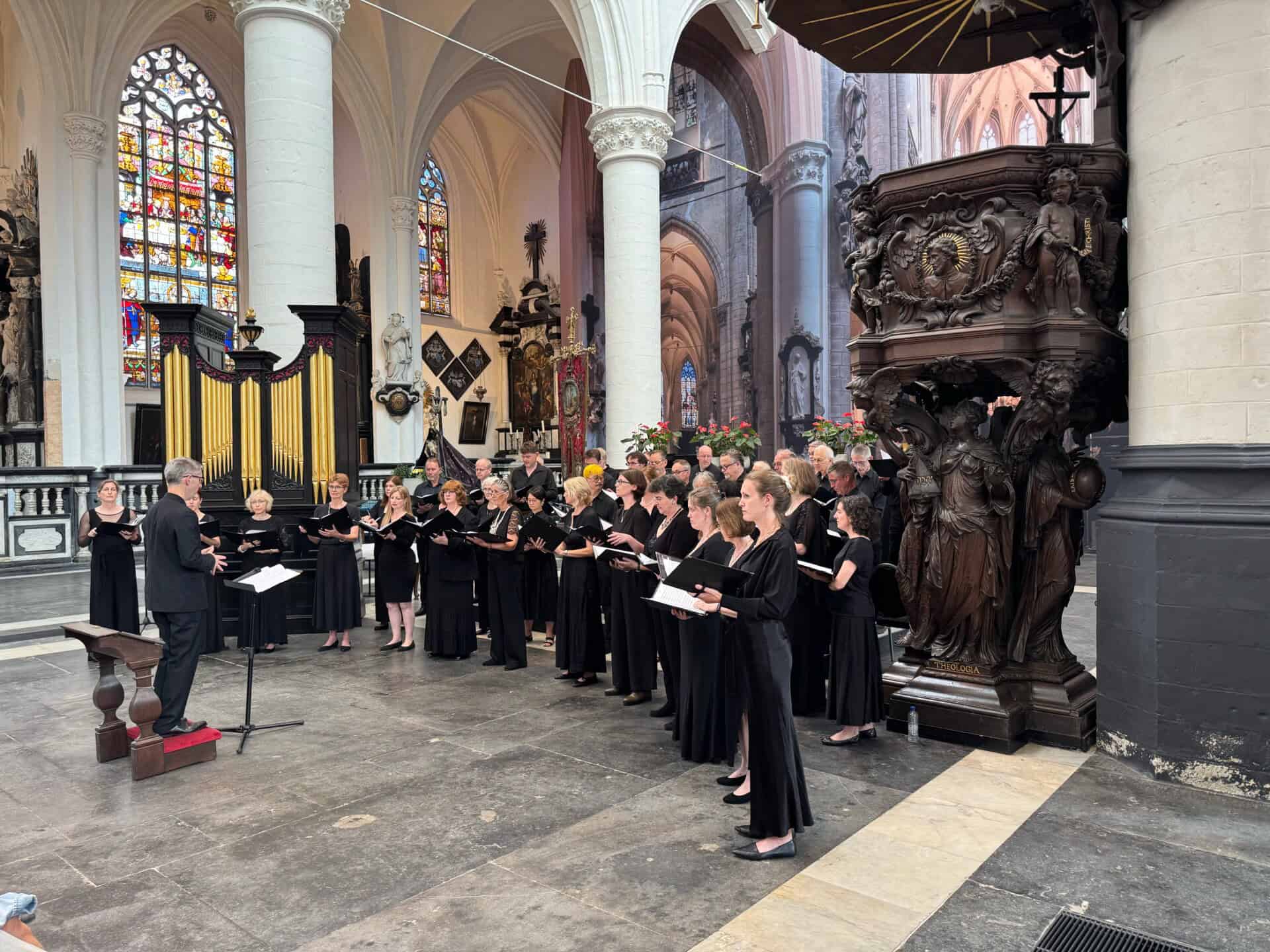
On Sunday afternoon, July 6, a special event took place in the impressive Sint-Jacobskerk in Antwerp: the British chamber choir Londinium presented a programme that highlighted the rich variety of English choral literature from the refined polyphony of the Renaissance to the fiery sounds of contemporary composers. The concert provided a brilliant overview of the English choral tradition from the 15th century to today.
What particularly stood out was the effortless transition between the different musical styles: whether it was a Renaissance madrigal or a contemporary piece from 2024, everything was performed with unprecedented precision. It is therefore no exaggeration to count Londinium among the best amateur choirs I have ever heard.
A musical pilgrimage to the soul
The Sint-Jacobskerk, traditionally a stopping point for pilgrims on their way to Santiago de Compostela, formed the setting on this afternoon for a musical pilgrimage that led us through the most moving corners of the soul. Although the journey was not physical, the music led us along familiar and surprising paths, through which we rediscovered ourselves.
Exemplary organisation and introductions
Compliments for the excellent organisation of the event, which offered not only the texts in their original language but also in Dutch. Furthermore, the introductions by conductor Andrew Griffiths – with his typical English irony – were greatly appreciated. They enabled the audience to delve even further into the music and enjoy what followed with even greater understanding.
Opener: A masterpiece from the Renaissance
The concert began with a jewel from the English Renaissance: Hosanna to the Son of David by Orlando Gibbons (1583-1625). The choir gave the piece a festive, almost cheerful atmosphere, without losing sight of the calm that the words "Peace in heaven" evoke. The choir succeeded in finding a delicate balance between religious serenity and musical intensity. The tone was set immediately and it was clear to everyone: this afternoon would be something special.
The drama of the English landscape
This was followed by The Hills by John Ireland (1879-1962), a work that evokes the drama of the English landscape with deep harmonies and a rich tonal palette. Originally written as a gift for the coronation of Queen Elizabeth II, the choir performed this work with an inspiration that perfectly conveyed the beauty of the English hills. Quite fitting to the theme, Psalm 121 I Will Lift Up Mine Eyes by Kerensa Briggs (born 1991) was then performed, a work from 2022, in which prayers resonated with fiery energy and upward force.
Composers from the time of Elizabeth I
After these modern works, the choir dove into the past, with two composers from the time of Elizabeth I. This Sweet and Merry Month of May by her favourite composer William Byrd (ca. 1540-1623) allowed the liveliness of a spring dream to blossom. As Vesta Was From Latmos Hill Descending by Thomas Weelkes (1576-1623) followed, a composition from the collection "The Triumphs of Oriana". This work, which honoured the queen personally – Oriana was incidentally her pet name – breathed the glory of the English Renaissance and was performed with playful charm, whereby the word "hasted" was perfectly translated into music.
Subtle transition to the 20th and 21st centuries
The programme then took a subtle turn towards the 21st century. He Wishes for the Cloths of Heaven by Howard Skempton (born 1947) was an impressive example of contemporary English choral music. The work interweaves a delicate sonic world, steeped in emotional intimacy, while the deeply felt performance enabled the choir to make the deeper layers of W.B. Yeats' text shine.
Dream world and early Renaissance
We were then taken into the dreamy atmosphere of Lief, begheeft mij niet by Pierre de la Rue (ca. 1452-1518), a work from the early Renaissance. This work by de la Rue, composer at the court of Margaret of Austria in Mechelen, was sung by the choir in Middle Dutch, with the harmonies performed with absolute precision. The pain and joy of love came out beautifully. Since the choir had performed in Mechelen the day before, this was a nice tribute to a great composer from our region.
Heroism and longing
The dramatic O Wild West Wind by Edward Elgar (1857-1934) formed a new depth in the programme, in which every note was permeated with heroism and longing. The piece received an impressive performance that touched the soul.
Contemporary sounds and the magic of bees
The concert reached another highlight with Here Hum the Bees by Cecilia McDowall (born 1951). This fascinating work brought the humming of bees to life, so that you could almost immerse yourself in their busy activities. After this piece, you will never look at bees in the same way again. It was music that highlighted the everyday in a surprising way and powerfully depicted the power of cooperation – both of bees and of the choir. The choir proved its strength once again, but perhaps the best wine was indeed saved for the end of the feast?
A touching farewell
Valiant for Truth, composed by Ralph Vaughan Williams (1872-1958) on a text by the 17th-century writer John Bunyan, touched the heart deeply. This work, based on Bunyan's "The Pilgrim's Progress", describes the journey of a man preparing for his death and accepting it with unshakeable faith. It is a reflection on the joy of dying, seen as a liberation from earthly cares, and the arrival in heavenly rest.
The choir sang this piece from 1940 (!) with impressive intensity, with every note perfectly translating the serene determination of the text. The singers managed to hold the deep, contemplative atmosphere of the work, while at the same time emphasizing the joy and calm of the ultimate surrender to death. This work gained its particular depth through the symbolism in the text, in which the trumpets were the sign of welcome in heaven – an element that the choir interpreted in an inimitable way. Although the trumpets were not physically present, their 'call' in the music was conveyed so strikingly through the building up of the choral parts that it seemed as if you could actually hear them. This moment was one of the most moving of the concert, where the musical lines and the emotional charge wove together perfectly. It was a powerful and poetic farewell, a musical reflection on ultimate surrender to the higher.
In the style of a piece such as Valiant for Truth, the true essence of Vaughan Williams' compositions comes to the fore: the balance between human fragility and the strength of spiritual conviction, performed by music that is both powerful and subtle. The choir brought this message with a conviction that did more than justice to the composition.
Celebration lingers on
The music remained festive, but gained depth with Ecce vicit leo by Peter Philips (1560-1628). This technically demanding work let the figurative trumpets from the previous piece continue to resonate. Philips, a Catholic who fled England to escape the persecutions under Elizabeth I, found a new home in Antwerp. The work, first published in 1613, reflects the rich polyphonic tradition of the city.
What makes this piece special is the way Philips unfolds his musical ideas in a complex web of voices, but Ecce vicit leo is more than merely a triumphant procession – it also reflects the inner strength and depth of the soul, masterfully translated into counterpoint and dynamics and brilliantly performed by the choir.
A miraculous visual-musical moment
Then something miraculous happened…
At the very first note of the heavenly Beati quorum via by Charles Villiers Stanford (1852-1924), the sun suddenly broke through the clouds, and the church interior filled with radiant light. The symbolism could not have been more fitting. Stanford, master in combining English Romanticism with liturgical splendor, had captured a moment of pure transcendence with this work. As the first notes of the choir rose up, it seemed as if the light wove itself into the music itself, a visual and musical symphony that intensified the spiritual charge of the moment. It was a moment in which the music not only filled the space, but seemed to embrace the soul. It was as if the joy of a righteous life was underscored in a miraculous way by nature itself.
And how can you musically surpass such a majestic moment? Fair is the Heaven by William Henry Harris (1883-1973) concluded the concert in an equally breathtaking and natural way. Harris, a master in combining English choral music with deep religious expression, brought the listeners to new heights of musical sublimity. The choir found in this the perfect balance between grandeur and narrative depth, with every note radiating both intimacy and sublimity. The rich harmonies created an almost heavenly atmosphere, while the words How then can mortal tongue hope to express the image of such endless perfectness reminded the listener once more of the inexpressible greatness of the heavenly. It was as if the sunrays that filled the church interior doubled their light through the music itself, which spread like a warm blanket over the entire space and the listeners.
A surprising climax
Finally, as an unexpected surprise, Hear My Heart Sing by Bernard Hughes (b.1974) followed, a reflection on the haste and madness of our existence. The choir showed its full ability in this work from 2024, which made the conclusion of this concert an unexpected, yet extremely impressive culmination.
Excellent craftsmanship and emotion
Throughout the concert, Londinium displayed a brilliant clarity, with a silky-soft tone in the higher registers that floated like an ethereal breeze through the Gothic space. The voices blended seamlessly into a harmonic whole, with Griffiths' unmistakable control over his ensemble immediately striking. His conducting style, characterized by precision and a sharp sense of nuance, led the choir to an exceptional performance. His musical acuity ensured that Londinium moved effortlessly through the many layers of harmonies, always with a clear focus on the music itself.
Londinium's Belgian debut – an indelible impression
The Belgian debut of Londinium will undoubtedly remain in the memory of those present. It was a grandiose tribute to the English choral tradition, full of emotion, technique and an exploration of that rich repertoire. The choir proved not only why it has built such a strong reputation in London, but also why it keeps winning over new generations of music fans: through its constant pursuit of refinement, its openness to new music and its deep reverence for the past. We therefore look forward with great anticipation to their next performance in Belgium!