

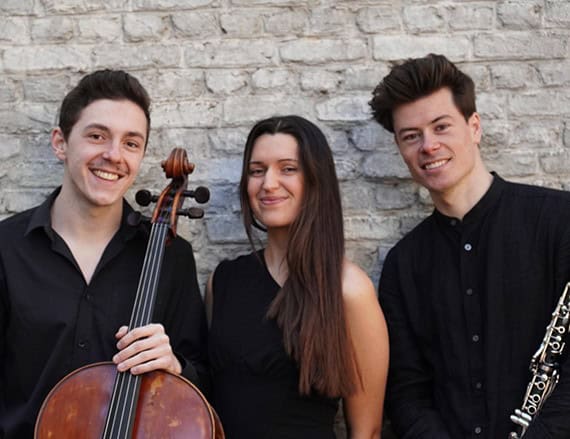
When someone achieves the highest distinctions at a young age on two instruments - piano and clarinet - at the Brussels Conservatory and gives an afternoon concert there with friends, you simply have to listen. This concerns Alexander Declercq. This time he plays clarinet, together with friends/colleagues João Pedro Gonçalves (cello) and Violeta Gonzales (piano) works by two excellent composers, Beethoven and Brahms. First the Trio no. 4 by a young Beethoven, his opus 11. Although in performances the clarinet is often replaced by the violin, we see here on stage the instrument combination for which it was originally written. The young musicians soloed each on their own instrument and accompanying each other in a delightful and virtuoso lively interplay. Con brio Beethoven asked of the performers. They fulfilled that request completely. In the adagio the cello - who else - takes the lead first, then tenderly and restrained softly follows the clarinet rounded off by exquisitely delicate piano playing. And from a closing allegretto you always become cheerful, especially when the theme is based on a street tune from that time. Everything delivered without fail at a high level of quality.
[caption id="attachment_33612" align="alignleft" width="200"] © Alexander Declercq[/caption]
Subsequently a trio by Brahms, born six years after Beethoven's death. How different that sounds. You hear ample late romanticism and immediately also that Brahms idiom. A young Beethoven alongside a mature Brahms. That must sound different, a completely different world. Alexander Declercq: "The one is a fresh Beethoven, the other is a super-late Brahms, there can be almost no greater contrast. The Beethoven Trio is much less serious. He was even ashamed of that third movement because it was too folksy. But I think that's so cool because then to place opposite each other. That Brahms is a bit his testament, he wanted to stop writing until he met the clarinetist Richard Mühlfeld. And the old Brahms was so impressed that he wrote a couple of pieces for him."
And indeed, that Brahms sounds darker, more expansive, melancholic yet with a powerful finale. That Trio is generally considered a finger exercise for his sublime Clarinet Quintet. Again you can enjoy that interplay between clarinet and cello. Alexander Declercq, who treats his mouthpieces and ligatures with great care, switches here to a different clarinet: "I play the Beethoven on a B-flat clarinet, which is somewhat more resonant, lighter and clearer in tone and Brahms wrote his trio for A clarinet. That is somewhat darker in color and that suits the cello better here."
You sometimes wonder how listeners in the time of Beethoven and Brahms reacted and how the musicians sounded then. Here the grateful audience - a full Conservatory hall - heard an extremely driven group of young musicians who radiated nothing but passion for music