

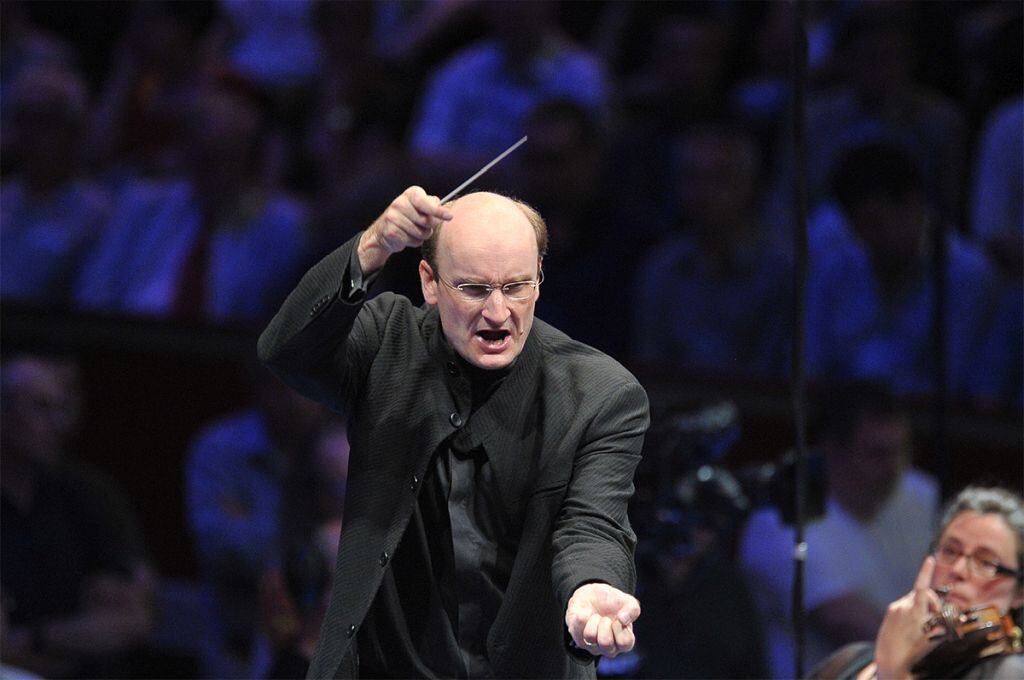
Sometimes a concert hall transforms into a cathedral of attention — where sound becomes not mere echo, but conscience. Such an afternoon Andrew Manze offered with the Radio Filharmonisch Orkest during the Saturday Matinee of November 15 in the Concertgebouw in Amsterdam, with a program carefully constructed around grief, reflection and reconciliation.
Since I had seen Manze conduct Ralph Vaughan Williams' Sixth Symphony (1872-1958) in Antwerp at the end of October, I knew I wanted to hear more of him in this composer. That he led the Third Symphony in Amsterdam made the choice obvious. Moreover, that I could hear Johan Dalene — a young soloist whose playing I admire for its rare clarity — in Concentric Paths by Thomas Adès (°1971), one of the most intriguing contemporary composers, felt like an unexpected gift. The layered Sinfonia da Requiem by Benjamin Britten (1913-1976) served as an ideal introduction to this program.
Three British voices, three generations, one emotional line: from Britten's youthful requiem through Adès' mirroring labyrinth to Vaughan Williams' pastoral stillness. With these three works, Manze built a dramaturgy of quieting: an arc from grief through reflection to reconciliation.
Benjamin Britten – Sinfonia da Requiem
When Benjamin Britten composed his Sinfonia da Requiem in 1939, he was not yet thirty. From his exile in America, he wrote it as a commissioned work for the Japanese imperial jubilee. Despite the request for a festive piece, he chose a requiem, a wordless mass for the dead, permeated with personal pacifism. The Japanese authorities promptly refused it: too somber, too Christian, too little honor to the emperor. The irony was great: an anti-war manifesto rejected by a nation heading toward war. Manze placed the work deliberately in that moral light.
The Lacrymosa sounded like a slow heartbeat: a dull throbbing rhythm in cellos, basses and timpani from which the music slowly broke free. The low strings formed a dark, breathing foundation, while the woodwinds drew their fragile lines — more a whispering protest than a lamentation. Everything remained restrained; expression came not from grand gestures but from the weight of silence between them. Manze let that tension arc breathe widely, without weakening the undercurrent: grief as restraint, as breath gathering before the storm of the Dies irae. There he drove the Radio Filharmonisch Orkest to razor-sharp precision: rhythmic eruptions as echoes of a world destroying itself. The brass sounded furious, but never grotesque; Manze kept the tone human.
And then the Requiem aeternam. Where the Dies irae breathes anger, this final section seeks reconciliation — but not without struggle. Britten's harmonic language softens, but remains charged: peace is not given, it must be fought for. Manze's greatest merit lay in his sense of proportion. He did not let the orchestra burst into pathos, but tempered the storm to an inner fire. As a result, the final movement did not sound like an epilogue, but like reconciliation: a gentle return into shadow. A single flute, a descending line in the violins — everything breathed compassion. Britten's rejected "Japanese" requiem sounded here as a universal human prayer: music that does not weep, but listens.
Thomas Adès – Concentric Paths, violin concerto
With Thomas Adès we enter another dimension: not an elegy, but an intellectual dissection of emotion. Concentric Paths from 2005, written for Anthony Marwood, belongs to his most refined orchestral works. The title refers to circles around an invisible center — a metaphor for remembrance and returning introspection. Where Britten lays bare emotions, Adès abstracts them: he shows the interior not as confession, but as movement. Beneath this geometric surface breathes a deep melancholy. The three parts — Rings, Paths and Rounds — form an arc from extroverted dynamism to stilled introspection. Johan Dalene, the young Swede of just 25, was the pivot of this sound architecture. His technique seems effortless; particularly remarkable was how he dared to use silence. His tone possesses an inner calm: a transparency that did not tame Adès' complexity, but let it breathe. Dalene is a violinist to follow: reserved, without showmanship, entirely in service of the music.
In Rings his violin sounded like a light ray through a prism. The lines were taut, but never cold; vibrato minimal, phrasing natural. Manze kept the orchestra in transparent layers: strings like mist, woodwinds like echoes of Dalene's tone. The middle section, Paths, became the beating heart of the concerto. Adès balances on the edge of tonality, without leaving it. The violin searches for footing, a dialogue between order and emotion. Dalene played it not as construction, but as confession: every note weighed, every silence charged. Manze's accompaniment was a lesson in attentive conducting: giving space without letting go.
In Rounds the circle returned in transformed guise. The orchestra swelled, the violin intertwined within it until it was no longer clear who led and who followed. Dalene hovered above the shimmering sound fabric — not as part of it, but as center. His playing convinced not through volume, but through clarity of intention. The music did not end; it evaporated. Dalene remained motionless after the final note, as if he himself still had to return from where the music had taken him. Though the outsider of the program, it fit perfectly within this framework thematically: people circle and seek connection. Adès shows that modernity need not be cold: it can also be the form in which sensibility examines itself — and finds itself.
Encore – Ysaÿe, Sonata for violin No. 5, movements 2 & 3
After Concentric Paths came an encore that made a deep impression on many: Johan Dalene chose two movements from the Fifth Sonata for violin by Eugène Ysaÿe (1858-1931), the second movement "Danse rustique" and the third movement "Moderato amabile" — a masterpiece of virtuosity and expression. The "Danse rustique" brought a charming, rhythmic playfulness: Dalene played with a natural swing and lively articulation, where every phrase breathed without ever losing its structure. The dance-like lines felt spontaneous and organic, as if the violin itself struck the rhythm from the earth.
In "Moderato amabile" he revealed a side of the violin that you rarely hear so intimately: long, songlike lines, subtle vibrato and a tone that was both vulnerable and brilliant. Where in Adès' concerto silence played a role, here every silence was charged with emotion; Dalene transformed the written notes into a story that literally pulled you inward. His interpretation of Ysaÿe was a stunning display of technical mastery and musical insight: no superficial virtuosity, but an encore that captured both ears and heart. The audience was drawn into the delicate balance between lyricism and sharpness, between improvisatory freedom and meticulous precision. It was a conclusion that felt equally brilliant and intimate, and which continued the line of the programme: from reflection and stillness to a personal, almost intimate dialogue with the music.

Ralph Vaughan Williams – Symphony No. 3 "A Pastoral Symphony"
After the storm and the reflection came the reconciliation. Vaughan Williams' Third Symphony, completed in 1921, bears the name "Pastoral", but describes no landscape — rather a state of mind. The composer, who served as an ambulance driver at the front, processed in this work his memory of the silence after the violence. Yet that silence is not empty; it is charged with distant echoes of trumpets, fragments of folk melodies, voices that exist only as memory. Vaughan Williams constructed the symphony not as a classical four-part structure, but as a cycle of breath — from awakening to stillness. Each movement reflects a facet of renewed life: first the mist of memory, then sorrowful remembrance, then the laboured recovery of movement, and finally the purification of acceptance.
Molto moderato — A serene opening. The music rises like morning mist above abandoned fields. The flutes weave a gentle melody over a pulsing foundation of violas. Manze let the lines flow as if they rose from the landscape itself: the melody is not a theme, but a breathing pattern. In the hazy harmonies, the shadow of Debussy still rings through, but Vaughan Williams makes them rounder, more human. This movement breathed hope, not certainty.
Lento moderato — The voice of memory. The trumpet solo – a distant echo of the battlefield – sounded like a voice from a dream. Not triumph, but regret. The phrasing was spare, the timbre muted. What was once a field signal became in Manze's hands an elegy. The orchestra answered with velvety pianissimi: memory became sound, sorrow that will not complain.
Moderato pesante – Presto — Man rediscovers his step. A dance, but with lead in the feet. The rhythms are folk, but broken; every exuberance is immediately contradicted by melancholy. Vaughan Williams does not quote, but echoes the English folk idiom as memory of a pre-war era. The cadences falter, joy remains restrained, a dance for those who know what they lost. Manze chose sober directness: the orchestra sounded like earth, not air.
Lento — The epilogue, a voice without words. Soprano Elisabeth Hetherington entered as a figure from the afterlife, a herald of another world. Her wordless song – immaculate, straightforward, almost supernatural – floated above the orchestra like a light of forgiveness. In this finale the human merged with the natural. The soprano was not a soloist but an element: wind, air, presence. The harmony remained open, undecided – as if Vaughan Williams refused to have the last word. The sounds slowly dissolved, until nothing remained but silence. Vaughan Williams' "Pastoral" is not nostalgia, but a moral landscape: a post-war meditation on beginning again. It shows that reconciliation is not loud, but humble. Manze understood that perfectly: his reading was not sentimental, but spiritual – a form of listening to what no longer sounds, and precisely thereby remains present.
Epilogue – The breath of an island
What this afternoon connected was not only British origin, but a moral tone. Britten mourned, Adès reflected, Vaughan Williams remembered. Three works, three faces of the British conscience: together they formed the portrait of an island that is more than tradition — a place where music thinks about existence. Manze brought their voices together into one gesture of humanity. The Radio Filharmonisch Orkest played with a precision that never became distant and a warmth that never melted into pathos. Johan Dalene proved himself a rare young musician: not concerned with making an impression, but with understanding. Elisabeth Hetherington bestowed the finale with her ethereal voice as the sealing of a prayer.
When the last sound faded, the Concertgebouw seemed for a moment no longer a hall, but a resonant body in which silence took the place of music. One felt how these three British voices did not speak of loss, but of the ability to listen after loss. Britten gave that listening form as a voice of conscience, Adès as a reflection of the inner self, Vaughan Williams as the acceptance of silence as an answer. Manze let us hear that British music does not consist of styles or schools, but of an attitude towards life: restraint as a form of courage. As if the island itself breathed in their notes — not with the breath of power, but of compassion.
November is a month in which we collectively pause for Armistice, Remembrance Day or Totensonntag. These three works showed how music can do that: not by proclaiming, but by remembering. Mourning, reflecting, reconciling – a musical circle that gains a different kind of clarity at precisely this time of year. The Saturday Matinee is blowing out 65 candles this season. With carefully curated programmes such as this afternoon's, it continues to surprise its visitors — and leave them speechless.


