

It is a bold message from author and musicologist Ignace Bossuyt to warn his readers in the first pages that this will not be easy reading. No, he says, because "even though this is still not an obvious option for many, it makes no sense to write about music without using specialized terminology."
But no worries, we know that Ignace Bossuyt is a first-class pedagogue. That is why it remains pleasant to hear him explain the compositional principles, this time of Haendel, the young Haendel. Moreover, there is again an extensive list of explanations of that specialized terminology included. If necessary, you can consult his excellent "Van noten en tonen. Wegwijs in de muzikale begrippen".
But anyway, that young Haendel... We follow him from his birthplace Halle, his travels to Berlin and Hamburg and of course his Italian years until he leaves Hannover for London for good. As an introduction to all this, you first read an intelligent sketch of the many musical genres that circulated in Europe at the time of Haendel and Bach (they were contemporaries).
In situating Haendel's young years, Bossuyt encounters a couple of composers he described in his most recent work on German Baroque, including Scheidt, Krieger, Froberger, Kerll and Kuhnau. He tells about the first work of fourteen-year-old Haendel. And it also covers his introduction and friendship with Telemann, then still two boys of 14 and 18 years old, and Haendel's stay in the trading city Hamburg. Together with Johann Mattheson, then also only 18, he went to Lubeck to hear Buxtehude at work. He too was a childhood friend, all three seeking a musical career and appointment. Later, the Protestant Haendel traveled to Catholic Italy, then a patchwork of separate states, and stayed in Rome, Florence, Naples, Venice. That lasted three years. And he was able to work there thanks to a couple of serious patrons, including the Roman cardinal Pamphili, of the still magnificent Palazzo Doria Pamphili on the Via del Corso. That Italian period gave him two oratorios, cantatas and other liturgical works and two operas. He wrote his Agrippina in Venice. Bossuyt tells you in detail about the complications that all this entailed, also about his return to Hannover. But London was already calling. He traveled there twice before staying there permanently. And that is where this erudite biographical sketch of Haendel's young years ends.
And then begins an impressive analysis of everything Haendel wrote in those first London years (until 1713), vocal and instrumental, 34 pieces from the more than 100 compositions he wrote at that time. ... And once again with suggestions to listen to them immediately by using the QR code that is printed along with text (each time also translated) and score. This has become a standard method in books dealing with music. In the appendix also many listening examples on YouTube and Spotify
After all those extensive analyses and discussions of those first London compositions from Haendel's young years, Bossuyt concludes how undervalued they are and certainly not well-known. Incidentally, not in Klara's Top 100 either: Haendel lands halfway there with 2 works, Bach scored 13 hits. Unnecessary to list how thoroughly the author dissects all those young works. Only this. It is with a very interesting discourse that Bossuyt concludes his latest book. About how Haendel effortlessly assimilates all those different European musical styles into his own work and takes the German tradition, Italian lyricism and French gallantry to England. But especially how Haendel should not be seen as a lesser composer because of his many borrowings from his own work and that of contemporaries. And he quotes Goethe in doing so: "I have known artists who prided themselves on having followed no master whatsoever. They would on the contrary have attributed everything solely to their own genius. What fools!." Bossuyt adds a statement by the great musicologist and composer Johann Mattheson: "...as long as the borrowing takes on a better and more beautiful form than in the context from which it was taken." Now it is waiting for the second part in which Georg Friedrich Haendel, that German early talent, dives into the bustling English opera life and celebrates triumphs there. But it is clear that even the young Haendel deserves re-evaluation. Bossuyt convincingly proves that he is more than the Ombra mai fu and Lascio ch'io pianga with which he lands at 43 and 45 on the most recent Klara list.
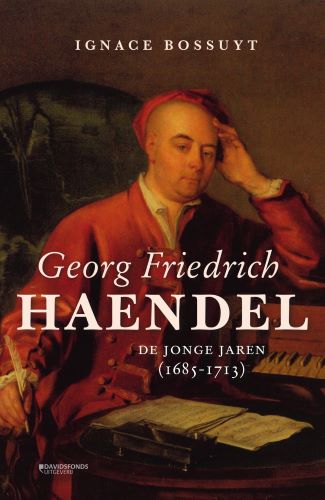
- WHO: Ignace Bossuyt
- WHAT: Georg Friedrich Haendel. De jonge jaren (1685-1713)
- PUBLISHER: Davidfonds/Standaard uitgeverij, 2022, 301 pp.
- ORDER: Standaard Uitgeverij