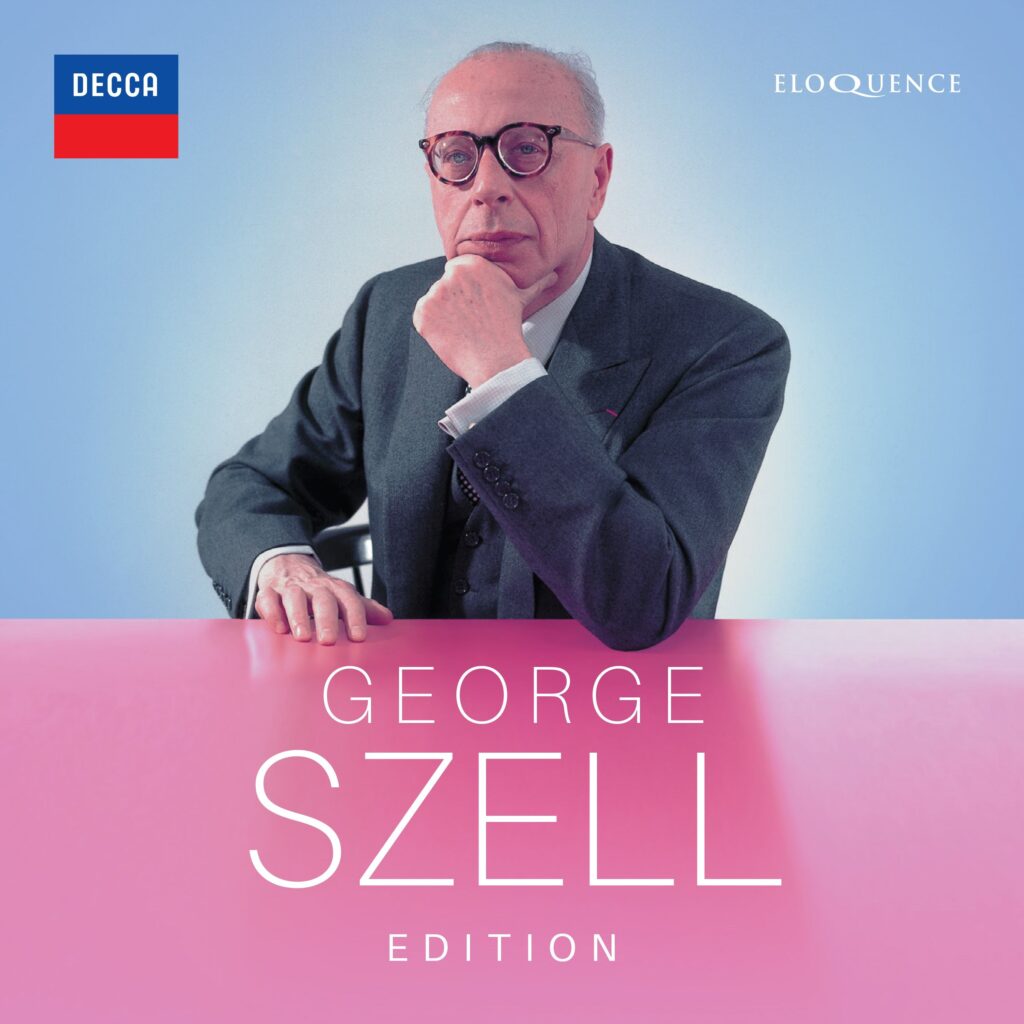
In the first part of this review, it became clear how differently Szell's need for control could manifest: sometimes it remained on the surface, sometimes it became – as in the Brahms concerto with Clifford Curzon – a source of expression. The remaining recordings in this box show that this expressive side of Szell is far from an exception.
Lyricism without sentimentality
This side comes across perhaps even more convincingly in Antonín Dvořák's Eighth Symphony (1841-1904) on cd 5, undoubtedly one of the highlights of the entire edition. From the opening measures, the music sounds as if Szell fully comprehends it. In the first movement, he draws out melancholy, fire, lyricism and joy of life; the second movement becomes very lyrical and builds compellingly towards its climax; in the third, rhythm and lyricism merge effortlessly. The Concertgebouworkest plays brilliantly – the glowing strings, the rich woodwinds, the brass in the finale – and Szell makes precise use of those qualities of the Amsterdam orchestra. The result is precisely rich without being cold, substantial without sounding heavy.
The Cello Concerto with Pierre Fournier and the Berliner Philharmoniker on the same cd is likewise among the absolute highlights. The orchestral introduction is built up with great intensity, and when Fournier enters, his cello seems to emerge from it naturally – aristocratic in tone, never sentimental. Fournier and Szell tell one story from beginning to end, with the flute solos serving as natural responses within that dialogue rather than mere decoration.
Light, colour and elegance
Ein Sommernachtstraum by Felix Mendelssohn (1809-1847) and Rosamunde by Franz Schubert (1797-1828) on cd 7 present another surprise – a side of Szell that easily remains underappreciated. Mendelssohn's overture is strikingly clear, with impeccably pure woodwinds; the Scherzo brisk and stylish without sacrificing spontaneity; the Notturno acquires its fairy-tale atmosphere immediately thanks to the horns. Even the all-too-familiar Wedding March gains freshness, simply because Szell treats it as music and not as routine.
In Schubert's Rosamunde, what stands out is how he gives meaning to even the smallest miniature: here too, without text, a story emerges that seems to unfold of its own accord. The larger orchestral scoring is unusual today, but Schubert's lyricism remains undiminished beneath it, sustained by the Concertgebouworkest that proved so convincing in Dvořák as well.
Wolfgang Amadeus Mozart's Piano Concertos nos. 23 and 27 (1756-1791) on cd 8 fit in surprisingly well with this. With Curzon and the Wiener Philharmoniker, Mozart sounds richly coloured, but never muddy; the tempi sound remarkably modern. Curzon plays with that natural, almost self-evident sense of style that made him so credible in Brahms as well – the slow movement of no. 23 moves through simplicity, no. 27 through the delightful musicality between pianist, conductor and orchestra.
Enjoying without restraint
Perhaps the most unexpected cd in the box is cd 6, with Georg Friedrich Händel (1685-1759) in the orchestrations of Hamilton Harty. Purists may well shudder at it, but I got incredible pleasure from it. If there is one Baroque composer whose music lends itself to orchestration for large symphony orchestra, it is Händel: Harty keeps the Water Music rhythmic and light despite the lavish scoring, and Szell plays with as much sharpness as love for detail. That is less self-evident than it sounds: precisely in this apparently lightest repertoire of the box must that lightness itself still be constructed, note by note, and it is precisely there that Szell's craftsmanship makes itself felt unobtrusively – a discipline that does not present itself as effort, but as effortlessness.
The added rehearsal recording is particularly valuable. Szell proves to be a calm, friendly and very concrete conductor – an accent, a retard, a tone colour, always named functionally, never theatrically. You hear someone who knows the score completely and uses that knowledge to steer the orchestra, without unnecessary words, precisely to where he wants it to be. A nice correction to the cliché of the autocrat.
The Music for the Royal Fireworks begins somewhat ceremonially, but gains life as it progresses. Less convincing is Ombra mai fu: too romantic, too slow and drowned in the lavish orchestration by August Reinhard, which nearly causes the aria to collapse under its own good intentions. The Menuet in Thomas Beecham's arrangement, by contrast, works much more naturally. Yet the overall impression remains: a conductor so often associated with discipline sounds here above all like someone who is having fun.
Not everything can be controlled
On cd 10, the flip side of Szell's approach returns one more time, but distributed across the two works by Pyotr Ilyich Tchaikovsky (1840-1893) that this cd contains. The First Piano Concerto makes no wholly strong impression. The recording quality plays a role again, but interpretatively too, the spontaneous glow lags somewhat behind the technical mastery.
The Fourth Symphony is a completely different story, and for me one of the most pleasant surprises of the box. Szell constructs the large dramatic arcs with an almost unshakeable logic, and precisely because of this, the fateful motif here gains something compelling that would be lost with a more exuberant approach. The Scherzo, with its famous pizzicati, is razor-sharp and light at the same time, the second movement sings without ever becoming sentimental and the finale builds towards a climax that is convincing precisely because Szell does not force it. This is Tchaikovsky without sentimentality, but by no means without fire – a symphony that proves that restraint and emotional charge do not get in each other's way here, but rather reinforce each other. Where the piano concerto on the same cd remains stuck in detachment, the symphony comes into full bloom.
The perfect encounter
If I had to choose one recording from the box to show someone unfamiliar with Szell what he was capable of, I would reach for Jean Sibelius (1865-1957) on cd 9. The Second Symphony seems tailor-made for him: the architecture is completely laid bare, yet feeling never disappears. Especially in the finale it becomes clear how masterfully he constructs his dramatic arcs – he forces nothing, the climax emerges from everything that preceded it and thus hits all the harder.
I also know Szell's live recording with the Concertgebouworkest and his last recording from Tokyo, shortly before his death. That last one has for me still a special, concentrated glow, but this studio version grabs at the throat just as much. What distinguishes it from the other highlights in this box is that here the architecture itself becomes the drama: with Dvořák and Tchaikovsky the emotion had to break through the structure, as it were, but with Sibelius the two converge so completely that the distinction dissolves. No better conclusion conceivable for what these ten cds have to tell about Szell.
A nuanced portrait
A box like this does not need to convince from beginning to end to be valuable. It is precisely the differences between the recordings that make clear how strongly Szell's results could depend on the score, the orchestra and the musician opposite him.
Therefore, this George Szell Edition is more than a collection of historical recordings. It shows a conductor who is not always right, but who has almost always something to say – and it is precisely that which makes these ten cds worth listening to.