Evening 5 – 31 May 2024
Klassiek Centraal brings you a report of both candidates defending their finalist position each final evening. To avoid being influenced, swept along or otherwise affected by third-party commentary, we do not attend commentary discussions before or after, nor do we read commentaries. In this way we hope to present an objective opinion. May the best win.
Each finalist will perform the mandatory work, Variations Litaniques, which was written specifically for the final of this violin session by Thierry Escaich (world premiere on Monday 27 May 2024), and a concerto of their choice, with the Belgian National Orchestra, conducted by Antony Hermus. The announcement of the ranking of the laureates will take place after the last performance, on Saturday 1 June around midnight.
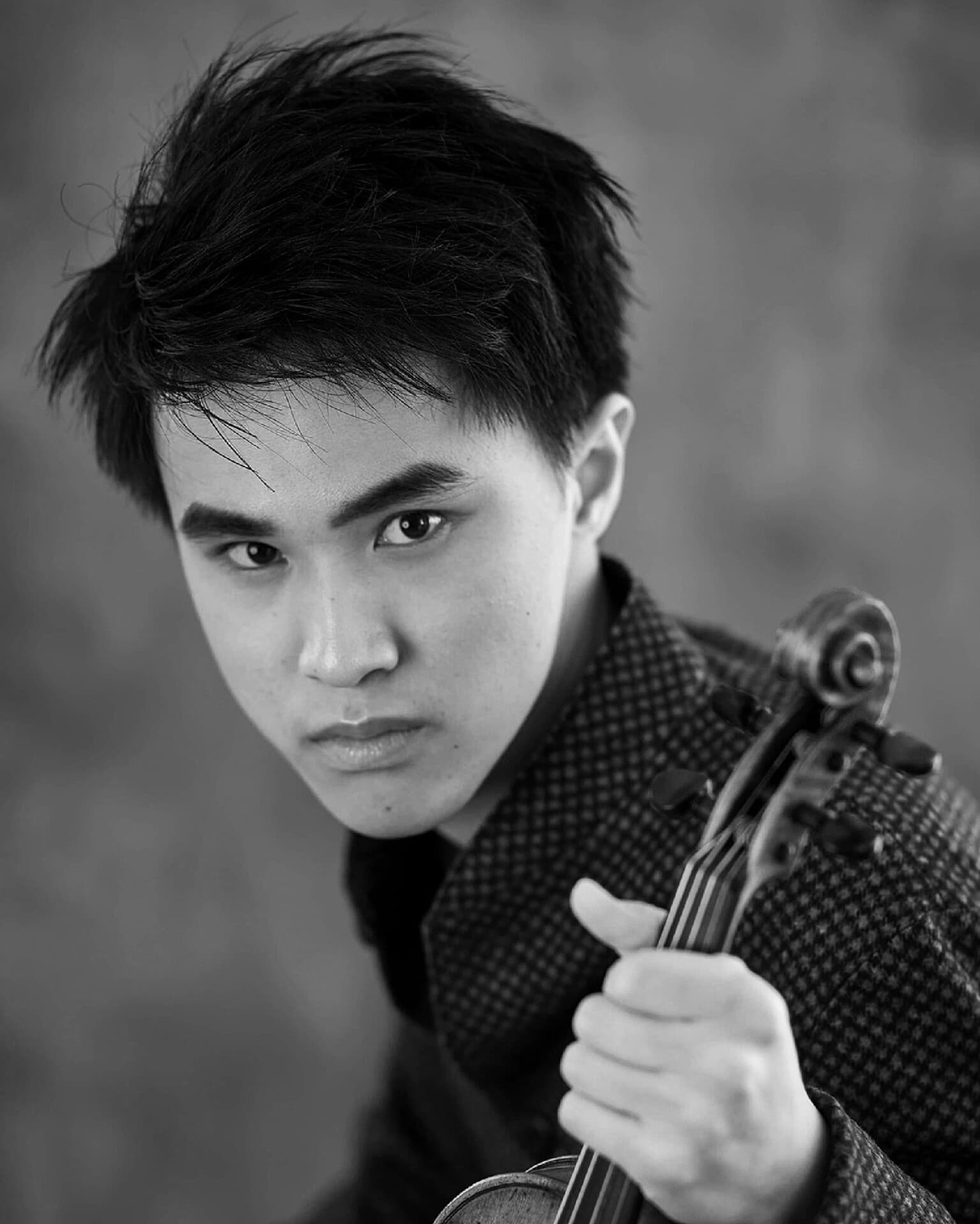
Kevin Zhu (United States of America, °2000)
Programme
- Thierry Escaich: Variations Litaniques
- Dmitry Shostakovich: Concerto no. 1 in a op. 77
This violinist takes the stage with absolute confidence and performs accordingly. He clearly wants to go down in the history of the KEW. It remains to be seen whether that will actually happen… In the imposed work he is not cautious, but virtuosic, strong, demanding. You hear it in his music, you see it in his facial expression. Ambition through and through. The inclination to begin with a supplication is not present in this energetic litany. Zhu gives his best as a master of technique, of virtuosity, but understanding of the content he rather leaves aside…
Well, the 'diabolical' concerto by Shostakovich, the concerto where he – as can be supposed – implicitly criticizes the communist dictatorship under which he lived, the fear that brought with it, but also cautious hope in the sense of 'this cannot last, it will eventually turn out well'. Perhaps Oistrach also meant the conditions in the country at that time with the 'diabolical'? Should there not be more (restrained) nervousness and stress resounding, with the glissandi fashionable in their time (Kevin Zhu does not play any) and heavy vibrato (which also does not really come into play)? It becomes a performance according to a contemporary interpretation that nevertheless lacks some insight into the time the concerto came to life. Once again it becomes clear that brilliant works are not always understood and are reduced to a piece of music that is known and that you have to play at a competition, on stage, have to record because 'that is the piece'.
Minami Yoshida (Japan, °1998)
Programme
- Thierry Escaich: Variations Litaniques
- Edward Elgar: Concerto in b op. 61
She looks with a serious gaze, but plays very subtly at the opening of the mandatory work, specially composed for this competition by Thierry Escaich. Much nuance, accentuations. The dialogue with the first violin (solo by the concertmaster) is warm and deep until it rises to the heights. A litany may not be immediately recognizable in this interpretation, but it is certainly a beautiful, musically charged performance. Her dialogue with the conductor and thus with the orchestra is there, even with a wink despite the beads of sweat. She commands silence and the musicians follow her attentively through the finely spun thread that proves its strength in the final chord.
Warmth, that is how you could actually describe this entire concerto as Minami Yoshida plays it. Much feeling resonates in her playing. Even though she looks tense (who doesn't in such a competition?), you don't hear it. A bit smoldering and with plenty of cream, or is it 'plum pudding', she serves up this concerto. The somewhat more virtuosic passages that Elgar incorporated there, noblesse oblige, she performs with a seriousness that does not joke. The ear almost in the violin, now and then the eyes open towards the conductor, full bows… She is in her element and she lets you enjoy. She is one of the few who does not play a competition, but a concert. Isn't that what it's all about? The music above all, the competition is ultimately 'only' a snapshot in what is hopefully a long career as a musician. And that? That is the straight path this Japanese musician is treading.