

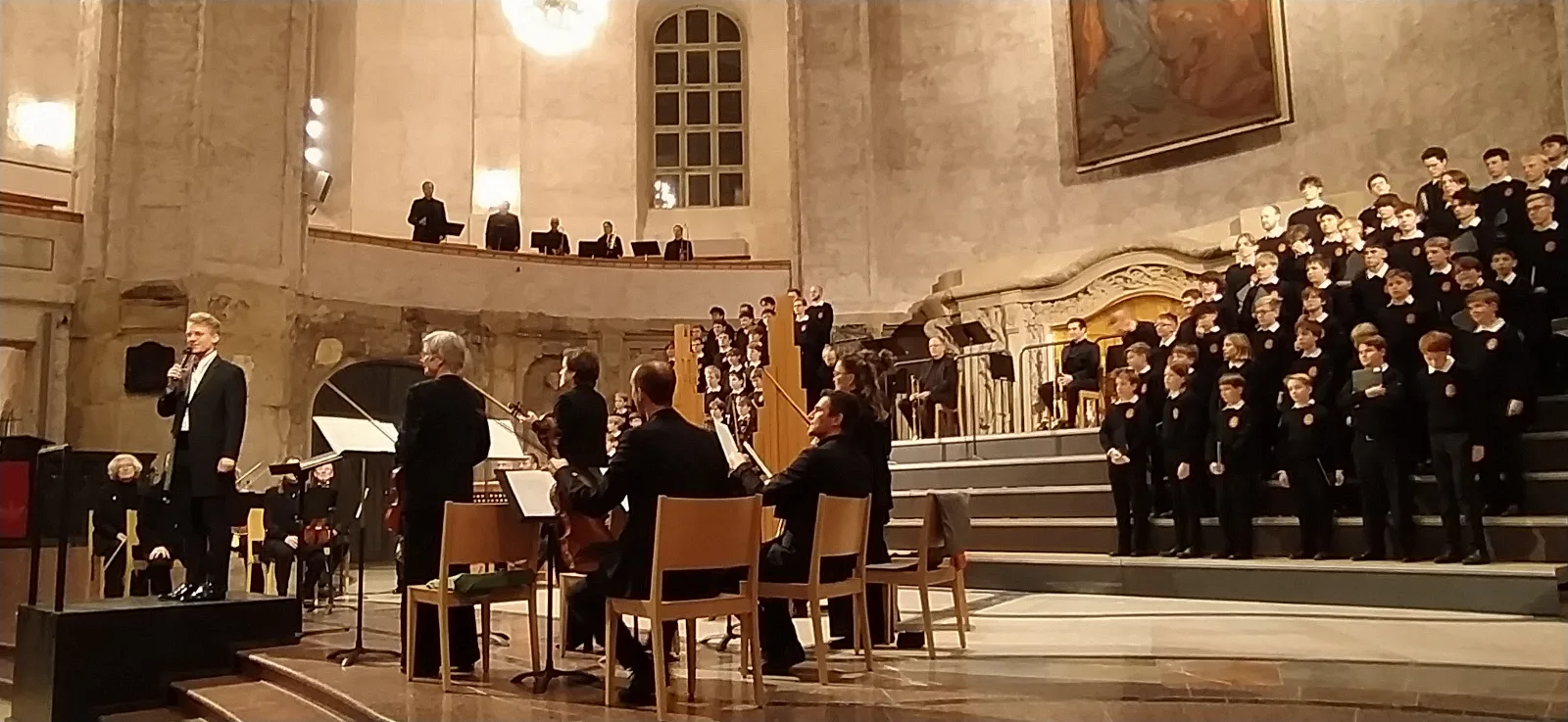
Some concerts are so remarkable that afterwards you hardly find words to describe what you have experienced. The performance of the Missa Salisburgensis in the Dresdner Kreuzkirche was such a moment for me. This had been on my musical bucket list for a long time: to one day experience this monumental work in a church space that lends itself to it, with a choir and instrumentalists who can truly carry the music. That this wish would be fulfilled precisely during the jubilee year of the Augsburger Domsingknaben, and with such a performance, I could hardly have imagined.
A church building as a sound instrument
Even before the first note sounded, I was impressed by the arrangement. At the front, on the left and right, stood two eight-part choirs, with some space between them for two wind players and four soloists from the choir (tenor and bass). On the first gallery, on either side, was a row of wind players. Further back in the church, at the same height, two more groups were positioned, this time including timpani. In front of the choirs stood the strings, two organs and the continuo. The arrangement was adapted to the different works on the programme, but the space remained an essential part of the musical experience throughout.
This is precisely what the Missa Salisburgensis à 53 voci, attributed to Heinrich Ignaz Franz Biber (1644-1704), calls for. The mass was composed in 1682 for the celebration of the 1100th anniversary of the Archdiocese of Salzburg. With its extensive vocal and instrumental forces, it is among the most monumental works of seventeenth-century church music. The various groups were not simply brought together to produce a large volume: their mutual dialogue and their distribution across the church space are an integral part of the composition.
I had hoped beforehand that the acoustics of the Kreuzkirche would support all of this, but what I heard exceeded my expectations. The reverberation was exceptionally well controlled and nowhere intrusive. Even when all the musicians played and sang together, the sound remained beautifully balanced. The arrangement and the mutual relationships were clearly carefully attuned to the space. When the various choirs came in simultaneously, you as a listener were truly surrounded by the music. In those moments I felt completely enveloped in the sound world Biber had created. It was overwhelming, but never merely loud or massive.
Supplication and exuberance
Already in the Kyrie it became clear how familiar the Augsburger Domsingknaben are with this repertoire. The plea took on a clear, penetrating shape. What struck me in particular was the naturalness with which even the youngest boys sang with full devotion. From their posture and concentration you could see that they had not only rehearsed this music but had truly made it their own.
In the Gloria, the spatial dialogue between the choirs became one of the great strengths. The et in terra pax gained extra weight in these turbulent times. Afterwards I heard individual voices answering one another and so building together a monumental whole. I kept marvelling at the way all those groups found each other and yet retained their own place within the music. The closing Amen sounded festive and exuberant.
In the Credo, the tender, moving Et incarnatus est was especially affecting. The Crucifixus sounded piercing, while at Et unam sanctam catholicam particular attention was paid to the text. The Amen at the end of the Credo had a more inward-turned character than that of the Gloria.
The Sanctus and Benedictus were performed with great sensitivity to the layered quality of the music. The Hosanna had a beautifully shaped build-up, after which Benedictus qui venit was emphatically set forth as a promise of victory. In the Agnus Dei, strength and restraint stood side by side. The entries on Agnus Dei came each time like an eruption; at miserere nobis the music was then pulled back. The closing plea for pacem seemed almost forced into being. The final chord lingered for a moment in the space. Afterwards I needed silence to let the experience settle.
Between monument and intimacy
The mass did not stand on its own but formed part of a programme constructed like a musical celebration of Mass. Antonio Bertali's (1605-1669) Sonata a 13 served as a fitting instrumental opening, like an introit leading me into the sound world of the seventeenth century. Between the Gloria and the Credo sounded Celebremus cum gaudio by Johann Melchior Gletle (1626-1683). As Kapellmeister he was connected to the cathedral of Augsburg and thus forms a fitting link with the history of the choir. The spatial placement made this work especially remarkable: three boys sang from the rear part of the church, while the small instrumental ensemble remained at the front. I found it a memorable moment in which the musical dialogue spanned the full length of the church space.
Several works by Johann Stadlmayr (c. 1575-1648) also resounded. His multi-choir writing fitted beautifully with Biber's musical language. His Cantate Domino, with a breathtaking Et exultavit, stayed with me in particular, though his Benedicam Dominum also fascinated. In it, two tenor soloists, together with the instrumental ensemble, were given full scope to shape the work in a more intimate and serious manner. Stadlmayr's Sonata a 13 then formed an ideal instrumental prelude to the Agnus Dei.
A very different kind of attention was demanded by Gletle's Quis mihi det, an a cappella work in which the word tremor above all captured the imagination, with a striking trembling in the voices. It was a skilful and refined vocal moment, which stood out all the more in a programme where the instrumental and vocal sonic mass regularly assumed impressive proportions. Amid so much sonic volume and baroque splendour, that musical restraint was more than welcome. I would even have liked to hear a little more a cappella music. It would have given the ears some rest and made the contrasts with the monumental works even stronger.
That is immediately my only small reservation about an evening that otherwise completely overwhelmed me. In the great tutti passages, an individual boy's voice occasionally disappeared into the dense sonic mass. With a work of such enormous forces, this is hardly avoidable. It did little to diminish the quality of the performance. The choral singing was excellent, the instrumentalists played with great precision, and the various groups remained accurately aligned with one another. Above all, the attention to textual and musical detail made an impression. Even in this monumental setting, there was room for nuance and for the meaning of individual words.
A tradition that lives on
Fifty years ago, the tradition of the Augsburger Domsingknaben was rebuilt, drawing on a much older choral history. In my recent conversation with Stefan Steinemann, who has led the choir since 2020, he returned to the idea that a tradition only remains alive when each generation makes it its own anew. After this evening, I understand those words even better. The boys stood here not as custodians of a historical repertoire, but as young musicians who truly inhabit this music. The naturalness with which they brought the complex polyphony to life bore witness to a musical training that reaches much further than learning notes.
I have experienced many remarkable concerts, but this evening will retain a special place. A work that had been on my wish list for so long, heard live in an ideal church space and performed by such dedicated and accomplished musicians: it was an experience I will not soon forget. Through this performance, the Missa Salisburgensis has become for me more than a monument of the Baroque: it is also a living, overwhelming experience. And that is what I take with me.