

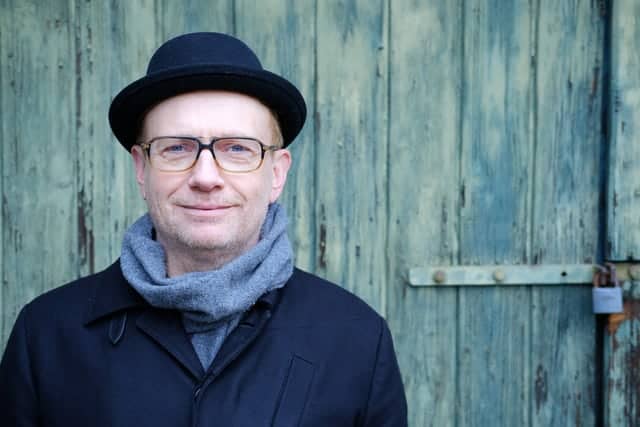
Hide to Show by German composer Michael Beil is the opening of the annual Transit festival in Leuven. The Nadar Ensemble explores internet culture through live video, isolation and the boundaries of hyperreality. A conversation with the composer about the grey area between music and theatre and what remains of the concept of reality. And: he prefers hyperpop to classical music.
Michael Beil: "I want to stay in the concert setting, but go as far as possible towards the theatre setting, so together with instrumentalists, no actors or singers. That gives the piece charm but there is also a sense of loss because the audience expects actors and singers based on the setup, but they are not there. So some people find that strange, but that is my intention with this piece. In 2021 we were very well prepared. We had long rehearsals. We got together three times, twice for five days and once for three days. This cycle resulted in a form of co-composition with the musicians. I didn't even have to write down most of the adjustments. I could work with the musicians like that. We could come up with solutions along the way. And that was a dream come true. That was a wonderful experience. After that we made five performances in Essen, at a festival for game-related art. So all kinds of digital and video and this was a nice experience with a young audience, not the typical contemporary music audience, but very open-minded people."
Do you compose differently than usual to reach young people?
"Hide to Show is like a musical, so not a long piece. I don't follow the dramaturgy of a classical composer, but that of an entertaining composer. I write short pieces. Perhaps this way of working is not so appreciated in the classical world. But I wanted to go for it because it is very much related to the internet and social media. Everything that passes by there is short and young people are no longer used to listening to long things. Sometimes they can listen for a long time to drone music with some smoke beforehand, but actually they prefer short pieces of music of 3 minutes. Although this project was somewhat risky, I think I ultimately did it well."
Does the rehearsal process play an important role in the composition process?
"In my work you have to do much more than play notes. This can be very embarrassing for classical musicians because many musicians don't know how to walk or move. Then they feel ashamed and that is also uncomfortable for the audience. The musicians make many movements on stage, such as coming, going, sitting, standing, moving with their instruments. Musicians naturally make many gestures when they talk about music. Everyone dances and sings. Actually, I only do things that musicians would normally do at home or on stage. I focus on movements that musicians make on stage, nothing more. They can do it, but it is difficult for them because they feel a bit lost when they are not holding their instruments. So there is always half that I have to encourage and the other half that I have to hold back. But in this case it is mainly about privacy. It is about what people do at home, filming themselves and then showing it to the audience. But when the audience sees it, they no longer see them as real people, but as a representation, just like the internet, like TikTok."
[caption id="attachment_51288" align="alignleft" width="227"] © Wynold Verweij[/caption]
Does the piece show hyperreality or is it itself hyperreality?
"I would say both. The piece shows the process of hyperreality. There are six parts and the parts consist of 6 small pieces, and in each part there is the same piece with a different aspect. In each part there is a dance, but they are six dances with different aspects of the same piece. And there is one story that runs through the piece with six small parts. That is about the folk song Ievan Polka, seen through the Japanese internet sensation Hatsune Miku, a virtual person. The concert situation is hyperreality. Because it only exists virtually on the internet, but it becomes real when a lot of real people in the concert hall enjoy a concert. So it is a very special kind of reality because you have both, you still have the virtuality on stage because Miku is not there. It is just holographic action. But the band is real and the dancers of the band are also real. In the audience everything is real, only the artist is not real. This is a very clear example of how a kind of reality can take place in music."
The musicians are usually separated in their booths, they are isolated. How can ensemble playing be rehearsed then?
"You can't imagine how strange the situation is for them when you're in such a box. They really play in their box and they don't see or hear what the others are doing. The audience has the impression that they are all connected, but that can't be. Of course it is difficult for rhythm and intonation. So at rehearsals they come out of the boxes and practise ensemble playing, maintaining intonation, and then they go back into their boxes. That is what we always do. But from the subject matter, it is very important to me that during the performance I show that being together is the exception and being alone is the norm as it is in our world today."
In some scenes you use technology to achieve perfection. Don't you thereby take away the personality of the musician?
"I'm a controlling person. And when I started with Hide to show, I told myself that this would be the first piece in which I would totally avoid control but it ended up with a lot of control. That was a miss on my part. The only control I actually have is what you have in every concert: the right pitch at the right moment. But I also add the gestures, the gestures have to be in time because they are recorded and played back later and they have to match the music in other parts.
I'll give you an example. There's a section where they're all in the boxes and they sing without sound, they open their mouth, dance a bit and there's no singing in that section. But there's other music. And the mouth movements match that song perfectly. And that is for me one of the most intense experiences of all performances. In that other part people have difficulty seeing whether it's projection or real, because the projectors are very good and you sometimes really have to concentrate. But then they realize that the boxes are closed. It's a live video and they sing the song, but: how can that? Technology helps me bring surprise into the piece."
What does creativity mean to you?
"I see the process of creativity as a filtering process. We are constantly receiving more information from all over the world. The most important task of the composer is to filter this flow in a certain way. Which way? That is a decision, a creative decision. And what a composer then has to do is transform. So there is a transformation process of things that people know. I would say that the old way to make art is to see or hear something great and unknown that you have never experienced before. Nowadays we see art more as something that is transformed from the real world, like Duchamp who puts the (appropriated by him - WV) urinal in the museum. And then it's not a urinal anymore. But it raises a lot of questions and people are very surprised to see why it's in the museum. And that's what I try to do with music: filter, transform and then, if I deliver good work as a composer, surprise people with new connotations for things they already know".
What kind of compositions are typical for Michael Beil?
"My specialty is the use of live video, and live video in this complicated setup. I'm the only one who can do that at the moment. Because I have a lot of experience with it, I use this form of live video. I do that to play with musical form, it's always related to music. It's always to show something with music or the musicians, and with the video I try to put people on the trail so they can wonder what's going on. So to give people something at the beginning of a piece until a certain point comes where they think, OK, I get it, it's boring. And then something happens that is really surprising. So if people, after they have heard and seen my piece, are left amazed, then I have succeeded. My music is music that questions things."
Will you ever write an opera?
"No. All my pieces are in a sense already operas. And if I had to do an opera, I would do an ironic non-opera without singers. Yes, because honestly I don't like classical. I really like Pop. Right now I listen a lot to Hyperpop, for example by British producer/singer/dj Sophie.
Besides, it's not possible to find new ways to play the violin these days. No matter what you do with it, it remains a violin. And there is currently also a stagnation in the development of electronic instruments. Controllers aren't inventing anything anymore. Most young composers are now mainly busy with synthesizers and modules. That's a strange situation. I let them do their thing. I'm not interested in that. I'm very interested in what comes after this."
What comes after the violin and electronic instruments?
"We could use implants, for example, put something in our throat to sing like Hatsune Miku. Just kidding: I put an implant in my arm and then I can play piano perfectly. Still, I think that's the future. The future is virtual glasses and implants, but classical instruments will always be there and we need orchestras, maybe a bit like we need old paintings in the museum. It's nice. We all want that. We go to the Louvre and we see the old art and we go to the concert hall and we listen to Beethoven."
All your works are available for free in open source. Why are you so generous?
"That's a sign to show that my work is not a miracle that comes from a divine artist. I'm just a normal person who decided to specialize in music. On my website you can download every score, all the tapes. Other composers can use my tapes and sample them and use them in their own pieces. And they already have. That's how we work. You see something, we like it and then we use it. And together with other things we also transform it and we are a community. Why would I do it differently?"
WHAT: Hide to show by Michael Beil
WHO: Nadar Ensemble
WHERE: STUK, Leuven
DATE: 20 October 2023
TICKETS: festival2021.be