

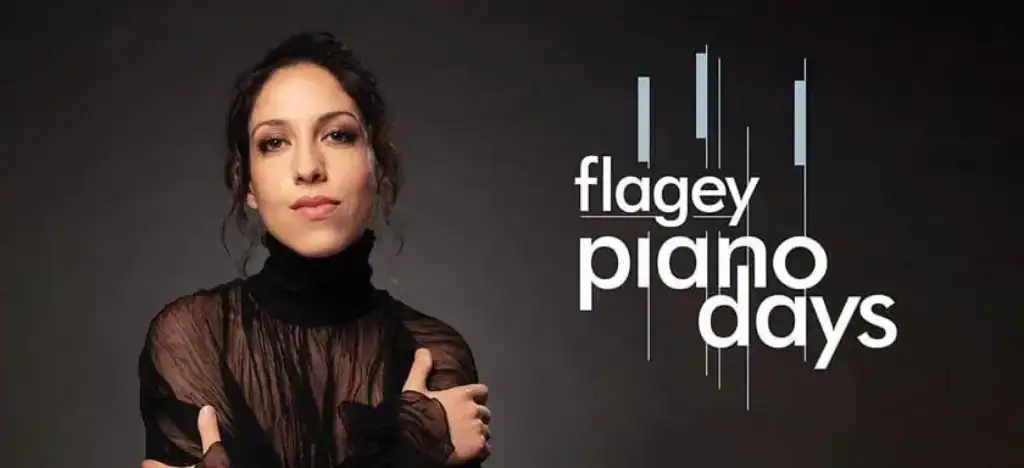
In February, Brussels traditionally becomes a city of keys. No metal, no brass, no strings setting the tone, but the instrument that can be everything: orchestra, sound laboratory, intimate confessional. From 11 to 15 February 2026, the Flagey Piano Days once again bring together a richly varied programme in which the piano is not presented as a museum piece, but as a living, breathing prism of musical ideas.
What has characterised this festival for years is not so much the accumulation of big names – though they are there again – but the way generations, styles and playing traditions intersect. Classical repertoire stands alongside contemporary exploration, pure virtuosity alongside reflective stillness, solo formats alongside hybrid projects in which electronics and neoclassicism claim their place. The piano appears here in all its guises.
Great voices, carried tradition
The focal point of this edition undoubtedly lies with a number of pianists who have been shaping the instrument for decades. Elisabeth Leonskaja occupies a special place. Her eightieth birthday is celebrated at Flagey with two concerts that exemplify her trajectory: a solo recital featuring Mozart, Schubert and Schönberg – repertoire in which her sober, unforced depth comes fully into its own – and Beethoven's Third Piano Concerto with the Brussels Philharmonic under Kazushi Ono. Not a nostalgic tribute, but a living artistry that still provides direction.
Beatrice Rana also makes her long-awaited Flagey debut. Her programme – Prokofiev, Debussy and Tchaikovsky – combines technical brilliance with a refined sense of tone colour. Rana belongs to that rare type of pianist who never views virtuosity as an end in itself, but as a means to let structure and poetry speak.
With Pierre-Laurent Aimard comes a thinker at the keyboard to Brussels. In the run-up to György Kurtág's hundredth birthday, he places Játékok alongside Schubert's dances. The result promises to be not a historical discourse, but a poetic dialogue on simplicity, fragmentation and musical intimacy – themes that bring both composers surprisingly close together.
The future in formation
As befits a festival with ambition, Flagey explicitly looks ahead. Young American pianist Eric Lu, recent laureate of the Chopin Competition, presents Schubert and Chopin in a programme that promises more than mere competition lustre. Tony Siqi Yun, discovered through international competitions, and Romanian pianist Ionut Cibotariu also showcase themselves in repertoire that tests their musical maturity, not merely their technical prowess.
A special place is reserved for Jonathan Biss, pianist, thinker and writer, who makes his Flagey debut with a broadly assembled recital programme – from Mendelssohn to Kurtág. His approach fits seamlessly with the spirit of the festival: repertoire as conversation, not as a display case.
Hybrid sounds and late hours
That the piano is not confined to the concert hall is proved by the Late Night concerts by Laurie Torres and Niklas Paschburg. Here the keyboard merges with electronic textures and neoclassical atmospheres, in formats more akin to a sensory journey than a traditional recital. These are moments when Flagey explicitly explores the boundaries of the classical concert, without depriving the instrument of its identity.
Belgian accents and returning voices
The Belgian piano scene remains firmly anchored in the programme. Jean-Claude Vanden Eynden returns with Franck and Schubert, repertoire that underscores his analytical clarity and architectural vision. Julien Libeer and Korneel Bernolet explore with piano, pianoforte and harpsichord the kinship between the Couperin family and Ravel – a concert that couples historical curiosity with sound experimentation.
Familiar Flagey names such as Plamena Mangova, Dmytro Choni and Alexander Malofeev also make their comeback, each with a programme that sharply defines their personal signature.
More than concerts
Beyond the performances, the festival offers space for deeper engagement. Music Talks provide context and background to works and composers, while the Piano Expo with instruments from Piano's Maene's collection sheds light on the material side of piano playing. These are not peripheral activities, but conscious invitations to listen differently.
The Flagey Piano Days 2026 present not a canon, but a landscape. A landscape in which the piano simultaneously embodies past and future, in which great traditions are passed on and new voices gradually take shape. For those willing not only to hear, but also to listen, this festival remains a standing appointment in the Brussels winter.
Be sure to check out https://www.flagey.be/pianodays and keep an eye on Klassiek Centraal for interviews with some of the pianists and concert reviews!