


Prior to his concert at the Korean Cultural Center in Brussels on Thursday, January 22, where he will perform Anton Kraft's cello concerto, we had a fascinating conversation with South Korean cellist Yoonsoo Yeo.
The discovery of an inner language
The cello sounds like a voice to Yoonsoo Yeo. Not by chance: from an early age, he was moved by the way the instrument can express emotions that elude words. Growing up with recordings of Yo-Yo Ma and Pablo Casals, he intuitively felt that music is more than form or sound alone. "Even as a child, I had the feeling that music speaks directly to inner experience," he says. It was not the physical proximity to the instrument or purely aesthetic beauty that was decisive, but the idea that expression can be its own, autonomous language.
That thought accompanied him when he started playing at the age of eight. For years, the cello remained a source of joy, without pressure or ambition. Only when he was eleven and a teacher approached him after a concert about his exceptional talent did something begin to shift. A year of more intensive study and unexpected competition wins followed. "Then I thought: maybe this is my path." Yet that path was far from obvious. Yeo struggles with hearing loss in one ear, a limitation that made him doubt himself repeatedly. What kept him going was the experience that his playing could touch others. "Seeing people become happy through music gave me the strength to continue."
An identity between continents
Born in New Zealand, Yoonsoo Yeo moved to South Korea at the age of nine to study music. The transition was profound. Not only the language – with its fine-grained distinction between formal and informal registers – proved to be a challenge, but the culture also felt stricter, more structured. Where New Zealand offered space for freedom and imagination, Korea taught him focus, discipline, and the drive to achieve. "In hindsight," he says, "I developed my flexibility in New Zealand, and in Korea learned how to fully deploy it."
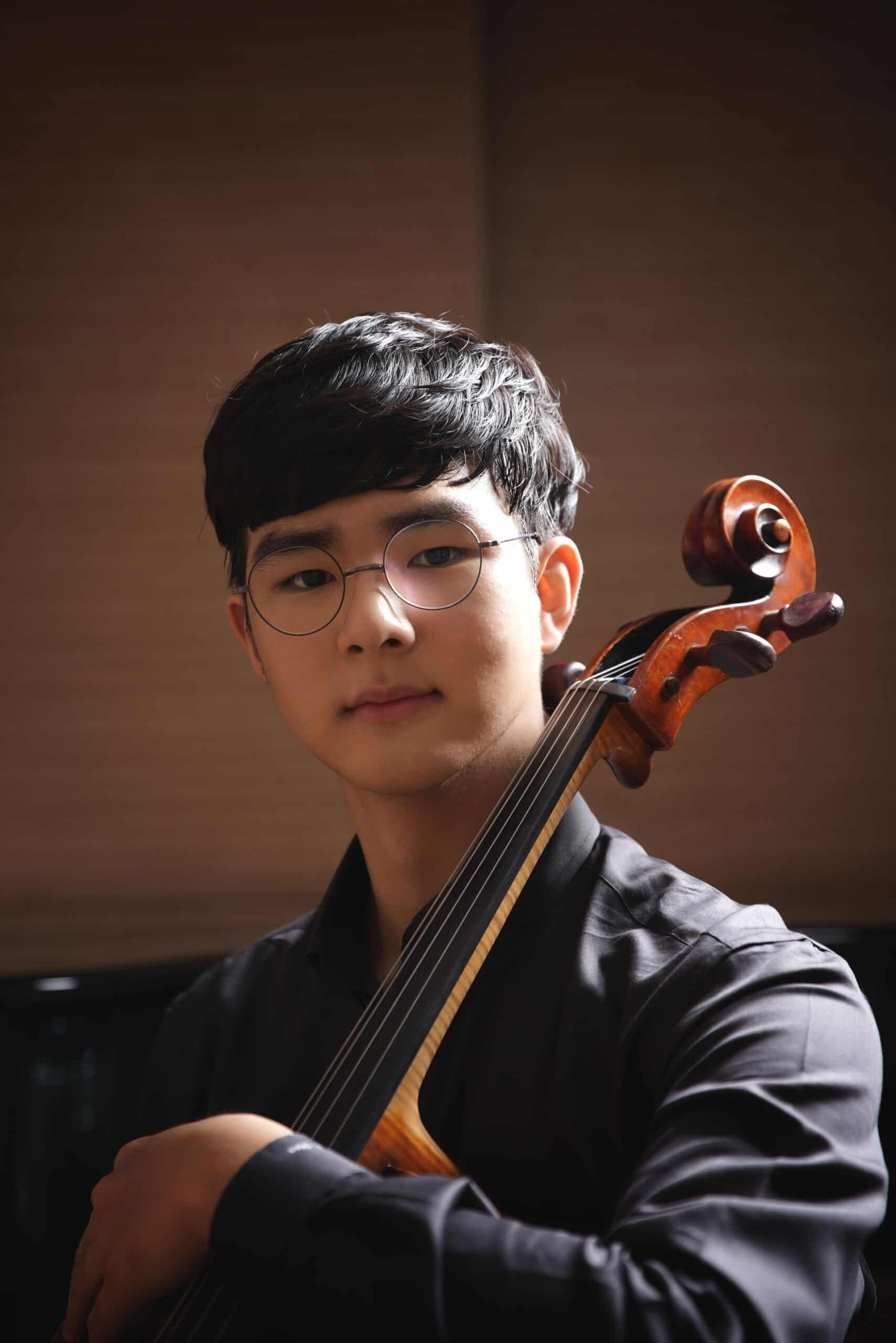 Later came studies in the United States – including at the Curtis Institute of Music – and today he continues his education in Europe. Each continent left its mark. "My musical identity was not shaped by one country, but by the combination of all those experiences." It perhaps explains why his playing is difficult to pin down in a single aesthetic framework: it is rooted, but not bounded.
This cultural layering also influences how Yeo experiences audience culture. In East Asia, he notices great emotional intensity among listeners, but also a certain distance from classical music as daily practice. In Japan, he says, classical music is deeply rooted in social life and remarkably accessible. In South Korea, by contrast, it is more often experienced as a genre for devoted enthusiasts. In Belgium and more broadly in Europe, music feels more naturally woven into daily life for him: attending a concert is not an exception but a natural part of the culture. This organic relationship between musicians and audiences creates, according to Yeo, more freedom and space for artistic experimentation.
Competition as self-examination
From an early age, Yeo received international recognition through competitions. Yet he did not experience success as liberating. On the contrary: it fueled an inner drive to meet expectations. "I did competitions not for the prizes, but to understand where I stood and who I could become." Growth, not results, was the measure. He has never lost that attitude.
In a competitive music world, Yeo tries to protect his artistic voice by not measuring himself against others, but by listening attentively. "Everyone has their own way of shining." For him, authenticity means: knowing what your strengths are, being honest about your shortcomings, and working on them without losing your individuality.
Learning to listen
The differences between his education in South Korea and the United States were fundamental. In South Korea, the emphasis was on acquiring technical means and stylistic ideals. Curtis, by contrast, encouraged critical reflection and interpretive freedom. "They did not ask for the right answer, but for possibilities." That shift taught him to listen – to the music, but also to himself.
Mentors like Peter Wiley and Carter Brey played a key role in this. Wiley coupled creative freedom with daily discipline: Bach, scales, études. Brey taught him how context changes everything, how intonation, sound, and bowing technique differ between solo playing, chamber music, and orchestra. One piece of advice stuck with him: technique must never become an obstacle to expression. "Reliable technique is ultimately what makes freedom possible."
The Royal Elisabeth Music Chapel as laboratory
Since September 2023, Yoonsoo Yeo has been Artist in Residence at the Royal Elisabeth Music Chapel. The remote location, in the midst of the forest, creates a rare concentration. "Here I can practice the way I really need to." More than the practice time, it is the many performance opportunities and the holistic approach that shape him. "The Royal Elisabeth Music Chapel takes responsibility for the person behind the musician."
Under the guidance of Gary Hoffman and Jeroen Reuling, Yeo developed something he had previously missed: the ability to self-diagnose. "I now see not only what is missing, but also what I can build on." That clarity gave him stronger artistic self-confidence.
The international community at the Muziekkapel works as a mirror. "I learn enormously by listening to others." The diversity of sounds, backgrounds and approaches is broadening, sometimes overwhelming, but always stimulating.
Yeo explicitly views this phase as a decisive period in his life. At 24 years old, he experiences the years until his thirties as a 'golden time', in which he wants to explore and push his boundaries. Especially in terms of sound, intonation systems and technical refinement, he feels there is still uncharted territory. Not out of impatience, but out of curiosity, he wants to discover how far he can go. He sees that open attitude as an essential part of artistic maturation.
Repertoire as a mirror of the soul
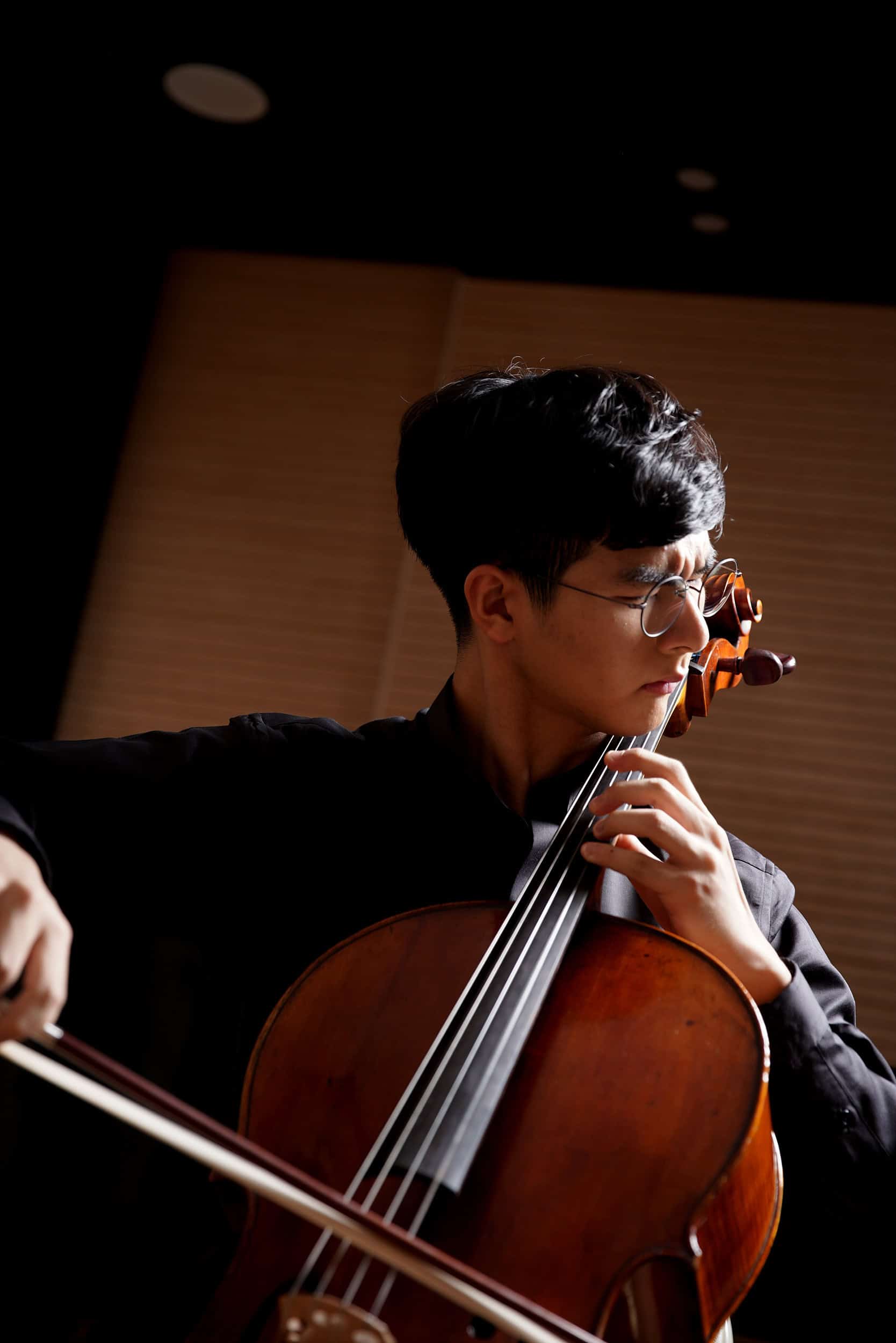 Yeo's repertoire choice is broad and context-sensitive. Sometimes he seeks tension, sometimes rest. "It depends on the space, the audience, and also on my own inner state." His approach to the score is equally nuanced. With composers like Beethoven, the text is the foundation; with Haydn or Piazzolla, he allows more room for spontaneity, fed by historical knowledge and personal instinct.
Tonight he plays the Cello Concerto in D by Anton Kraft with the Orchestre Royal de Chambre de Wallonie. The work, related to Haydn but more strikingly virtuosic, requires, according to him, not heroic struggle, but elegance and confidence. "The challenge is to show refinement without letting the effort show."
Although he does not experience the concerto as a battle, the technical demands are real. Especially in the third movement, complex arpeggio passages confront him again and again with utmost concentration and flexibility. Yet he does not view these moments either as something that must be 'overcome', but as part of the larger musical gesture.
Instrument as conversation partner
Yeo plays a Carl Becker cello from 1934. Not the objective timbre, but compatibility with his inner sound conception was decisive. "An instrument must resonate with who you are." When that resonance is there, a broader world of expressive possibilities opens up. "Then a dialogue emerges, and I sometimes discover directions I had not foreseen."
On doubt, imperfection and meaning
For Yeo, an interpretation is never finished. Every performance is provisional, subject to time and experience. Perfectionism remains a driving force, but he knows that true perfection does not exist. Sometimes music asks for rest, for distance. "Like food must ripen, so does music."
Doubt is a constant companion. He investigates, tests alternatives, leaves questions open. Only on stage does he let go of that doubt. "There I rely on my process. That is the only thing I do not question."
That doubt is not only existential, but also methodical. Yeo continually tests different interpretive possibilities and deliberately leaves some questions open until just before the performance. It is precisely that process that feeds his confidence: once playing, he chooses to let go of the doubt and entrust himself completely to the work that preceded it.
What he wishes for the audience is not a single emotion, but something that lingers: a question, a discomfort, a moment of reflection. "Music may also chafe." The most meaningful concerts are those that continue to live in the listener.
Looking ahead
Yoonsoo Yeo does not think in terms of career, but of necessary encounters. In the short term, he wants to continue growing; in the long term, he hopes that his music – not his name – will be remembered. A modest dream is an integral performance of Beethoven's cello sonatas and variations: a life journey in sound.
He places that personal vision within a broader reflection on the future of classical music. According to Yeo, tradition need not be the opposite of innovation. He advocates for attention to contemporary composers and for ways to reconnect classical music with the present, without losing its depth and dignity. For young musicians, he sees a double responsibility in this: to pass on the heritage with integrity and to build bridges to new forms of meaning.
For young musicians, he has simple but demanding advice: be patient, compare less, listen more. Failure is part of it. "As long as mistakes do not take away your curiosity and courage, they are one of the most honest teachers."
Besides Casals and Yo-Yo Ma, Yeo also mentions Julian Steckel as a figure who has strongly influenced his imagination. Not as a model to copy, but as proof of how far the instrument can be pushed. What he retains from his role models are not ready-made answers, but values: dedication, courage and an open imagination.
And perhaps one thought sums it all up: music is not about perfection, but about honest communication. In that tension between discipline and sincerity, Yoonsoo Yeo seeks his voice – and lets the cello speak.