

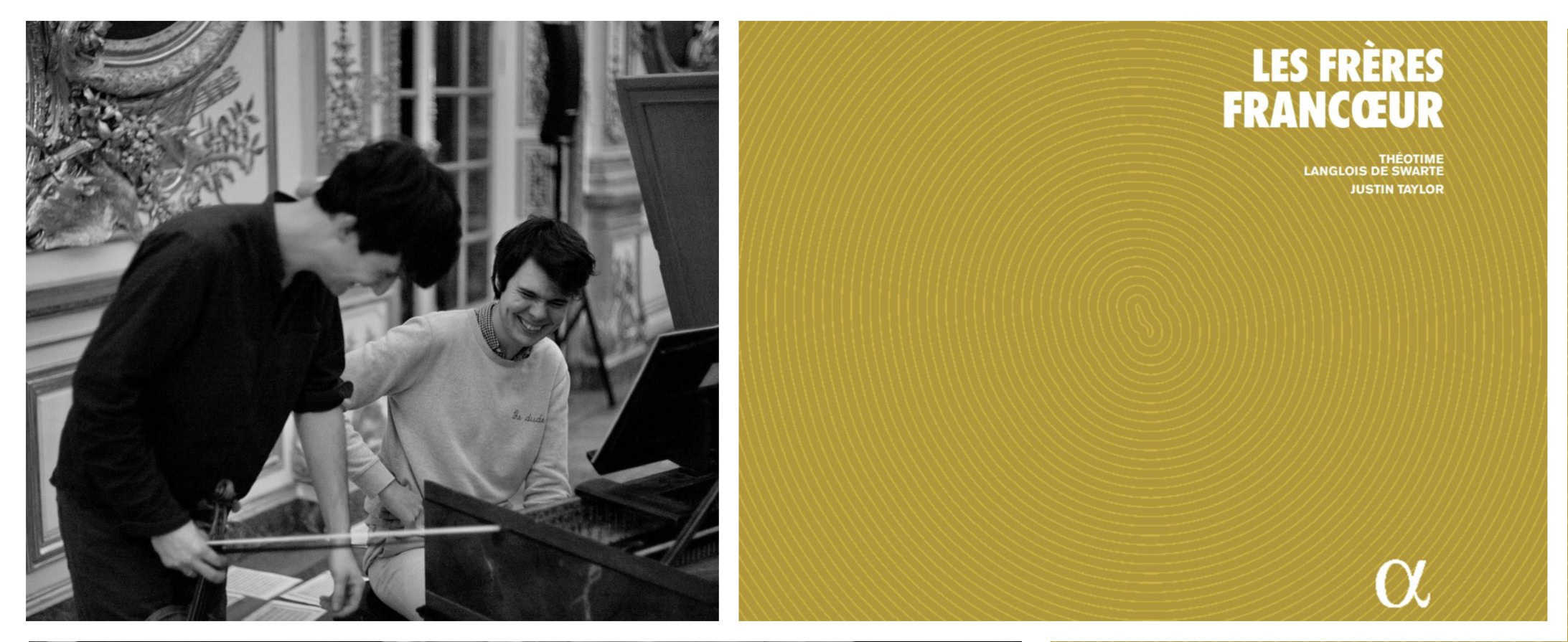
Truly candid
Just one genuinely silly question: which of the Francoeur brothers was actually the most capable composer? Was it Louis Francoeur, "l'Aîné" thus (ca. 1692-1745). Or rather François "le Cadet". Well, they were undoubtedly a match for each other, it turns out. Both from the concluding Rondeau from the sonata in G minor by François (opus 2, no. 6, 1730) and from Louis' indescribable Largo from the sonata in B minor (opus 1, no. 6, 1715). With these two pieces, the core of Les frères Francoeur is reached. Registers are opened, and the soul of their music is delightfully laid bare and revealed. These genuinely authentic performances moreover make us realize that today, in potential, we can experience the most beautiful of musical times and also appreciate it at its true value. A time in which dichotomies all too often hold sway, yes even lustily celebrated down to the bone, but which in classical music, as notably between speaking and singing, are apparently overcome without any effort. How to make clear the tremendous candor of Louis' Largo, the makers of this record must have thought. As the impression of an imprint that asks for eternal reprint? Or by providing, as insidiously as movingly, a brief excerpt from Les Augustales – "Le théâtre s'éclaire". Spot on indeed! These chief songbirds, as balm for the heart, you simply must listen to. Hear, hear, hear again:Pleasure for the gallery
Just two genuinely rhetorical questions. Must there still be sand. And who would have made all those arrangements for strings and keyboards, straight from the tragedies Tarcis et Zélie (1728) and Scanderberg (1735), anyway. Are all those wonderful 'partitions réduits', as if they were tickets for the foyer, only to be thanked to that François (pl.). Fact is that there not only intimate disclosures take place (Tarcis et Zélie), but also the fieriest and most astonishing playing pleasure passes by (Scanderberg). Before diving once again into the sonatas of the Francoeurs. Where next to energetic and neatly timed pleasantries – the Courante by Louis for example – also thoughtful work keeps bubbling up. Cases in point: the aptly intoned and thus consoling Allemande and Sicilienne by François. Great class then, with a de Swarte who as a short entremets incidentally still balances a colourful improvisation on the Elder's sonata in G major. The Chaconne by Louis-Joseph Francoeur (1738-1804), "qu'il à faitte pour donner à son oncle", is by the way not the cherry on the cake of this musical family, but a cheerfully inspired homage. Because tears of joy that remain nonetheless – schwung, timpani stroke – among the most delectable. No one today still believes that the performance of Scanderberg back then was a resounding failure, quite the opposite:Resigned to passion
It is a reflection with which Les frères Francoeur concludes. "Pour plaire l'art ne peut prêter qu'une faible imposture". A comical subtitle for the heroic ballet Le Prince de Noisy (1749)? Or a subtle hint to everyone who keeps confusing culture with leisure time; or refuses to connect it with "la condition humaine". The finding remains in any case that Les frères Francoeur has been conceived and performed by all involved as one compelling story. That the tracks on the back of the cover have no numbers, only underscores the intention of the makers. Little to nothing was left to chance or doubt, and that also speaks from the sequence of glowing, compelling pleas. Where you can thus repeatedly warm yourself for a moment. Like to the passion, where here too ultimately is resigned to. "La passion est encore ce qui aide le mieux à vivre", it seems Émile Zola (1840-1902) was also convinced of that. Or as the duo Langlois de Swarte–Taylor paraphrases it: "Plus encore, la musique est ce qui aide le mieux à vivre!" Hence this friendly request: more singing from you please, with yet a Pleiades of other notes on it.There has to be passion A passion for living, surviving And that means detachment
 5/5
WHO: Théotime Langlois de Swarte (violin, Jacob Stainer, 1668) & Justin Taylor (anonymous harpsichord, from 17th-century Lyon, "mis au grand clavier par Joseph Colesse" in 1747, restored in 2003 by Laurent Soumagnac)
WHAT: Les frères Francoeur, with music by Louis and François Francoeur (ca. 1692-1745 / 1698-1787), Louis-Joseph Francoeur (1738-1804), Jean-Jacques Baptiste Anet (1676-1755), François Rebel (1701-1775) and Jean Durocher (18th century)
RELEASE: Alpha Classics, ALPHA 895 (1 cd)
PHOTOS: © Julien Benhamou & Robin Davies
MERITS MORE THAN A DETOUR: la Cité musicale-Metz, 25 March 2023
ORDER CD: JPC
5/5
WHO: Théotime Langlois de Swarte (violin, Jacob Stainer, 1668) & Justin Taylor (anonymous harpsichord, from 17th-century Lyon, "mis au grand clavier par Joseph Colesse" in 1747, restored in 2003 by Laurent Soumagnac)
WHAT: Les frères Francoeur, with music by Louis and François Francoeur (ca. 1692-1745 / 1698-1787), Louis-Joseph Francoeur (1738-1804), Jean-Jacques Baptiste Anet (1676-1755), François Rebel (1701-1775) and Jean Durocher (18th century)
RELEASE: Alpha Classics, ALPHA 895 (1 cd)
PHOTOS: © Julien Benhamou & Robin Davies
MERITS MORE THAN A DETOUR: la Cité musicale-Metz, 25 March 2023
ORDER CD: JPC