

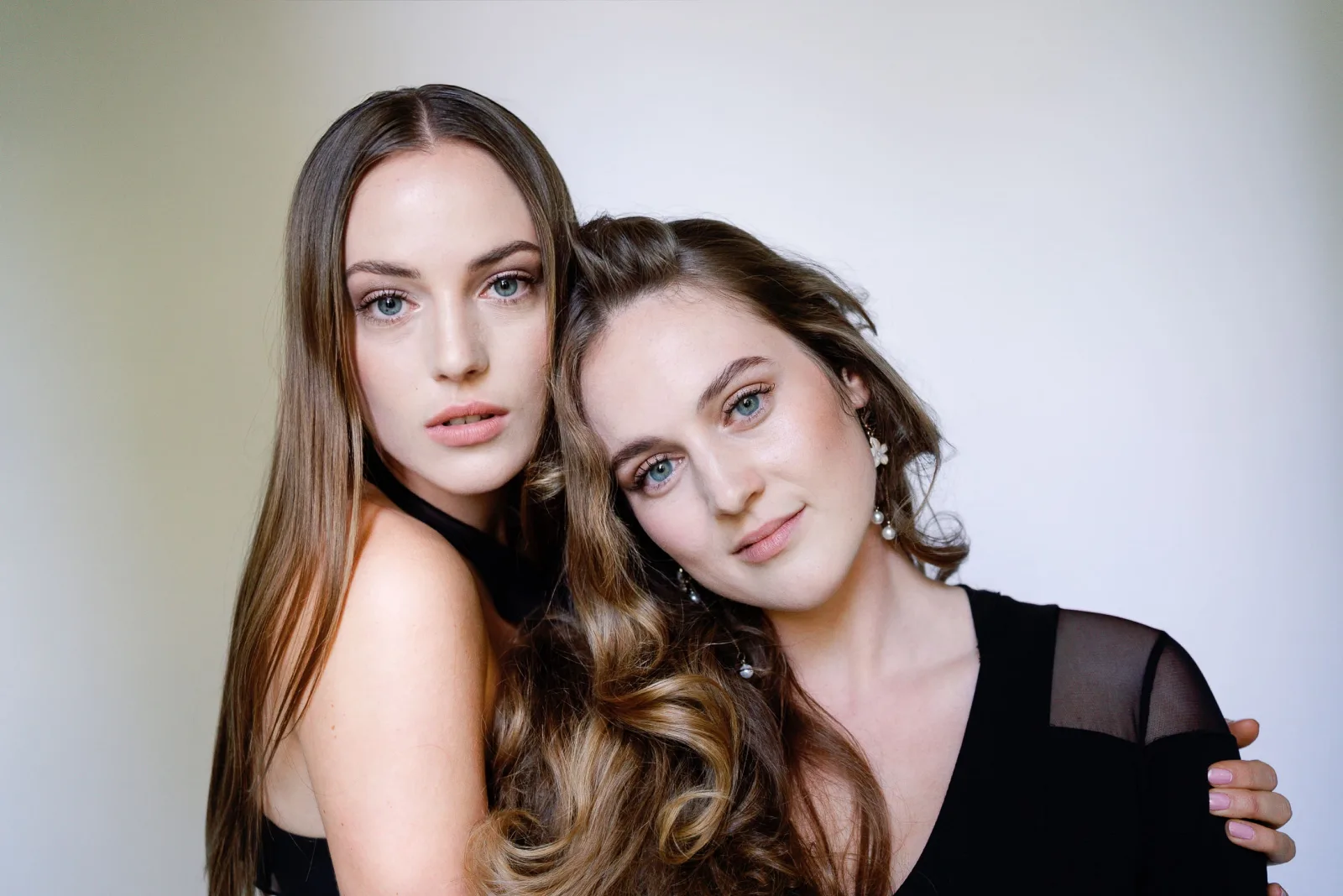
For Camille and Chloé Beniest, music was a natural part of everyday life from an early age. Their mother, pianist Gill Masson, taught her three daughters to play the piano. First the eldest sister Charlotte began, four years later Camille followed, and another four years after that Chloé. “At first we played ten minutes a day, but that gradually grew to half an hour and eventually much more. We practised before school, sometimes even during breakfast. That apple we could at least eat in the car,” Camille recalls.
Their mother drove the girls to competitions, concerts and rehearsals and continued to support them throughout their entire journey. “Without her we would certainly not be where we are today,” says Chloé. From the age of seven the first concerts and competitions followed. Camille toured Flanders together with her mother, Charlotte and actor Pol Goossen with the theatre production Driekoningentriptiek. At school, too, the sisters received extra time to practise thanks to a top-athlete or arts status.
Music was not their only interest. Alongside piano, Camille studied classical singing and chose the Science-Mathematics track with nine hours of mathematics. Between the ages of ten and eighteen she was active as a singer and performed, among other things, nine times with a symphony orchestra during Venlo Classic Live. She also sang with the National Orchestra of Montpellier, in a broadcast on France 2, and several times with the orchestra of the Heverband. She graduated as a Motion Designer; Chloé is studying International Journalism.
From coronavirus silence to a piano duo
The step towards a permanent piano duo came in 2020, when the coronavirus pandemic brought concert life to a standstill. The sisters decided to take part in an online competition of the Prinses Christina Concours. “I already knew how much fun it was to make music together, because earlier I had also taken part in some piano duo competitions with Charlotte. And so Chloé and I thought: let's try this together,” Camille explains. It worked so well that the sisters wanted to continue together. “And it was so much fun that we actually had no desire to stand on a stage as a solo pianist anymore,” says Chloé.
By playing together with Chloé, Camille discovered how much pleasure you can get from making music with two. As a child she did not have the same ambitions as her eldest sister, who dreamed of taking part in the Queen Elisabeth Competition: “I mainly knew that I really loved being on a stage!” Meanwhile she does not want to let go of the music world: “This is a world I absolutely don't want to give up. It has also become a real dream by now, one I go for wholeheartedly.”
In 2022 and 2023 several international competitions followed. The duo won, among others, the Pianoduofestivalconcours in Amsterdam, the Concours International de Piano de Brest in France, the Internationaal Concours Appassionata in Namur and the Concorso Pianistico Recondite Armonie in the Italian city of Grosseto.
In 2024 concerts followed and the sisters recorded their first album, which was released in 2025. In that same year they were selected for Club Talent Empowerment. That track brought new opportunities: they have already performed twice with orchestra and have appeared at venues such as Muziekgebouw Eindhoven and Musis in Arnhem. A concert tour through China, with concerts and masterclasses for young pianists, also made a strong impression on Chloé: “One of the absolute highlights was undoubtedly our concert tour through China. That adventure was truly incredible! A unique experience we will never forget. It was really… CRAZY!”
Making music together, growing together
That the sisters know each other inside out, also off the stage, plays an important role in their playing together. “We have always had a very strong bond and actually share everything,” says Chloé. Camille notices that this familiarity is also palpable while making music: “We know each other inside out and feel each other very well, without needing many words for it. We breathe together and make the same movements with our bodies when we play.”
Still, they do not always agree immediately on how to divide the parts. Sometimes both want to play the same part. “Then we try to convince each other with good arguments, haha. Sometimes that works, but often we also have to meet each other halfway,” Chloé explains. Camille has another solution: “Or we play rock-paper-scissors.” They also take into account who was allowed to choose for the previous piece.
After the division, they study their parts separately. Afterwards they look together for the right balance in dynamics, accents and interpretation. “We of course each bring our own interpretation to the piece, and we are very often on the same wavelength. If that isn't the case in a certain passage, we listen to each other's ideas and look together for a good middle ground. In the end we choose what feels best and fits most closely with the score and the character of the piece,” says Camille.
Music that tells a story
The repertoire of the C-Sisters is versatile. “We are mainly drawn to music that does something to you. We like to choose pieces that go very deep and move people, but equally works that are playful, surprising or even a little funny,” says Chloé: “For us it is important that a piece of music stays with the audience, that people feel something and still think back on it afterwards.”
Camille finds it important that with their music they tell a story. She gives the example of Rachmaninoff's Suite No. 1 for two pianos: "In the first movement we have to convey the beauty, in the second movement you hear the little birds, the night, love. In the third movement you really have to feel the anguish that the young Rachmaninoff was struggling with at the time. And the last one is the bells!"
Rachmaninoff drew inspiration for this Suite from poems. The four movements each have their own character and colour, which the sisters try to bring out in their performance. The music also demands a great deal from them. "Especially Rachmaninoff's Suite No. 1 goes very deep. The first time we played it together, we really had to catch our breath afterwards. The music moved us so deeply," says Camille.
Saint-Saëns and Shostakovich also offer very different possibilities. Chloé describes the music of Saint-Saëns as elegant, lyrical and refined. Shostakovich is, in her view, "a completely different story": "His music can be very playful, exuberant and even a bit mischievous, with unexpected turns, humour and sharp contrasts." Camille calls the works technically demanding, virtuosic and refined. "They are all great composers and yet the works are so different," Chloé observes.
A fairground of sounds in Shostakovich
C-Sisters Live also features the Concertino Op. 94 by Dmitri Shostakovich (1906-1975), which the composer wrote for his son Maxim. The first encounter was less straightforward for Camille than with Rachmaninoff: "With Rachmaninoff we were immediately captivated by the beautiful melodies, whereas Shostakovich is really something quite different. At first I wasn't a fan, but the longer I listened to it, the more I started to enjoy it."
The rehearsals certainly brought a lot of fun. The duo has been playing the work since 2023, but performed it most often in 2024 and 2025. "It sometimes reminded us of a fairground, where you hear all kinds of sounds mixed together," Chloé recounts. Camille remembers how her sister sometimes put on a typical fairground barker's voice during rehearsals: "Look here, a nice prize for everyone!"
Behind these playful memories lies a carefully considered approach. Chloé points to the contrast between her loud, heavy opening and Camille, who sounds very innocent and soft. In the fast passages they mainly want to preserve rhythmic precision and not rush. "Chloé is a bit of my metronome in that," says Camille. About the structure of the work she says: "What we mainly want to bring out are the different contrasts. We really want to magnify those seriously. The lyrical section we want to play very musically. And then comes the great build-up to the end, yes, which we of course think is wonderful!"
From orchestra to two pianos
Alongside Rachmaninoff and Shostakovich, the album contains two works by Camille Saint-Saëns (1835-1921) in an arrangement by Claude Debussy (1862-1918) for two pianos: Introduction et Rondo capriccioso and Danse macabre. The sisters had to translate an orchestral sound world into two instruments: "We often listened to the orchestral version and tried to ensure that piano 1, which takes the violin part, sounds as lyrical and elegant as the violin itself," Chloé explains. "That is certainly a challenge, since a piano is not a string instrument but a percussion instrument. The aim was therefore to convey that same elegance, refinement and fragility of the violin as well as possible on the piano."
In Introduction et Rondo capriccioso Chloé takes on the role of the violin and Camille plays the orchestra. In Danse macabre they both take on the violin part. "It is very rewarding to be able to play different roles in such an arrangement and to try together to bring the richness of a full orchestra to life with two pianos," says Camille.
The tension of a live concert
For their second album, Camille and Chloé deliberately chose a live recording. Camille explains that choice: "Because we feel that a live concert always has something special and is never quite the same as a recording." They also wanted to make the atmosphere of such a concert tangible on the album. In her view there is a different tension and extra adrenaline: the audience, the applause and the reactions are part of the moment.
Chloé too emphasises the spontaneity of a live concert: "Sometimes we take more risks, sometimes we take crazy tempos that we might take a little slower in a studio setting, and sometimes we add extra details because at that moment we are completely in a different world." This spontaneity, she feels, is hard to replicate in a studio.
The recording was made possible thanks to Gerald Moons, who handled both video and sound, and the help of various collaborators. To make the project financially viable, the sisters organised a crowdfunding campaign for the CD, the live recording and their concert tour to China. "Thanks to the support and enthusiasm of so many people, we successfully reached our crowdfunding goal. We are incredibly grateful for that," says Camille.
Since their first album, their ensemble playing has also grown. Playing on two pianos requires a different approach than playing four-hands on a single instrument. "You don't sit side by side, as with a four-hand piano piece, but you do see each other. That calls for a different way of listening and responding," Chloé explains. When she and Camille play together on one piano, one of them usually has the slightly more difficult part. The programme for two pianos on this CD is, according to Chloé, written more equally. Sometimes their ensemble playing is put to the test: "In the fourth movement of the Suite, we once even experienced that we simply couldn't hear each other anymore!"
The works on the new album are more difficult than those on their first disc. Chloé finds the second movement of the Suite especially challenging. Camille describes how, when playing together, she sometimes takes the melodic voice while Chloé plays the fast passages: "Then I have to listen very carefully to her to stay together, but at the same time I also want the freedom to let the beautiful melody sing."
Shostakovich's Concertino also makes high technical demands. "For almost the entire piece, Camille plays fast passages in which her left and right hands have to play the same notes. Those have to line up extremely precisely," says Chloé. The programme is therefore quite exhausting. "It demands an enormous amount from us, both technically and musically. But precisely because of that, we have also learned a great deal and notice how much our ensemble playing has grown," says Camille.
New musical paths
The plans of Camille and Chloé reach beyond the current repertoire. "We want to add a great many new works to our repertoire," says Camille. Their current programme includes, among other things, Rhapsody in Blue and Three Preludes by George Gershwin. It is a more accessible programme, in which there is also room for Camille as a singer. They perform a version of Yo Soy María, for example.
Another project takes them to the film music of Dirk Brossé for Daens. Their mother Gill Masson made a seven-part arrangement of it. "As far as we know, that version has never been performed before," Chloé relates. "We have since played the piece several times and notice that it is very well received by audiences. For some listeners it is even their favourite piece in the programme!"
Our eldest sister Charlotte is also joining in again. She is currently a pilot with KLM and therefore often in the country. This means we can once again rehearse together a lot: "We have already given three concerts the three of us, and it really feels wonderful to stand on stage together again," says Camille. The sisters hope for new collaborations with orchestras and performances at beautiful venues. "So we will certainly keep dreaming and working towards it," Camille concludes.
With the live recording, they also hope to give listeners at home something of the concert experience: "We mainly hope that people who listen to the album will feel transported back into the concert hall for a moment. That they not only hear the music, but can also breathe in a bit of the atmosphere, the tension and the energy that filled the hall at the time. Actually, we hope they feel as if they were there themselves!"
Anyone who wants to hear the C-Sisters live can go to Phil in Haarlem on 27 December 2026. There they will perform Le Carnaval des animaux by Camille Saint-Saëns together with Maestro Jules. Of course, Camille and Chloé will also be there with their CDs.