

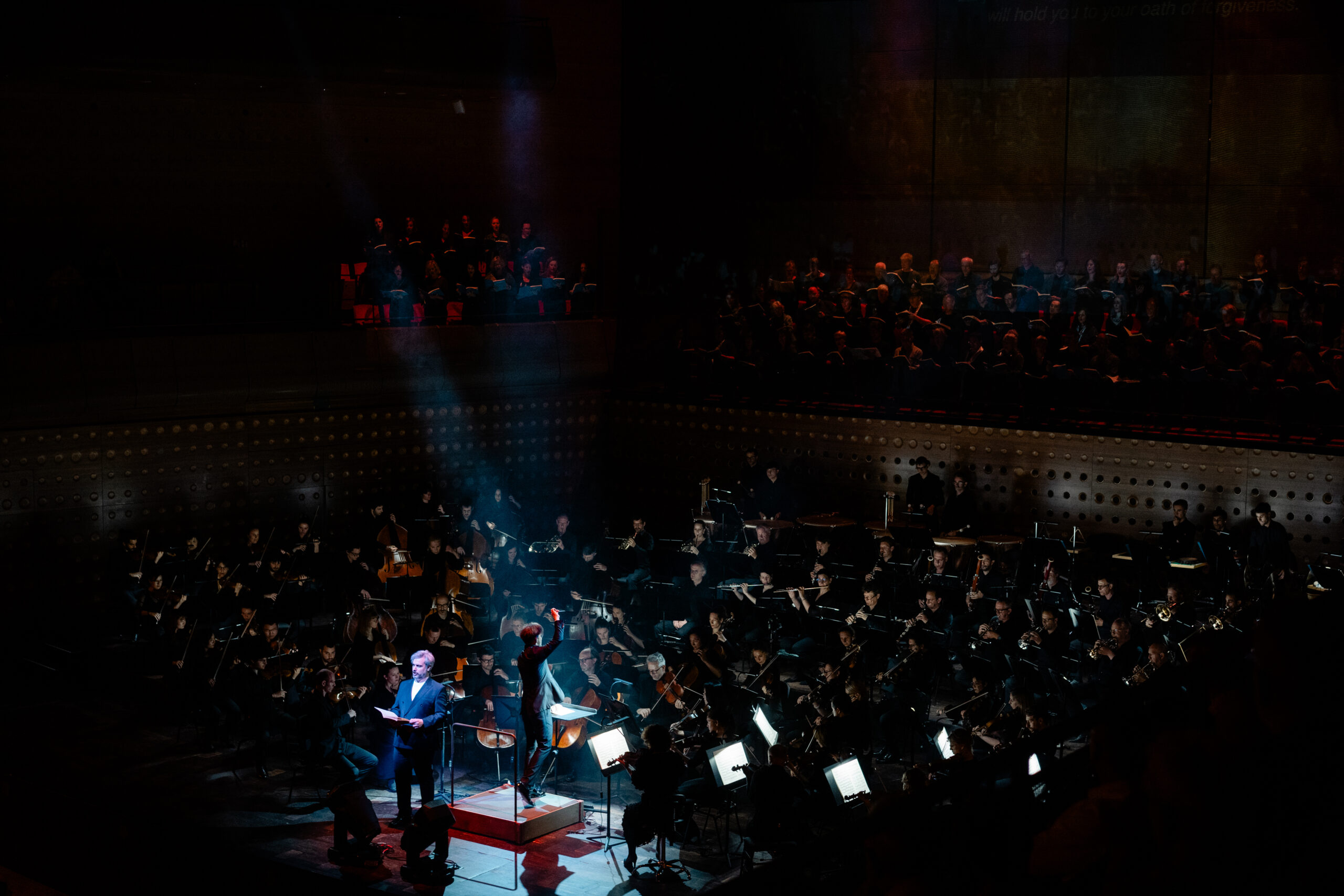
With Roméo et Juliette, Hector Berlioz (1803-1869) created in 1839 a work that stubbornly eludes every category. Not an opera, although Shakespeare is omnipresent. Not an oratorio, despite the prominent role for choir and soloists. And certainly not a classical symphony, even though the composer himself called it a symphonie dramatique. After a performance of Romeo and Juliet in Paris – with Irish actress Harriet Smithson as Juliette – Berlioz became so obsessed with Shakespeare that in this score he created his most personal musical universe. Ironically, Smithson would later become his wife, while their marriage proved as turbulent as that of Shakespeare's lovers ended fatally.
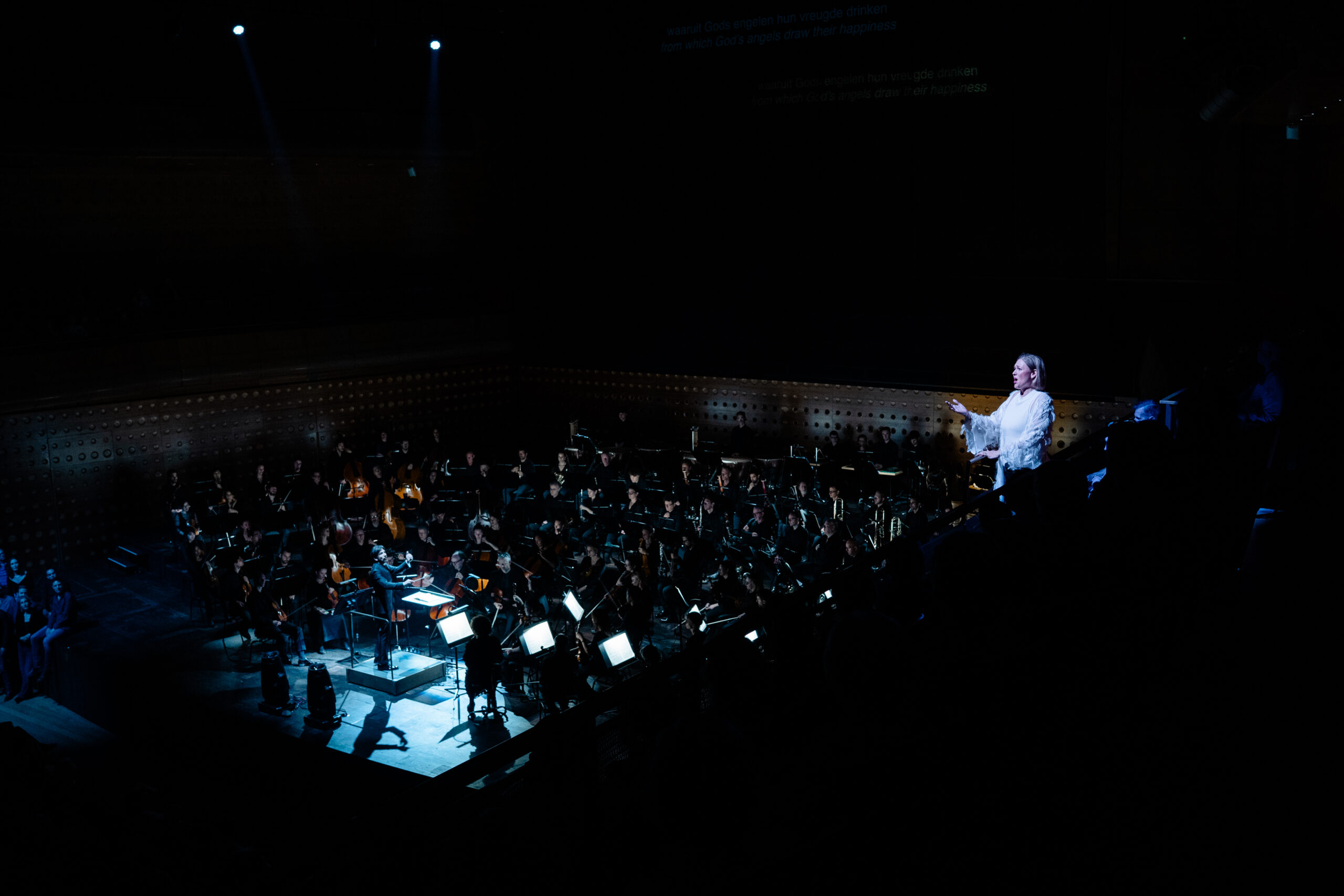 This capricious hybrid form of symphonic poetry, theatrical imagination and vocal drama makes Roméo et Juliette one of Berlioz's most visionary works. Wagner later called it a revelation. Rightly so, for the French composer opens up the symphony here into an almost cinematographic experience, in which colours, contrasts and emotions continually vie with each other. The two main characters are never sung in it but depicted by the orchestra itself – because words, according to the composer, simply fell short. Three soloists and two choirs surround them as witnesses and commentators.
A contemporary reading of Shakespeare
That precisely this score was now placed on the stands by the Antwerp Symphony Orchestra felt like a daring yet logical choice. In a scenic reading by director Aïda Gabriëls, the work moreover gained an extra theatrical dimension, without the music itself fading into the background. Gabriëls is known in her own country for transdisciplinary projects she creates as artist in residence of Muziektheater Transparant. Her approach departed from the ambiguity that Berlioz himself had created: in a mise-en-espace that deliberately uses the concert hall as a theatrical frame, she placed the masses – choir, orchestra, singers – as a collective body from which individuals only rise with difficulty. Writer Dominique De Groen added new texts that were not sung but made readable through projection as inner voices from the masses. Gabriëls continually searched for the topicality of the story: hatred, polarization and reconciliation were not abstract concepts, but palpable social tensions. Do we need conflict or violence to find common ground is the central question for both her and Berlioz.
The video projections thereby opened up the story to a broader social context. References to collective phenomena, ranging from football crowds to images reminiscent of mafia films, made the split between the two families recognizable to a contemporary audience. Not every projection was equally necessary and the repetition of certain images sometimes worked rather distractingly, but some moments were visually particularly striking, such as the death scenes (from known productions and films) and the closing images in which conductor and orchestra appeared as a hazy, almost dreamlike projection.
A substitute with authority
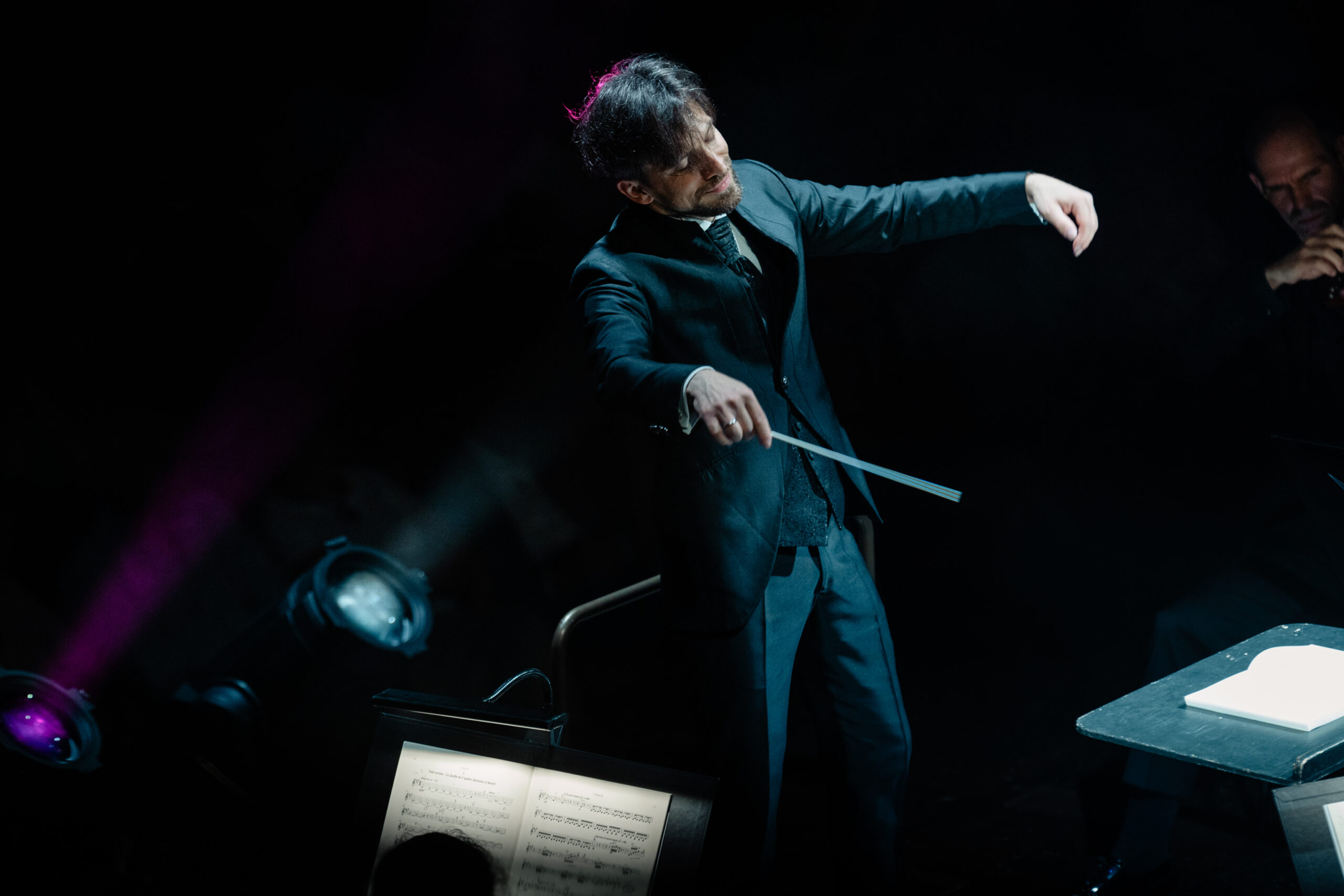 That evening, however, Cornelius Meister was centre stage, stepping in at the last minute for the ailing Dima Slobodeniouk. As Generalmusikdirektor of the Staatsoper Stuttgart and a welcome guest in the major opera houses, he stepped in with admirable nonchalance. He understood that Berlioz above all needs breathing space and transparency: not sluggish Romantic bombast, but a flexible build-up of tension in which every orchestral colour gained meaning. Berlioz was approached here not as a composer of mere Romantic eruptions, but as a master of colour and architecture. Meister let the long instrumental arcs breathe, without ever losing the dramatic pulse. Immediately in the turbulent opening passages it became clear how unerringly he guarded the architecture of the work. That he took over this complex score at the very last moment made the achievement all the more impressive. Meister conducted with infectious drive and visible engagement, as if he had had the work in his fingers for years. Under his direction the performance received a particularly convincing reading. We hope to see him many more times on the podium in Antwerp.
The ASO responded with a performance that sounded both technically polished and emotionally charged. The strings found their way effortlessly between ethereal softness and razor-sharp drama, and excelled in Berlioz' endless shifts between stillness and eruption. In the famous love scene – kept purely instrumental, because the composer found the human voice too coarse for it – an almost hallucinating beauty emerged: Meister brought the melodic lines with penetrating intensity without becoming sentimental, with an almost Mahlerian glow in the orchestra. The woodwinds gave the score that typically Berliozian nervousness, while the brass never sounded gratuitously spectacular, but offered precisely the heroic grandeur this music requires. The grating passages between the Capulets and the Montagues gained a raw energy that felt eerily contemporary. Berlioz' orchestral fantasy – sometimes visionary in its anticipation of Wagner and even Debussy – came fully into its own here. All sections of the orchestra delivered performances at a high level, making this performance also purely orchestrally one of the strongest ASO evenings of the season.
Choir and space as dramatic principle
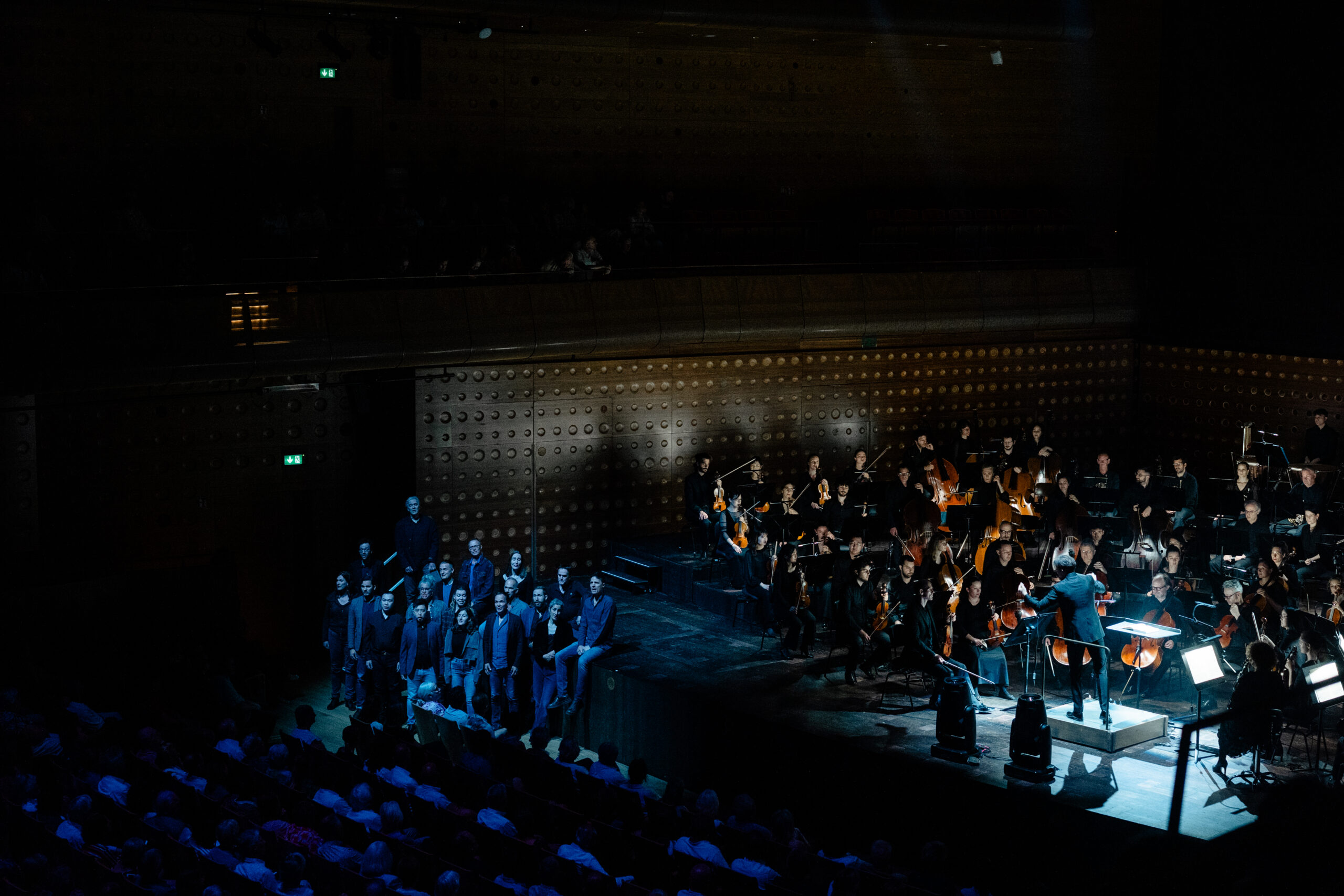 Berlioz wrote his choirs not as decorative ornament but as a dramatic engine. The Octopus Symfonisch Koor proved itself an excellent partner in this: compact in sound, rhythmically alert and with sufficient textual expression to carry the complex and capricious passages convincingly. The Laurens Collegium also functioned seamlessly within the two-choir whole, with Gabriëls giving shape to the contrast between the two families not only musically but also visually. Her mise-en-espace moreover played inventively with the hall space and produced remarkable acoustic effects in the process. A smaller ensemble of singers suddenly began from the middle of the stalls, immediately filled the hall with sound and subsequently took on a role as a crystal-clear commentary voice on and in front of the stage. When the soloists sang from the first balcony, this subtly alluded to Shakespeare's iconic balcony scene. The gradual visibility of the full choir behind a transparent curtain intensified the build-up of tension without diverting attention from the music. The final image, in which both choirs initially stood as hostile camps facing each other only to ultimately form the same line, gave the idea of reconciliation a simple but powerful theatrical translation. They were often small interventions, but those very thoughtful details made the scenic concept particularly convincing.
The soloists formed a homogeneous ensemble. Kai Rüütel-Pajula impressed with a warm, richly nuanced mezzo voice and an effortless expressivity that immediately gave colour to her contribution. Bryan Register convinced with a clear tenor, flexible in phrasing and with sufficient dramatic edge to maintain tension. Nahuel Di Pierro gave as father Laurence with his deep, sonorous bass a quiet authority to the whole and thus provided precisely the necessary human and moral depth within the ensemble.
Between reflection and music
The scenic interventions of Gabriëls were not all equally necessary – the conceptual layer of De Groen's texts sometimes lay somewhat prominently in the foreground – but they rarely disturbed the musical arc of tension and protected the work from a purely museum-like approach. The projected translations of Berlioz' French texts were a clear added value, as they allowed the audience to follow the story and dramaturgical development precisely. The additional reflective texts during the longer orchestral passages were conceptually interesting and aligned with the theme, although they sometimes demanded so much attention that focus was temporarily diverted from the music. That tension between concept and music was occasionally noticeable, but remained subordinate to the strong musical and theatrical impact of the performance.
A work that continues to move
What ultimately made this performance convincing was the ease with which music and drama coincided. Berlioz' score did not sound here as a historical curiosity, but as a living, breathing work full of dangerous beauty. More than a century and a half after its creation, Roméo et Juliette remains a composition that sweeps its audience between ecstasy and downfall. Gabriëls and Meister laid that wound mercilessly bare, without sacrificing the sensual beauty of the music. In this way, this performance became not only the promised feast for eye and ear, but also a confrontational mirror of an era in which reconciliation has again become a difficult concept. The sustained applause spoke for itself. The Antwerp Symphony Orchestra deserves all praise for programming this rarely performed score in its complete form and for choosing to give it new life through a thoughtful mise-en-espace. The result was a performance that made a deep impression both musically and theatrically.