

Festival and Marathon
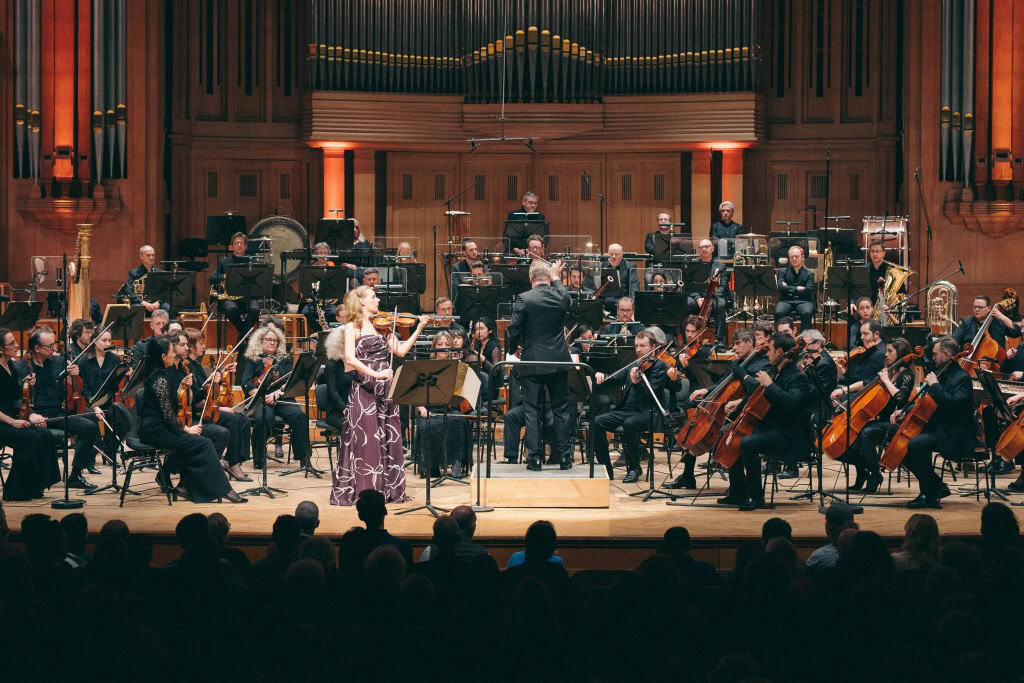
From 6 to 12 February, the Bártok Festival took place at BOZAR. Three concerts in the Henry Le Bœuf hall and on Sunday 8 February continuously from 11 to 3 p.m. a Bártok Marathon in four other halls at BOZAR. Guest was Dutch violinist Simone Lamsma, who performed with the NOB on 6 February the First Rhapsody for violin and orchestra and on 8 February Bártok's Second violin concerto.During the marathon no fewer than 23 smaller ensembles were programmed in four smaller halls at BOZAR. String quartets, wind ensembles, a piano quintet, duos etc. All sorts of arrangements for wind instruments, I listened to the Effel saxophone quartet and how differently a string quartet by Bártok can sound on saxophones. Not only professional musicians, but also students from the Brussels conservatory or amateurs such as the orchestra of the academy of Bornem.
As is well known, Béla Bártok was not only the greatest Hungarian composer of the twentieth century, he was also fascinated by the folk music of the entire Balkans. As a composer and ethnomusicologist, Bártok felt how Hungarian folk music and identity were under pressure. "In succinct and simple folk melodies you often hear how a musical idea can be expressed perfectly", he knew. That treasure of songs he wanted to explore before it was lost. He incorporated Hungarian, Romanian, Transylvanian and many other songs and dances into his oeuvre, also in large orchestral works. This was the focus of this festival. Apart from the Second Violin Concerto, no major works from his later period such as the famous Concerto for orchestra from 1945.
Bártok and Brussels
Béla Bartók (1881-1945) had a special relationship with Brussels. In the thirties he came to Brussels often and met the Antwerp musicologist Denijs Dille here, who would devote his entire life to Bártok's legacy and left his enormous archive to the Royal Library. The bond with Brussels is moreover embodied in the statue of Bártok on the Spanjeplein near Central Station, hidden behind the Ibis hotel. The restrained statue by Hungarian sculptor Imre Varga was donated to the city by Budapest in 1995, fifty years after Bártok's death.
It is through folk music that Bartok can develop his very own musical language, after influences from the French impressionists and Richard Strauss. In the Two Images op. 10 which were on the programme on 8 February, that influence was still clearly audible.
Then came The Miraculous Mandarin on the programme. Originally a pantomime, it is Bártok's first great masterpiece in which raw, harsh orchestral sounds alternate with intimate, dreamy passages. Intended as ballet music, it is today usually played as an orchestral suite. In the Henri Le Bœuf hall, the NOB sounds at its best. Conductor Antony Hermus has a somewhat comical walk, as if he has wandered out of a silent film, but what a grand, wondrous sound he draws from this orchestra.
She-wolf
Dutch violinist Simone Lamsma, born in 1985, does not yet belong to the great stars in the violin world, but is well on her way. I heard her on Radio Klara during the week preceding the Bártok Festival. Sometimes you hear a few tones from a violinist, then you want to hear her live. At eighteen, she won the Oscar Back violin competition in the Netherlands, since then she has been on stage with the greatest orchestras all over the world. Already in the first minutes of Bártok's Second violin concerto it is clear how Lamsma masters Bártok's language. There are even accents, typical accents as they also occur in spoken Hungarian, which she plays even more clearly than others.
Her "Aurore" Stradivarius from 1703 sounds like a silver thread above the orchestra
A soloist sometimes reveals himself through the encore. And in that Lamsma is generous. Sometimes she plays an entire solo sonata by Ysaӱe or Hindemith. After the applause she comes back and gestures to play something else. Bártok, how could it be otherwise. Together with concertmaster Misako Akama, she plays the last of the 44 duos for two violins, a Transylvanian dance, entirely in the spirit of this festival. Simone Lamsma is a brilliant violinist with a great future ahead of her. Remember the name. But don't be mistaken, Lamsma plays like a she-wolf.