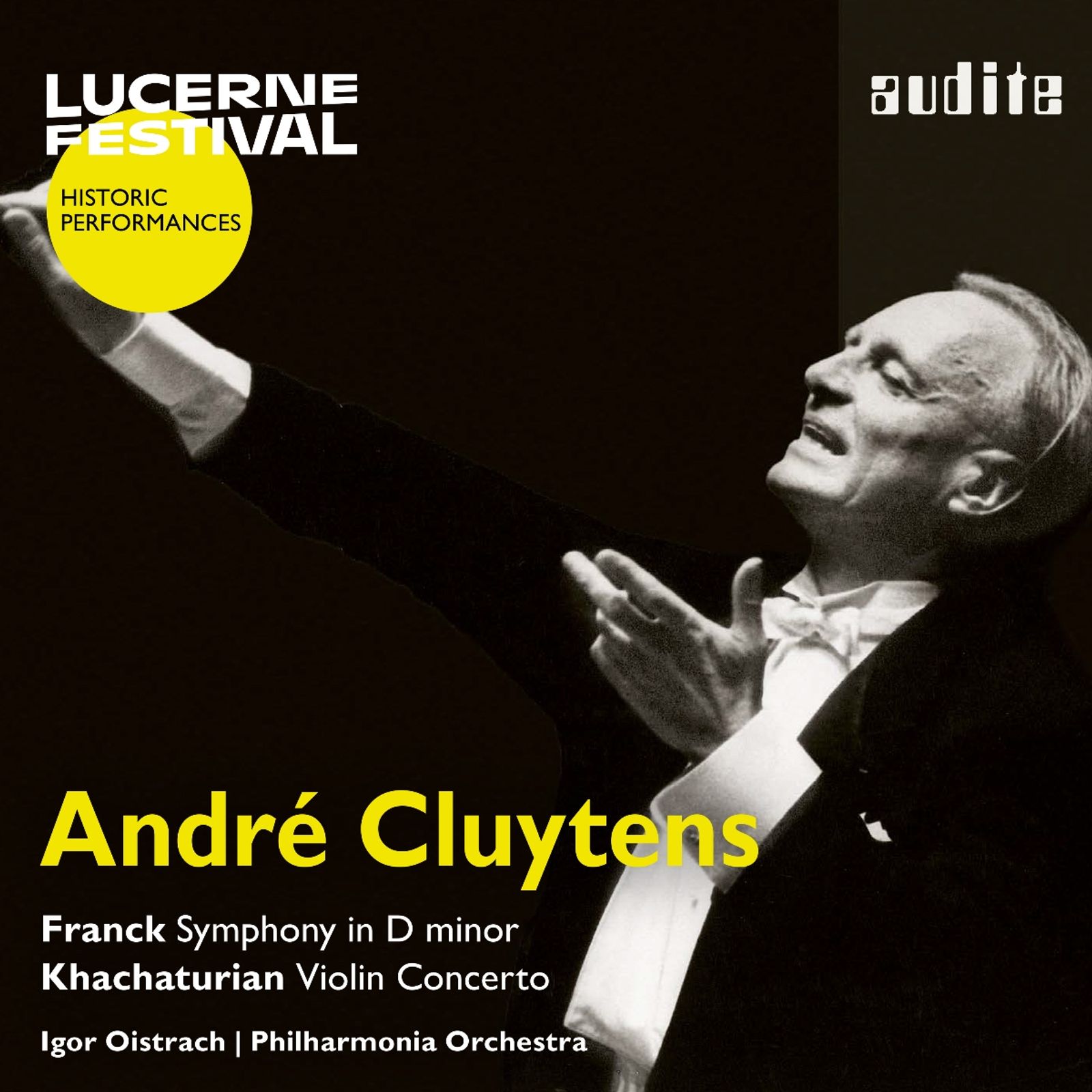
From the very first measures of the Symphony in D minor by César Franck (1822-1890), it becomes clear that André Cluytens does not approach this music as a late Romantic monument, but as living musical architecture. He chooses tempi that never become sluggish, but remain continuously in motion. This allows the symphony to retain its natural arc of tension, without ever sounding rushed. Cluytens deliberately avoids the heavy Romantic sonorous bath in which this work is so often immersed. Nowhere is the tension artificially heightened or reduced; the grand form unfolds organically, as if the music tells itself.
Especially the Allegretto impresses through its light, almost dancelike elegance. The woodwinds receive beautifully calibrated accents here that continuously give color and relief to the melodic lines, while the warm string sound nowhere becomes bogged down in murkiness or exaggerated sentimentality. What perhaps strikes most of all is the exemplary balance between the different orchestral groups. No single section dominates the sound picture; everything serves the score. The music seems to zoom in and out: intimate, chamber music conversations between a few instruments alternate with a broad symphonic panorama in which the Philharmonia Orchestra fully unfolds its rich, transparent sound. It is precisely this combination of liveliness, transparency, and orchestral warmth that makes this performance of Franck so irresistible.
This performance of Franck alone makes the Audite release worthwhile. But as the final chords still resonate, an inevitable question arises: how is it possible that a conductor of this caliber has almost disappeared from our musical memory today? Who really still knows André Cluytens? His name still appears in discographies of Ravel, Berlioz, or Bizet, and connoisseurs know that in the early sixties he recorded one of the most inspiring Beethoven cycles with the Berliner Philharmoniker – even before Herbert von Karajan realized his own cycle. Yet it has become remarkably quiet around a conductor who in his time was effortlessly mentioned alongside Charles Münch, Ernest Ansermet, and the slightly younger Jean Martinon, outside that circle of enthusiasts.
The accompanying essay by Malte Lohmann sheds fascinating light on the man behind this performance. Cluytens, born in 1905 in Antwerp as Augustin Cluytens, grew up in an exceptionally musical family in which conducting, singing, and making music were almost self-evident. Later he took French nationality and developed into one of the most important representatives of the French conducting school. Yet he was far from a specialist in one repertoire. He was the first Frenchman to conduct at Bayreuth and felt equally at home in Wagner as in Ravel, Berlioz, or Tchaikovsky. This versatility is also reflected in the program of the concert evening that Audite brought back to life on this CD.
The circumstances in which this recording was made are also revealing. After a conflict with the resident Festival Orchestra, the young Philharmonia Orchestra was brought to Lucerne in 1954. Cluytens shared the podium there with Furtwängler, Kubelík, Fricsay, and Karajan – a group that illustrates his international reputation better than any biography. That on that same concert evening a young soloist from the Soviet Union also made his appearance makes this historical recording all the more interesting.
For the Violin Concerto by Aram Khachaturian (1903-1978), the barely twenty-three-year-old Igor Oistrakh was engaged, son and pupil of David Oistrakh, who had created the work in Moscow in 1940. In the middle of the Cold War, such a musical encounter between East and West was far from self-evident, but the young Oistrakh proves here that he had long stood on his own feet. His playing combines faultless technique with a remarkably natural musicality. Especially in the warm Andante sostenuto his violin sings with an almost vocal intensity. In the first movement he plays the grand, technically very demanding cadenza of his father David – usually the most performed version, and even more demanding than Khachaturian's own original – with a virtuosity that sounds completely his own, without ever becoming ostentatious. Everything remains completely in service of the musical discourse.
Cluytens' accompaniment is no less impressive. Where Khachaturian's concerto can easily degenerate into colorful exoticism or mere virtuosic spectacle, he chooses a remarkably balanced approach. The Armenian local color remains fully present, but never becomes an end in itself. Behind the brilliant surface, Cluytens continuously lets the symphonic structure speak, so that the concerto not only shines as a soloist's calling card, but also as a tightly constructed orchestral composition. At the same time, he gives the orchestra a remarkable rhythmic resilience, whereby the angular dance rhythms and energetic orchestral tuttis continuously retain their natural impulse. Here too it becomes clear once again how unerringly Cluytens builds tension without exaggerating the music.
This release also convinces sonically. The original tapes have not been preserved and for this release a copy from the archives of the Institut national de l'audiovisuel was used. In practice, you hardly notice this. As is often the case with Audite, there is no attempt here to artificially modernize a historical recording; the restoration respects its age while at the same time allowing surprisingly much detail to be heard. Ludger Böckenhoff lets the historical mono sound breathe naturally, with sufficient air around the orchestra and a solo violin that never loses its presence.
Perhaps that is ultimately the greatest merit of this release. It not only documents an exceptional concert evening, but also restores a musical memory that was slowly threatening to fade. André Cluytens turns out to be no footnote beside Karajan, Münch or Ansermet, but a conductor with a completely distinctive artistic voice: energetic without sounding rushed, transparent without becoming distant, warm without ever falling into romantic excess and always completely in service of the music. His place in music history does not need to be fought for again; it simply needs to be listened to again.