


In 2005 Alena Baeva was a finalist in the Queen Elisabeth Competition in Brussels, where she played Shostakovich's First Violin Concerto. Twenty-one years later she returns with the same work, but as a very different musician. During an interview with Werner De Smet she says: "I have changed enormously as a musician since then. I would say I have become a music-maker, whereas in 2005 I was more of a 'reproducer' of music. Since then I have developed much more conscious ideas about how I play, why I play, and how the pieces I perform relate to time in music."
Of the competition itself, Baeva keeps mainly warm memories: the care, the love, the people she met. But the final itself did not go smoothly at all. Ten minutes before her performance, someone knocked on her dressing room door, the signal to change into her concert dress – a dress with numerous small buttons. When she finally began changing, she was suddenly told she had to go on stage immediately, while she was still struggling with the dress. "I remember that far more vividly than the performance itself," she laughs.
A journey through architecture and emotion
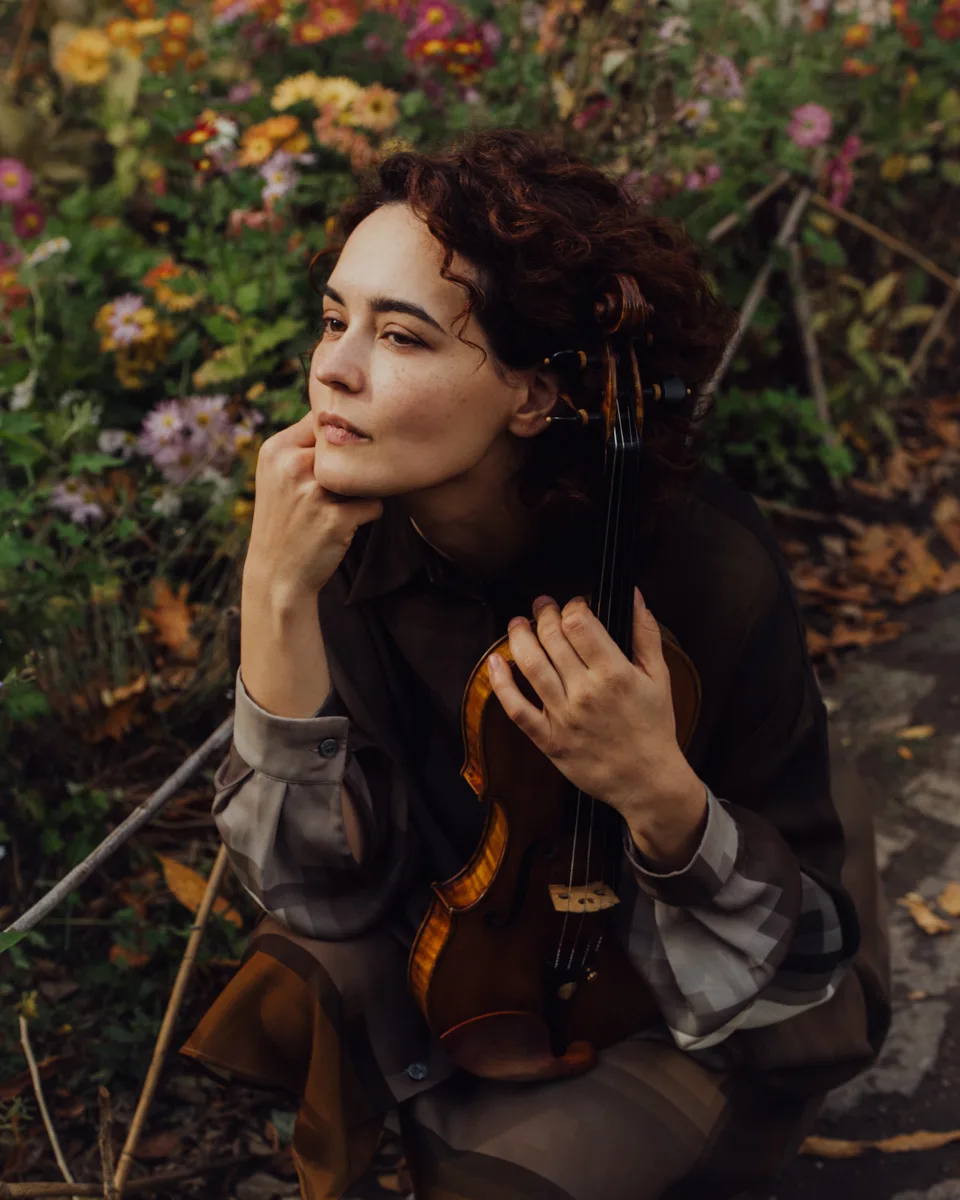 Baeva speaks with great commitment about Shostakovich's concerto. She has played it countless times and calls it "a precious work" with which she has grown up: "No other concerto unfolds in such a remarkable way. Each movement is architecturally built. It takes you on a journey." For her, the Passacaglia forms the emotional heart of the work. It contains an immense cadenza, unique in the violin repertoire: "There is no other cadenza like it, in no other violin concerto. That is Shostakovich's genius. It is one of his best works, and I am simply privileged to experience it again and again." She recently performed the concerto with conductor Kazushi Ono during a tour in Tokyo, and she looks forward to working with him again, now with the Brussels Philharmonic on Saturday 3 October at Flagey.
The First Violin Concerto was written in 1947–48, but because of the political context it could only be performed after Stalin's death. For Baeva, that history is inseparably linked to the music itself: "The language of Shostakovich is the language of his time, a kind of time machine that brings you to another reality – the reality of the era in which he lived." She points to the sarcasm and hidden messages in his music, alongside much joy that, on closer inspection, often turns out to be closer to pain. In his time, according to her, there was great danger and fear: "At any moment your neighbour could be taken from his apartment at night, and nobody knew where he was going." Shostakovich kept everything very close to his heart and tried to protect his many friends: "That is a frightening and tragic reality, very traumatic." Nevertheless, Baeva believes he succeeded not only in perceiving and expressing that reality in music of the highest level, but also in transcending it, because "his musical language carries so much hope and imagination within it. It shows the beauty of life, which is what makes his music so special."
In search of music waiting to be rediscovered
Baeva says she often feels herself falling in love with pieces of music and remains especially curious about new repertoire. There are works she likes to play again and again. She mentions Schumann's Violin Concerto – which she did not know as a child but later discovered, and which she considers one of the most remarkable violin concertos – and Bartók's as great loves. According to her there is an enormous amount of beautiful music, but sometimes a composer simply did not have the luck for a particular work to become well known, or a piece had an unusual history of its creation that kept it invisible for generations. "It is our task to bring those pieces to the audience. Ultimately, time decides," she says, pointing to Szymanowski, whose popularity grew strongly over the past ten years, while fifty years ago he was much less loved: "It really evolves, and it is exciting to be part of that."
Her teachers
Much of what Baeva considers important today as a musician she received from her teachers. From Olga Danilova, her first teacher from the age of five to ten, she received the physical foundation of violin playing, but also the joy of performing and of learning new pieces. Eduard Grach, with whom she studied in Moscow, wanted his students to have something meaningful to say and to let it be heard; he also gave her lessons in stage practice and presence on stage, as well as the practical side of playing with an orchestra. Shlomo Mintz, when she was fifteen, let her discover that you can open a score and see where a phrase is going, without a violin – a revelation that taught her to truly listen and to separate that listening from expectations and prejudices.
Ida Haendel showed her a contagious, childlike love for music. When Baeva asked whether she didn't get bored after playing Tchaikovsky's violin concerto so many times, Haendel looked at her almost offended and said: "This is such an incredibly beautiful piece of music. I am fortunate to be able to play it again and again. It is truly a privilege." Boris Gorlitsky taught her refinement and style in the details. Rostropovich radiated an energy you could feel up to ten metres around him, and taught her not to be afraid of musical goals that seemed unattainable at the time. Violinist Robert Mann impressed upon her: "A beautiful sound is like a beautiful girl without character – there has to be something that bothers you. It can't simply be good or beautiful or nice. It has to be real." Her greatest source of inspiration was Seiji Ozawa: "He was music himself, somehow – such a generous human being and musician, so modest and so full of life. At every moment he carried his love for music with him." From him she learned that there is no right or wrong way to feel music – it is always, always right.
Never routine
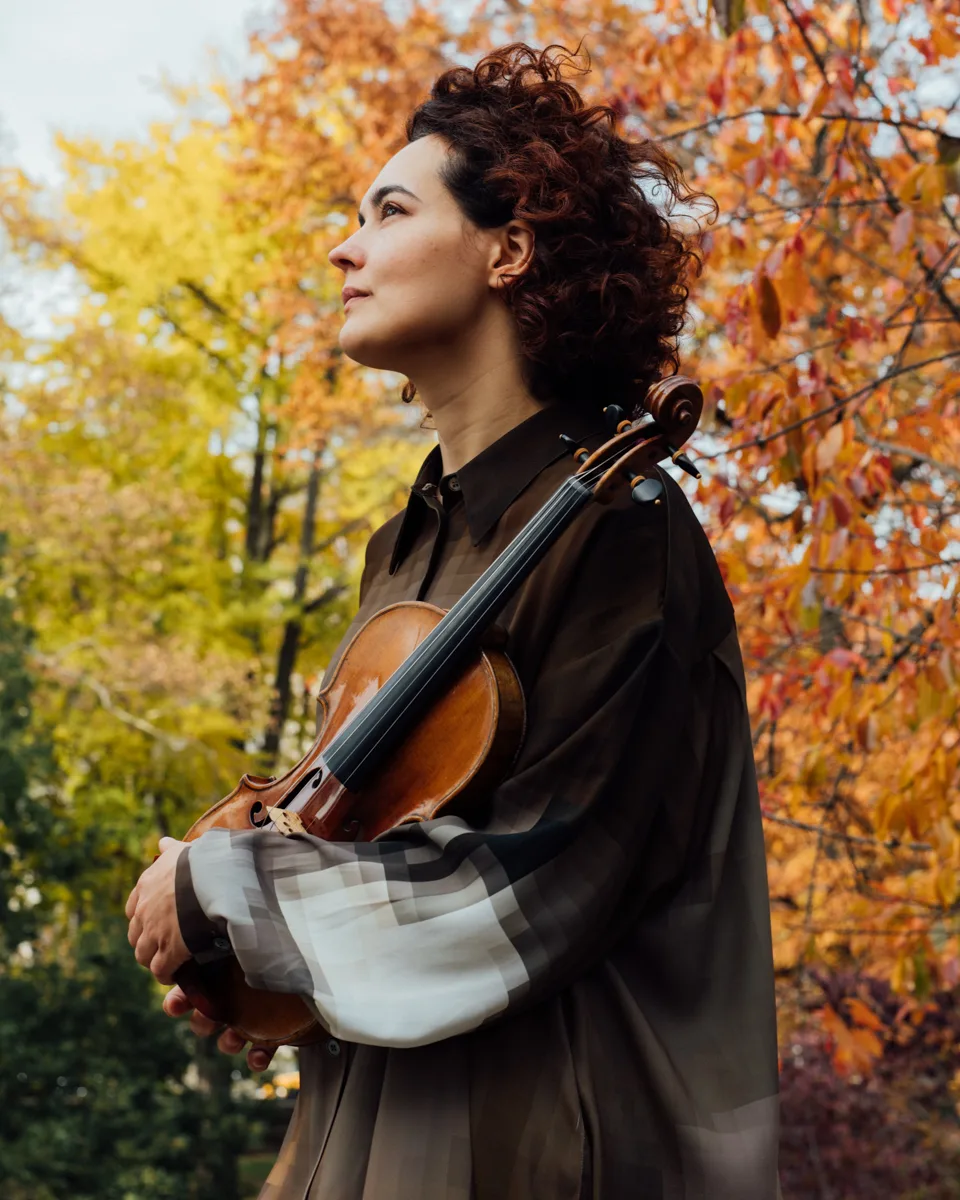 After more than twenty years of concert experience, Baeva has played a large part of the violin repertoire countless times. Yet she consciously tries to avoid routine. She invariably changes her way of working for a concert and wants to deliberately approach things differently, so as not to become accustomed to one particular way of preparing or playing a phrase. As soon as she finds a way to emphasise something, she tries to do it again the next time just slightly differently, "because I think I have to feel it in order for it to be sincere." She deliberately avoids repeating familiar solutions she has already found. While practising, she finds new fingerings and bowing techniques for every concert, and sometimes has difficulty remembering them all: "The danger is not that I get bored – the danger is that I don't remember all the new things I've just discovered."
What makes the difference for Baeva between a good and a truly inspiring collaboration? She is generally open to new ideas and enjoys hearing different approaches. She is most inspired by musicians who create something new, who have knowledge or insights about a piece, a composer, an era or art in general – and even when she does not share a particular vision, she remains curious enough to try it out. But it becomes truly special when she and her musical partners – conductor, orchestra or chamber music partner – share the same musical values: freedom, spontaneity and vulnerability: "My ultimate goal in performances is to truly bring the music to life: breathing and changing. I am over the moon when we can make music together in that spirit."
Music as breathing
Asked whether there was a moment when she felt very strongly why she plays the violin, Baeva replies that playing is for her as natural as breathing: "Sometimes it is a meditation, sometimes a game, sometimes I learn about myself, sometimes it is an athletic challenge." Playing the violin means so many different things to her at once that she does not see it as one specific activity – it is simply part of her life, evolving day after day.
She sums it up aptly herself: "I need art in my life, and this is the art form I know. There are so many ways to enjoy and communicate through music – for me, it is all connected."
Right after the concert
On Friday 9 October – a few days after the concert with the Brussels Philharmonic – Alena Baeva releases her new Alpha Classics album. It features violin concertos by Strauss & Bartók, performed with the Deutsche Kammerphilharmonie Bremen under the direction of Paavo Järvi.
Concert information can be found here: https://www.brusselsphilharmonic.be/nl/concerten/shostakovich-prokofiev-6-03-10-2026