

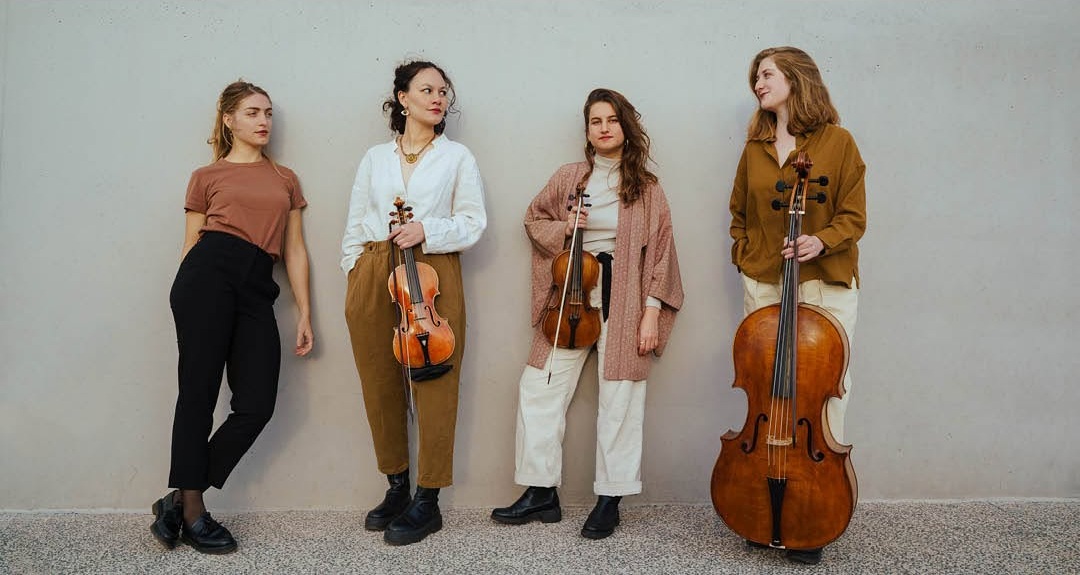
A journey through Europe, that's how The BanXhies' concert was announced. Anyone who closes the program booklet after the performance has indeed made a journey between Venice and Vienna. One full of beautiful music.
The BanXhies is a young ensemble. Since 2022 the four musicians have been playing together and to be honest: that's not very long. I didn't know the ensemble beforehand. But that the quartet is already remarkably close-knit became clear from the first notes. The BanXhies doesn't play as four individual musicians, but as one body. With one breath, one movement and – notably – also literally one physicality. The movements of the four were sometimes almost synchronized during playing. It says something about how intensely these musicians make music together.
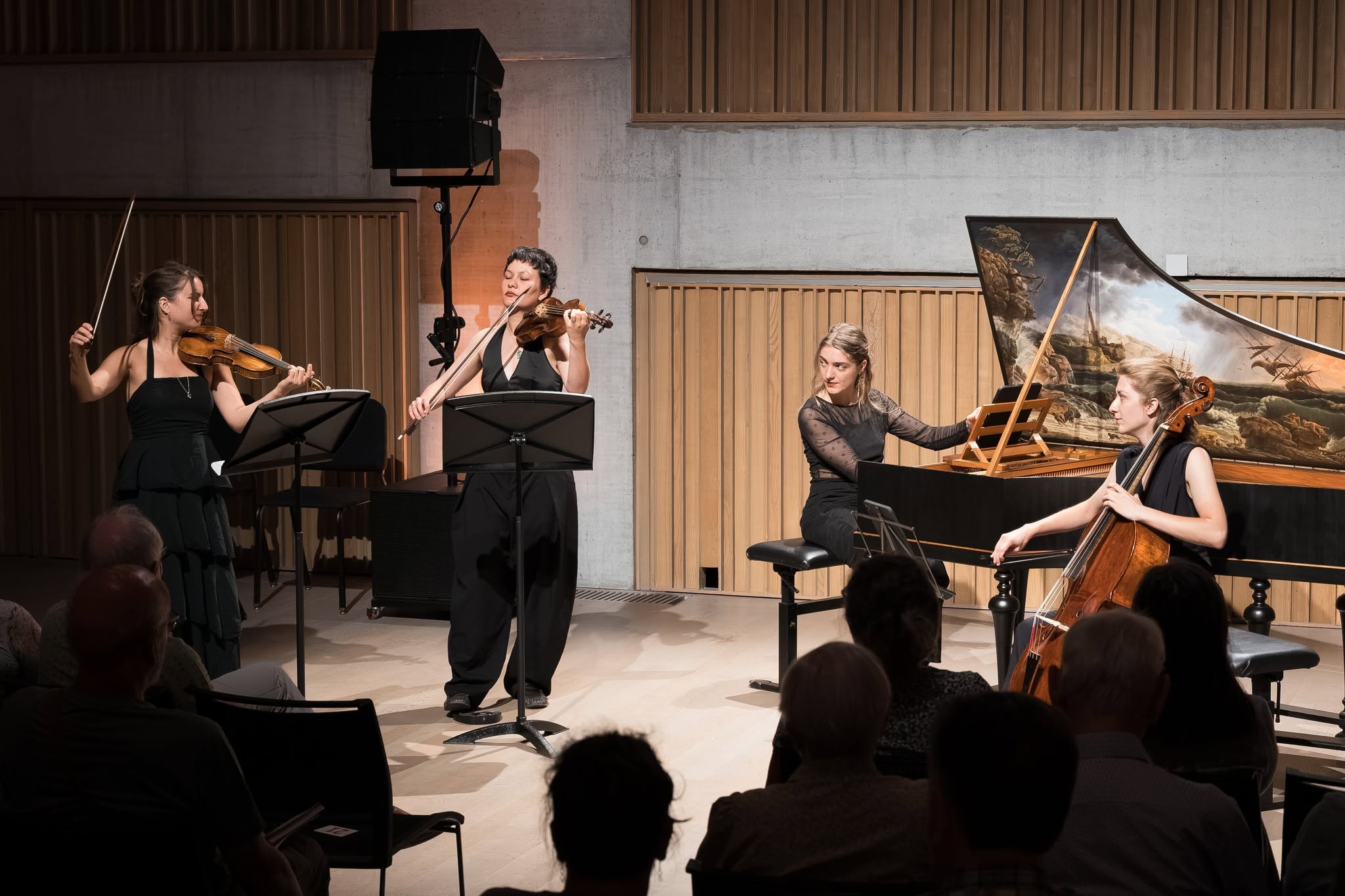 The concert in the special chamber music hall of the Concertgebouw, a kind of square tower that extends significantly upward, with the audience on different levels, was built around Italian trio sonatas. Caldara was the pivot point. He was indeed vice-kapellmeister at the Viennese court under Fux, and thus a beautiful historical and musical line emerged between Italy and Austria.
Around Caldara, a particularly rich program was woven with, among others, Vivaldi, Legrenzi, Bach, Porpora, Froberger, Biber, Muffat and Fux. Different styles, different composers and different musical characters, yet with a clear coherence.
The first notes are always important. The BanXhies came in immediately convincingly with a solo by Yaoré Talibart. There was breath in the playing, with long bows and sustained piano passages. Dissonances were sharply articulated and occasionally the music acquired something playful. Not frivolous, but energetic and with a kind of natural pleasure.
It was especially that combination that stayed with me: sustenance without becoming heavy, precision without sounding academic and playfulness without becoming superficial.
Legrenzi brought a completely different atmosphere than Caldara or Vivaldi. His music sounded particularly dramatic and ended for me almost with an open question mark. It was perhaps the work that stood most apart within the program, but precisely because of that it stayed with me.
Between the different works, harpsichordist Louise Acabo had several moments entirely to herself. What a performance! She combined a light touch with sufficient gravitas and seemed to crawl into her instrument. Especially in the second toccata, it was again noticeable how physical her playing was. She didn't just play on the instrument; she seemed to go into it. That was not only musically exceptional, but also visually.
After the first toccata, the music immediately went back into Caldara. And that is perhaps the strength of this program: the red thread was never really lost, even when the music itself went in a completely different direction.
Porpora for example impressed with extremely quiet passages. Silence is of course easy to achieve: you simply play softer. But here those whispering moments gained enormous depth and sustenance. You heard how little is needed to say much.
This was followed by a cello sonata by Vivaldi, with Suzanne Wolff as the central figure. Her playing was particularly vocal: broad legatos, long phrases and a continuous sense of the larger arc. At the same time it kept sparkling. Perhaps I missed a bit of power in this Vivaldi here and there, although that's perhaps mainly a matter of personal taste. In the fast passages, that impression was in any case completely swept away by a virtuosity that left no doubt.
After the second toccata came Biber, with one of the Rosary Sonatas. That music actually needs hardly any explanation. The entry was immediately powerful. Biber brought a completely different dimension into the program. Where Caldara and Vivaldi had shown other colors and forms, the music here gained an intensity that became almost physical. Especially the virtuosity stood out. For me, this was without doubt one of the highlights of the morning.
Towards the end, Muffat was performed. There was also a nice solo moment here, brought by Roxana Rastegar. Exactly which work and instrumentation I still need to check. The program booklet confused me more than once by the way. For instance at the end it seemed there was more listed with Muffat than was actually played. A detail? Absolutely. But for someone who likes to keep their internal GPS running during a concert and carefully follows the program booklet, something like that is enough to lose your bearings for a moment.
The last two programmed works were Fux and Caldara again.
 With Fux you felt again how intensely these four musicians are connected with each other. Moreover, Fux is not a composer you can simply treat as background music. Here he sounded the way he should: with attention, precision and space for the music to unfold itself. The Adagio, Sarabande and Passacaglia flew by. It was smooth, sustained and particularly pleasant to listen to. Visually it remained enjoyable too: four musicians who not only play well together, but also visibly carry each other along in the music.
And then came the farewell.
A Little Caldara to Say Goodbye.
I want to remember that sentence.
Not only because it is charming, but because it actually summarises the entire concert. Caldara was the common thread throughout the programme and yet this was not a concert that locked itself into one composer, one style or one country.
In the last Allegro that playfulness came to the fore again, but also the sustained quality that had characterised the concert from the beginning. It was as if the performance drew the audience once more towards the instruments.
The grateful audience was able to force an encore through minutes of applause: a piece from an opera by Händel. That was an excellent finale. It stood completely apart from the Italian and German repertoire that preceded it and significantly broadened my view of the ensemble. During the brief introduction to the encore, it also became clear where the name The BanXhies comes from. They are not limited to Italian and German music, but also perform repertoire from England, Irish music and even folk music.
That makes you curious.
Because although The BanXhies is still a young ensemble, it already sounds like a group that knows what they want to tell each other with their music. The interplay is tight, the musical lines are clear and there is room for both refinement and playfulness. Moreover, they seem to have no desire to be confined to one pigeonhole.
The Händel encore was therefore more than just a nice farewell. It was actually an invitation not to really say goodbye.
Rather: see you next time.
And perhaps above all: until the next cd. Because if A Little Caldara to Say Goodbye is a foretaste of what The BanXhies is preparing for cd, then as far as I'm concerned that release can come soon.
MAfestival The BanXhies photos: MAfestival / Laia Van den Borre concert: Friday 7 August 2026, Chamber Music Hall Concertgebouw, Brugge