

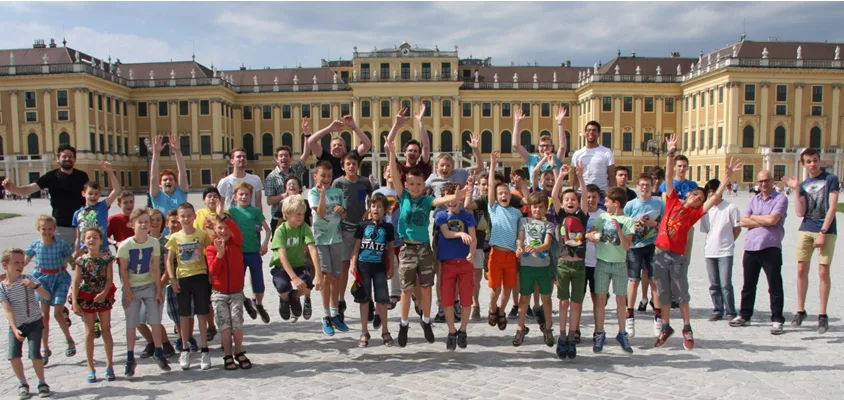
The Flanders Boys Choir is celebrating an impressive milestone this year: the choir turns exactly 95 years old. In all modesty, that makes it the very last remaining genuine boys' choir in Flanders. Conductor Dieter Van Handenhoven, who has led the choir with heart and soul for thirty years, looks back on a rich history, speaks openly about the social challenges, and looks ahead to the upcoming highlight concert with Joseph Haydn's Missa in tempore belli.
A small world with a great tradition
The choir's roots run deep. Speaking with Dieter Van Handenhoven, it quickly becomes clear that the choral world — and that of boys' choirs in particular — is a close-knit, though severely diminished, habitat. Van Handenhoven recalls how, through childhood memories of cathedral choirs and his own past as a singing boy in the 1980s, he entered the choral world. Since 1993 he has been at the helm of what was then still called In Dulci Jubilo, later rebranded as the more internationally sounding Flanders Boys Choir.
That name change was deliberate. "We wanted to make clear what the name stands for: a boys' choir from Flanders, as a recognizable anchor point at home and abroad," Van Handenhoven explains. Today the choir consists of an impressive core of 30 boys and 25 men.
The unique structure: from selection to the proven English system
How does a boys' choir survive 95 years in a time when such traditions have largely disappeared from Flanders? According to the conductor, this is thanks to a well-thought-out structure and an active, low-threshold approach.
Each year the choir visits some twenty primary schools in and around Sint-Niklaas (from all educational networks) to audition boys in their third year. From roughly 200 voices tested, about 80 boys receive an invitation letter. They begin in the second semester with an intensive preparatory course of one hour per week — the Flemish variant of the British probationers.
"The threshold has deliberately been kept very low," Van Handenhoven emphasizes. "There is no membership fee, only a one-time rental price for the uniform. In this way we give every child the chance to join."
Once the boys make the move to the actual choir after half a year, rehearsals take place in two sessions of an hour and a half per week. For this, the choir uses the English system: all boys sing the soprano part. The lower parts (alto, tenor and bass) are filled by the men's voices, including numerous young countertenors and former choristers. This saves an enormous amount of rehearsal time and ensures a strong focus on developing the young boys' voices. The oldest sopranos usually leave — due to voice breaking — around their fourteenth (sometimes sixteenth) year.
From church choir to social anchor
Originally founded as a college choir to sing at Eucharistic celebrations, the bond with the church has faded over the decades. Although the choir can still be heard during the midnight mass or on special request, its mission today is broader.
This, however, also brings new challenges in a city centre like Sint-Niklaas. Van Handenhoven notes that bringing children from different or more diverse cultural backgrounds into contact with classical and religious music is sometimes sensitive for parents. Yet the power of music remains universal: "A child is a child, and when the spark catches, it works." This is proven every day in the choir.
The alarm bell: the last boys' choir of Flanders
That the Flanders Boys Choir is today the very last active boys' choir in Flanders fills the conductor with mixed feelings. "Frankly, I have a very bad feeling about that," he says openly.
He has long advocated for a structural revival: the establishment of similar boys' choirs across the Flemish provinces. The response from the cultural sector and potentially involved organizations has so far been lacking. Yet the need is great. The choral world — from amateur choirs to opera houses and the Flemish Radio Choir — is in desperate need of well-trained Flemish male voices (tenors and basses). The breeding ground that a boys' choir provides is irreplaceable in this regard.
Looking ahead: Haydn's Missa in Tempore Belli
The choir looks forward with great energy to the upcoming concert. Soon the Flanders Boys Choir will present a grand performance project of Joseph Haydn's Missa in tempore belli (the Paukenmesse).
It is a deliberate choice in times of ongoing wars around the world. Haydn wrote the mass when the threat of Napoleon was real; the fear and tension resonate in the music and in the penetrating drum rolls of the timpani. Especially the ending (Dona nobis pacem), which instead of a gentle close sets down a veritable plea for peace, speaks volumes.
The choir performs with old, authentic instruments and a young, promising quartet of soloists: Elles Venhuizen (soprano), Hanna de Bruin (alto), Door Van Bergen (tenor) and Alexander Van Goethem (bass).
In addition to the almost sold-out performance in Sint-Niklaas on Wednesday 11 November (Armistice Day), the choir will also bring this work to Vlissingen (the Netherlands) on Sunday 22 November (4 p.m.), where the concert takes place in the Grote Kerk and tickets are still available.
Looking ahead to the centenary (100 years)
For the coming years, Dieter Van Handenhoven still has a whole host of dreams on his bucket list. He absolutely wants to program Bach's Weihnachtsoratorium once more — a masterpiece that was previously performed successfully in collaboration with the renowned conductor Ton Koopman. He also wants to thoroughly digitize the choir's physical archive and, ideally, work towards an international boys' choir festival by the choir's 100th anniversary. In other words: to be continued!