When the Royal Concertgebouw Orchestra descends on BOZAR, it always brings a substantial dose of history with it, but under Santtu-Matias Rouvali, that tradition received a wonderfully fresh boost on Saturday evening, May 16. Gone was the ceremonial prestige; in its place came movement, breath, and spontaneity. That conductor and orchestra clicked was palpable from the first notes: as if an orchestra that knows its playbook inside and out decided to deal the cards entirely differently this evening. The result? A concert that continually surprised and yet never lost its coherence.
The program aligned perfectly with this. From the nature lyrics of Antonín Dvořák (1841–1904) and the finely constructed modernism of Bohuslav Martinů (1890–1959), to the playful card game of Igor Stravinsky (1882–1971) and the sensual orchestral magic of Maurice Ravel (1875–1937): four works that each demonstrate how music continues to reinvent itself to remain expressive. Thus emerged a clear dramaturgical arc in which nearly a century of musical history paraded past. The journey ran from late Romantic expansion to modernistic fragmentation, without the underlying quest for lyricism ever disappearing.
The First Cards on the Table
With Dvořák's In Nature's Realm the evening opened in a spirit of openness and anticipation. This overture is the first part of the triptych Nature, Life and Love, in which Dvořák did not want to paint concrete images of nature, but sought the deep connection between humanity, nature, and emotion. The work had a beautiful beginning in the double basses, which immediately provided a warm, deep foundation. What often sounds like pure pastoral romanticism took on much more depth and energy under Rouvali. His interpretation kept the music continually in motion: nature as something breathing and changeable, not as a silent backdrop.
The Concertgebouw Orchestra played with beautiful transparency and demonstrated delightful interplay. Particularly the woodwinds gave the work an almost chamber-music refinement, while the strings added warmth without muddying the sound. Rouvali deliberately avoided any heavy sentiment. He emphasized internal tension and compression, as if Dvořák's romanticism was already coming under subtle pressure here. This made the work far more than a mere atmospheric sketch.
Lyricism with Vigorously Shuffled Cards
Martinů's First Cello Concerto formed the heart of the evening. This robust work combines European melancholy with a clear, almost objective and superbly nuanced orchestral language. That duality between emotion and construction determined the entire performance of this challenging piece, which was visibly savored by the audience.
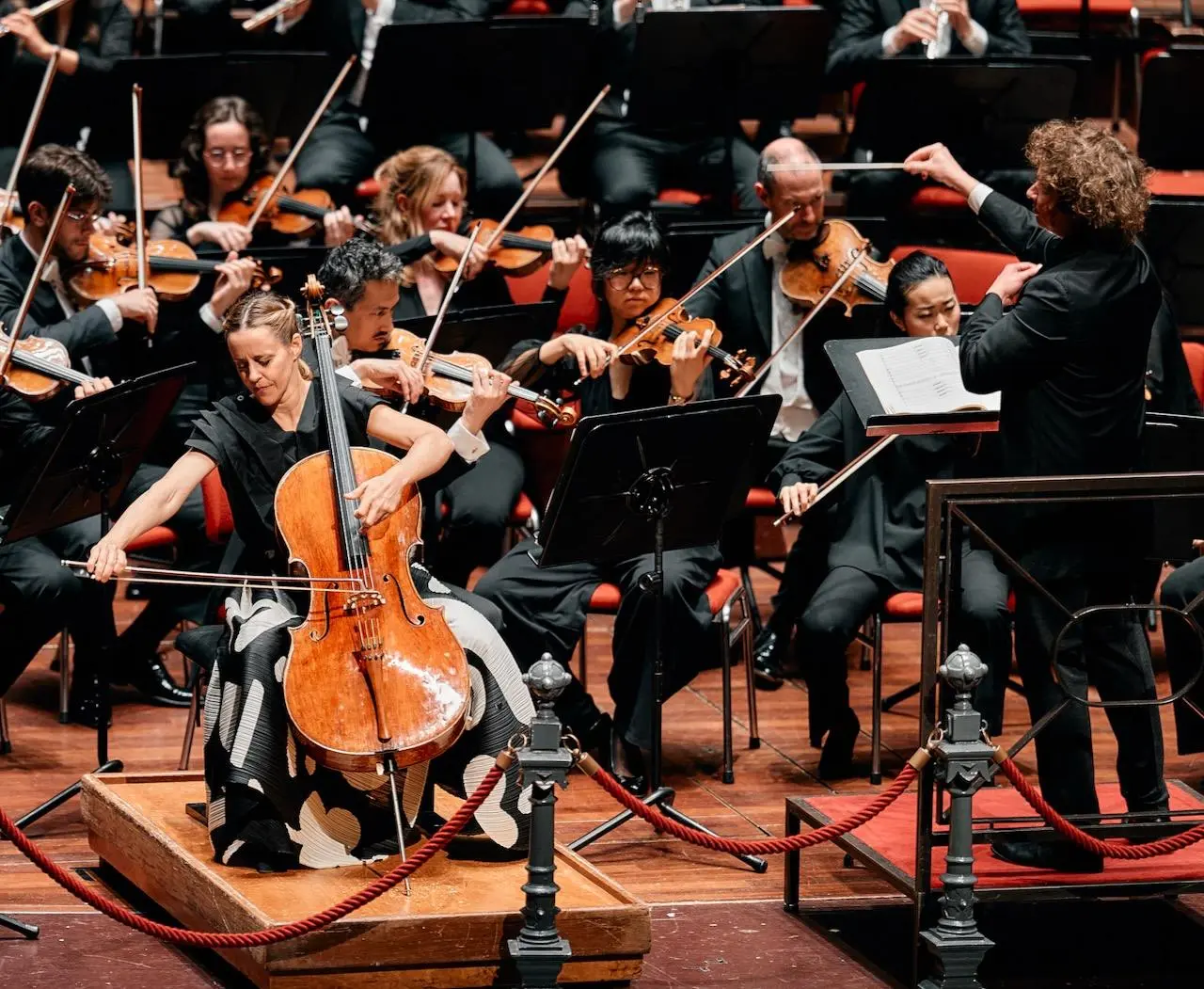
Sol Gabetta found precisely the right balance. Her playing possessed warmth and intensity, but remained always clear in line. Not broad, sweeping romanticism, but a taut, almost architectural construction. What stood out was the driven interplay and the beautiful eye contact between the cellist and the conductor; a dialogue that gave the performance wings. Gabetta made of the concerto not a romantic showpiece, but a lively conversation with the orchestra. In the first movement, the cello sometimes sounded more as commentator than as protagonist. The score contains some famous, abrupt orchestral passages, but the Concertgebouw Orchestra positioned itself with utmost restraint whenever the cello played, giving the solo line all the space it needed.
Especially in the delightfully melancholic second movement, a beautiful tension arose between introspection and movement. Beneath Martinů's melodic lines there always remains an undertone of unrest. Gabetta played this not as a grand emotional climax, but as concentrated inner tension. During a beautiful solo moment, her playing flowed beautifully together with that of the viola player—a musical understanding that was sealed after the piece when Gabetta personally thanked the violist.
In the finale, Martinů shuffles the cards anew. Rhythmic impulses, sharp accents, and abrupt shifts give the final section a nervous agility that Rouvali held tautly together without suppressing spontaneity. Gabetta maintained her clear linear playing here as well: virtuosity was never an end in itself. Through this, the finale gained not only energy but also an underlying restlessness.
The Concertgebouw Orchestra accompanied her with great alertness. Rouvali carefully guarded the structure, allowing Martinů's capricious construction to sound organic. The concerto unfolded right to the end as a subtle play of give and take.
The Game Becomes Explicit
With Card Game makes Stravinsky's metaphor literal. This ballet centered around a poker game is music as strategy, surprise, and irony. Motifs function as playing cards that are deployed, combined, or unexpectedly withdrawn. It's purely about the logic of the game itself, where bluffing and chance form the musical engine. In this neoclassical work from 1936, Stravinsky doesn't tell a story, but rather sets up rules that constantly shift.
Rouvali felt visibly at home here; his approach aligned perfectly with that game principle. He conducted with sharp, rhythmic alertness, while keeping the music simultaneously supple and dancelike. Every musical 'move' had a direct, audible consequence. He chose nervousness over elegance without hesitation: the music was allowed to chafe and unsettle, as long as the internal logic remained intact.
The performance shone through an incredible sense of playfulness. The Royal Concertgebouw Orchestra conveyed the constantly shifting moods you experience at an actual card game. By the end, it truly seemed as if the money was gone and all the chips had been lost. The orchestra dazzled in the speed with which colors alternated and brought about an insane wealth of sound. What was particularly impressive was how lightly the complexity remained sounding. Behind the playful facade, the precision remained astounding, without ever becoming academic.
All Colors at Once
With Ravel's Suite No. 2 from Daphnis and Chloé the absolute highlight of the evening arrived. This masterpiece for Diaghilev's Ballets Russes is one of the most colorful scores of the early twentieth century; a work in which sound becomes almost tangible. After Stravinsky's strategic game, the rules here seem completely dissolved. No more moves or cards, but a total explosion of color and light.
Rouvali opted not for impressionistic vagueness, but for clearly constructed tension. The Daybreak had a delightful buildup and grew layer by layer organically from silence. The flutes delivered beautiful work in coloring the awakening atmosphere. The subsequent pantomime was extremely atmospheric and formed a lovely, flowing transition toward the finale.
When the closing dance burst forth, the Royal Concertgebouw Orchestra combined rhythmic sharpness with pure sonic joy. That was perhaps the greatest quality of this performance: the music retained its refinement while simultaneously radiating an infectious playfulness. Even the grandest tutti passages remained completely transparent, so that the sensual abundance never became massive, but culminated in an overwhelming sonic orgasm.
Thus the evening moved from Stravinsky's strict game rules to Ravel's total surrender: from cards that compete with one another to a moment where all cards lie simultaneously open on the table.
The Winning Hand
What ultimately drove this evening toward the ultimate showdown was the masterful control of Santtu-Matias Rouvali. He connected structure and spontaneity in an admirable manner, allowing Sol Gabetta and the Royal Concertgebouw Orchestra all the space to shine. Nothing sounded monumental or fixed; as if each new musical card didn't close off, but rather was dealt anew.
Precisely because of this, this concert lingers. Not as a series of separate works, but as one continuous game in which the Royal Concertgebouw Orchestra proved that tradition only lives when you dare to rearrange it. Tonight the pot was won, because this concert wasn't about individual highlights, but about the incredible playfulness and the stunningly beautiful orchestral sound that kept everyone on the edge of their seat from beginning to end.