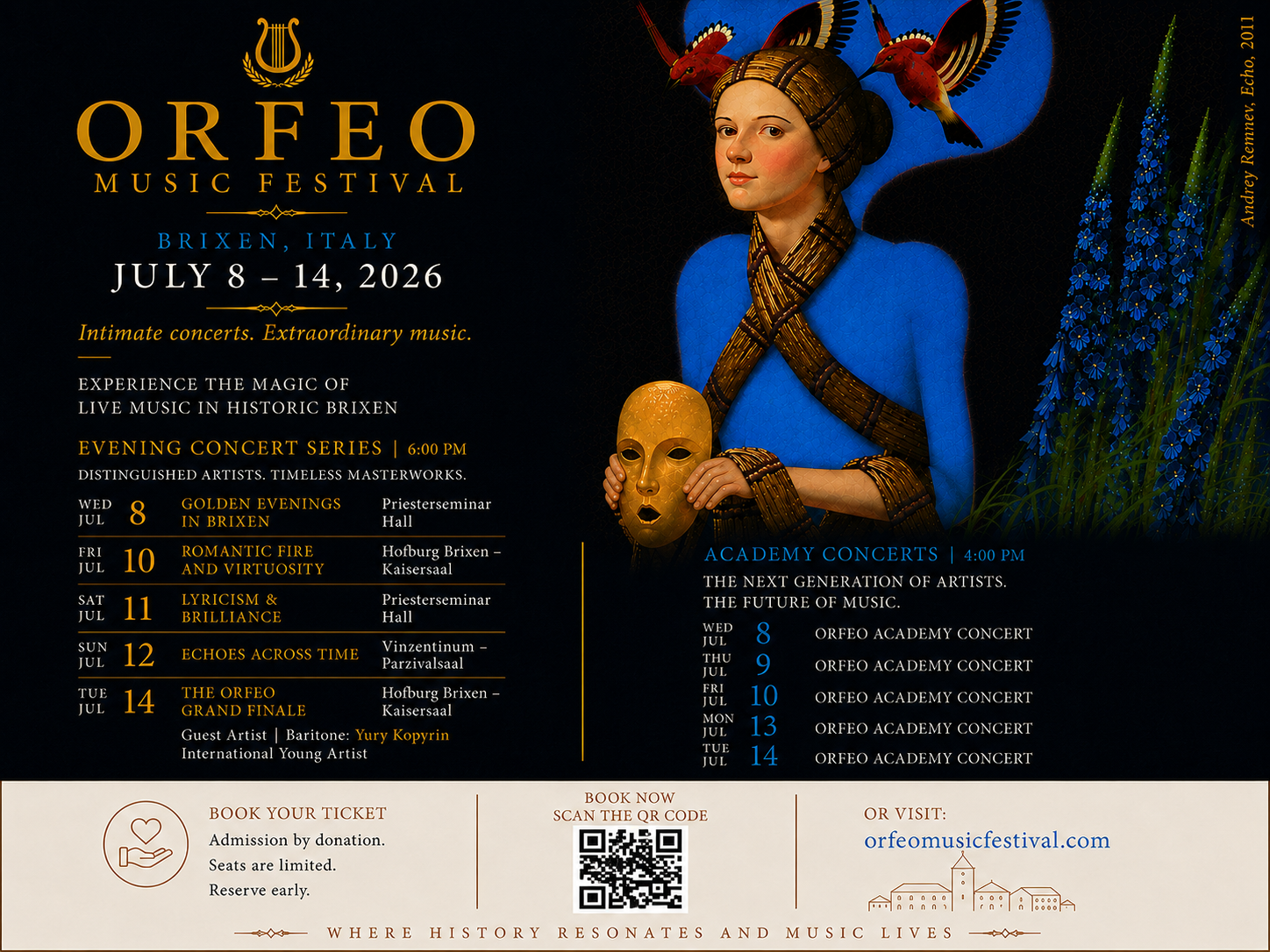
From July 6 to 14, 2026, the internationally renowned Orfeo Music Festival moves to Brixen/Bressanone for the first time, the oldest city in South Tyrol, Italy. After years in Sterzing/Vipiteno, the festival has chosen a new artistic home that seems ideal for a festival centered on depth, chamber music, and human connection.
Because Brixen is not a city that imposes itself immediately. It reveals itself slowly. Behind the stately Baroque façades, the arcades and squares, between the cathedral, cloisters and narrow streets, there reigns an almost unnatural calm. Here the Mediterranean lightness of Italy and the restrained seriousness of the Alpine world meet in a way that has become rare in Europe. The surrounding Dolomites stand out sharply against the sky, while vineyards, mountain meadows and cypress trees lend the landscape an almost picturesque gentleness.
It is an environment that naturally slows you down. Perhaps that is precisely one of the greatest qualities of the Orfeo Music Festival today.
Chamber music as human dialogue
Since its founding in 2003, the Orfeo Music Festival has grown into a fixture in the international summer festival circuit. Yet the festival stands out remarkably from the many academies and masterclass festivals that attract young musicians every summer. While elsewhere competition, visibility and career planning are often prominently present, this festival deliberately chooses a different approach. Under the motto "Making Music Together," the focus here is not on individual profiling, but on making music together itself.
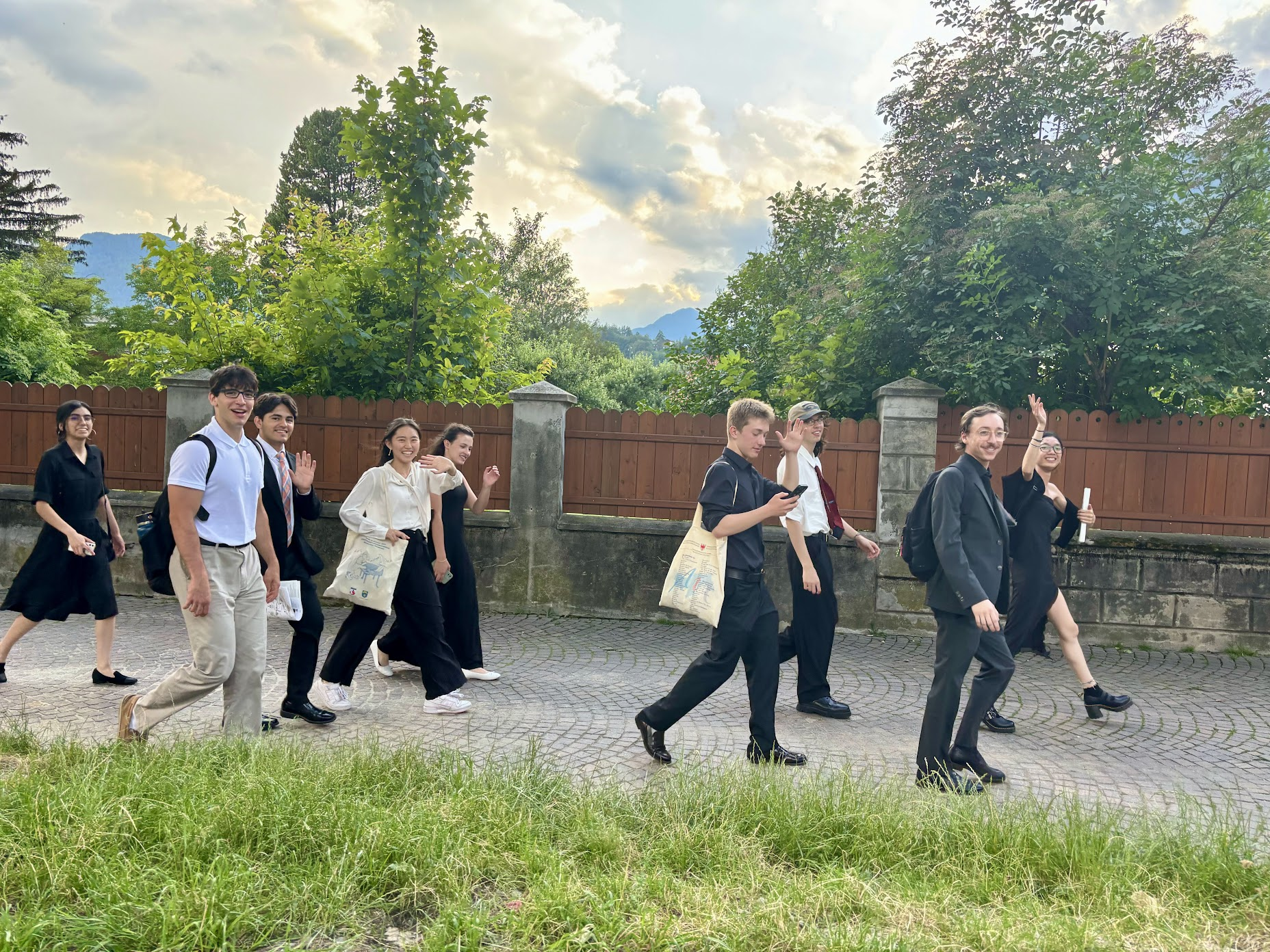 That sounds simple, but in reality it touches the essence of chamber music. For chamber music is perhaps the most human form of making music: listening before playing, responding before impressing. Anyone who has rehearsed a string quartet or truly tried to explore a sonata knows that technique is ultimately just the starting point. It's about breathing, trust, timing, vulnerability—in short: communication.
That's precisely why the festival's slogan—"Home of Chamber Music, Home of Artistic Excellence"—never feels like a marketing line. During the festival, dozens of small musical laboratories are created daily in which young musicians explore repertoire together with renowned artists, take risks and develop interpretations. Intensive rehearsals culminate in concerts that often possess striking spontaneity, precisely because they emerge from a genuine working process. Whoever walks into a rehearsal room during the festival hears both a Schubert quartet tentatively taking shape and a young singer searching for the right dramatic color in an operatic scene.
More than a classical summer academy
The festival's structure reflects that philosophy. In addition to individual lessons, the program includes extensive chamber music trajectories, public masterclasses, orchestra work, operatic scenes, lectures and specialized training for instrumentalists, singers and educators. What stands out is the breadth of the offering. Not only conservatory students, but also young professionals, experienced amateurs and teachers find a place here.
The festival also offers a series of additional modules that are more relevant today than ever: orchestra auditions, entrepreneurship for musicians, pedagogy, mindfulness for performers and even courses in performance psychology. This wide range of activities reveals a festival that views artistry more broadly than mere technical mastery. Mental resilience, concentration and artistic maturity also receive explicit attention here.
This combination of artistic rigor and human warmth perhaps explains why the Orfeo Music Festival has built a remarkable international reputation over the past two decades. Students from Europe, North America and Asia find their way to the festival each year. Among the alumni are several internationally successful names, including violinist Randall Goosby, recipient of the Avery Fisher Career Grant and now one of the most striking young American violinists of his generation.
The list of guest teachers and artists in residence is also impressive. The festival brings together each year performers, educators and researchers who are active at leading conservatories and concert halls worldwide. It is precisely this intergenerational exchange that gives the festival its special dynamism. Young musicians not only receive lessons here, but are immersed for ten days in an artistic community where conversations over meals, walks through the city or spontaneous evening sessions often prove as formative as an official masterclass.
A festival that also leaves room for reflection
The concert program forms the beating heart of the festival. Daily performances take place at various venues in and around Brixen/Bressanone: historic halls and concert venues, including the Hofburg, the Vinzentinum and the Priesterseminar, where the distance between stage and audience remains small. Here the proximity between performer and listener remains tangible not only physically, but also musically.
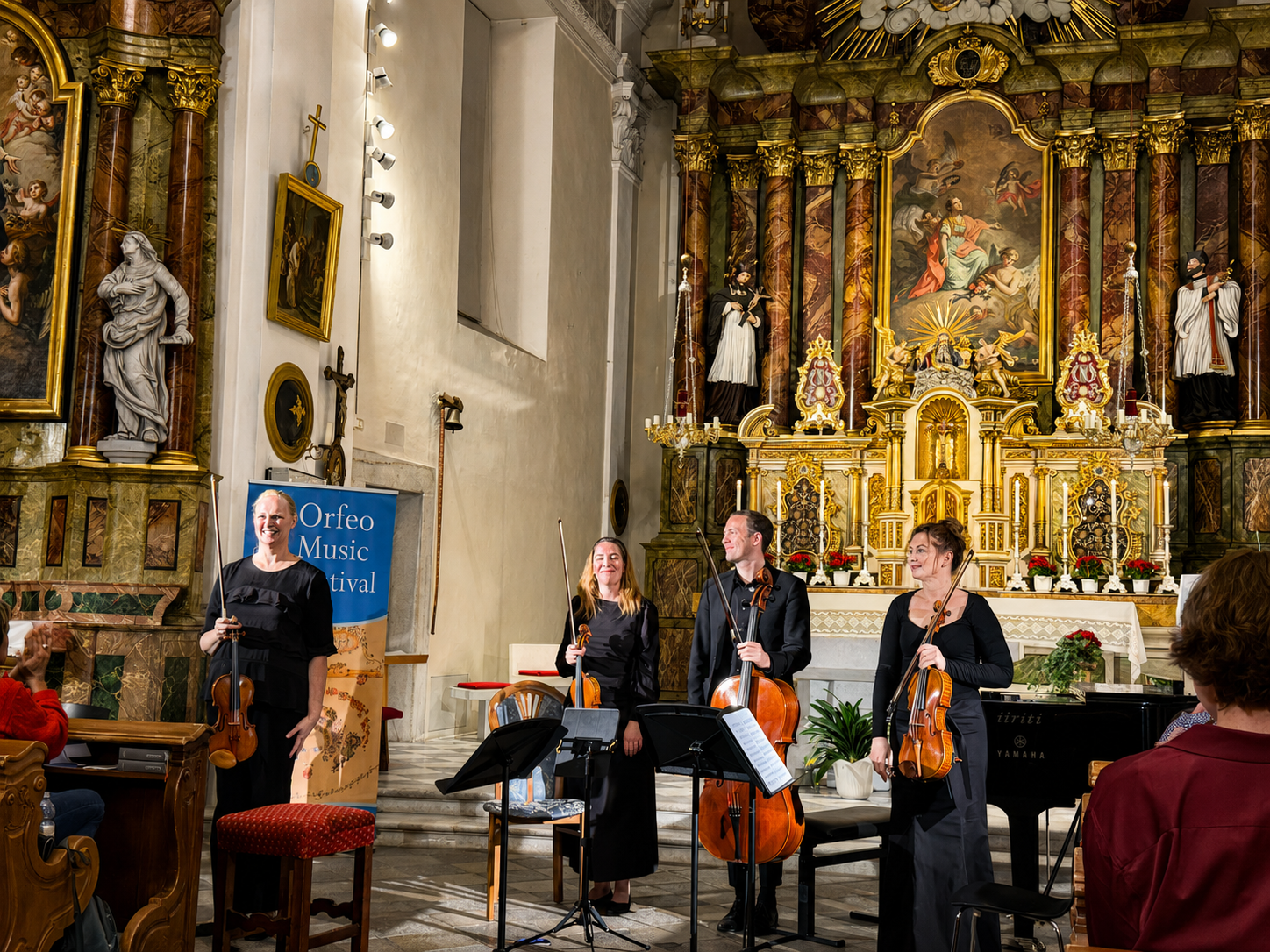 Brixen itself reinforces that feeling in an almost natural way. The city possesses centuries-old musical and cultural traditions. Anyone who walks through the old town square in the evening understands why so many artists are drawn to this region. The soft evening air, the mountain silhouettes in the distance, the bells of Brixen's cathedral, the silence that descends over the squares after sunset—these are circumstances that almost naturally invite concentration.
The Orfeo Music Festival uses that setting not as a backdrop, but as an integral part of the festival experience. In addition to musical activities, the festival organizes excursions and encounters that bring participants into contact with the cultural richness of the region. Notably, the festival does not focus exclusively on performance practice. Reflection and research also receive explicit attention. During the same period, the annual conference of the Institute for Russian Music Studies takes place again, bringing together researchers from around the world on themes such as Prokofiev, Shostakovich and the historical connections between Russian and Italian musical culture.
This combination of practice and intellectual depth gives the festival extra weight. Music is not only played here, but also questioned, investigated and placed in a broader cultural context. In a time when speed and superficiality increasingly shape the cultural landscape, that feels almost refreshing.
Perhaps that is ultimately the true meaning of the Orfeo Music Festival. Not merely a summer academy. Not just a series of concerts in a beautiful Alpine landscape. But a temporary community where music is allowed to emerge anew through attentiveness, silence, and human connection.
If you're staying in Northern Italy in early July and looking for a music festival where artistic excellence goes hand in hand with genuine human depth, you'd be wise to mark Brixen/Bressanone on your calendar.
In the lead-up to the festival, Klassiek Centraal interviews several instructors and subsequently reports on various concerts.