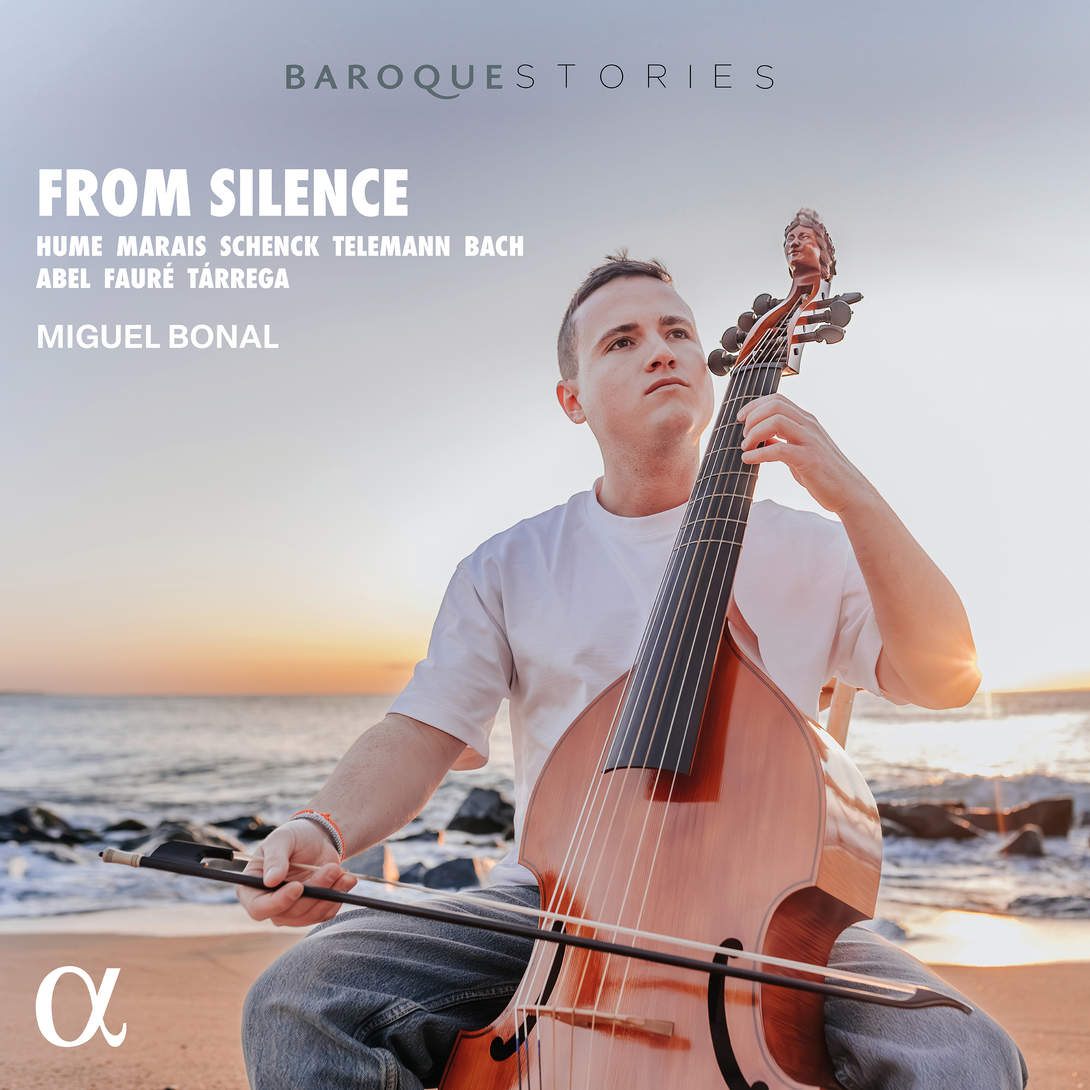
A solo album for viola da gamba without basso continuo or other instruments is a rare occurrence even in the early music world. Anyone who associates the instrument solely with the slow, sultry tones of a bass viol in a French Baroque ensemble is in for a surprise with this debut album by Miguel Bonal. From Silence is not merely an exercise in historical reconstruction, but a thoughtfully curated journey through over three centuries of gamba music – from the raw, soldier-like boldness of Tobias Hume to the dreamy nocturnal atmosphere of Gabriel Fauré.
Bonal, born in 1999 in Zaragoza, studied successively at the Escola Superior de Música de Catalunya with Emmanuel Balssa and earned his master's degree with distinction at the Royal Conservatory The Hague under Mieneke van der Velden. His training, which he supplemented with lessons from Wieland Kuijken and Vittorio Ghielmi, among others, has clearly left its mark: this is not a young virtuoso here to show off his technical prowess, but a musician who knows what he wants to say and how to say it.
Thoughtful dramaturgical structure
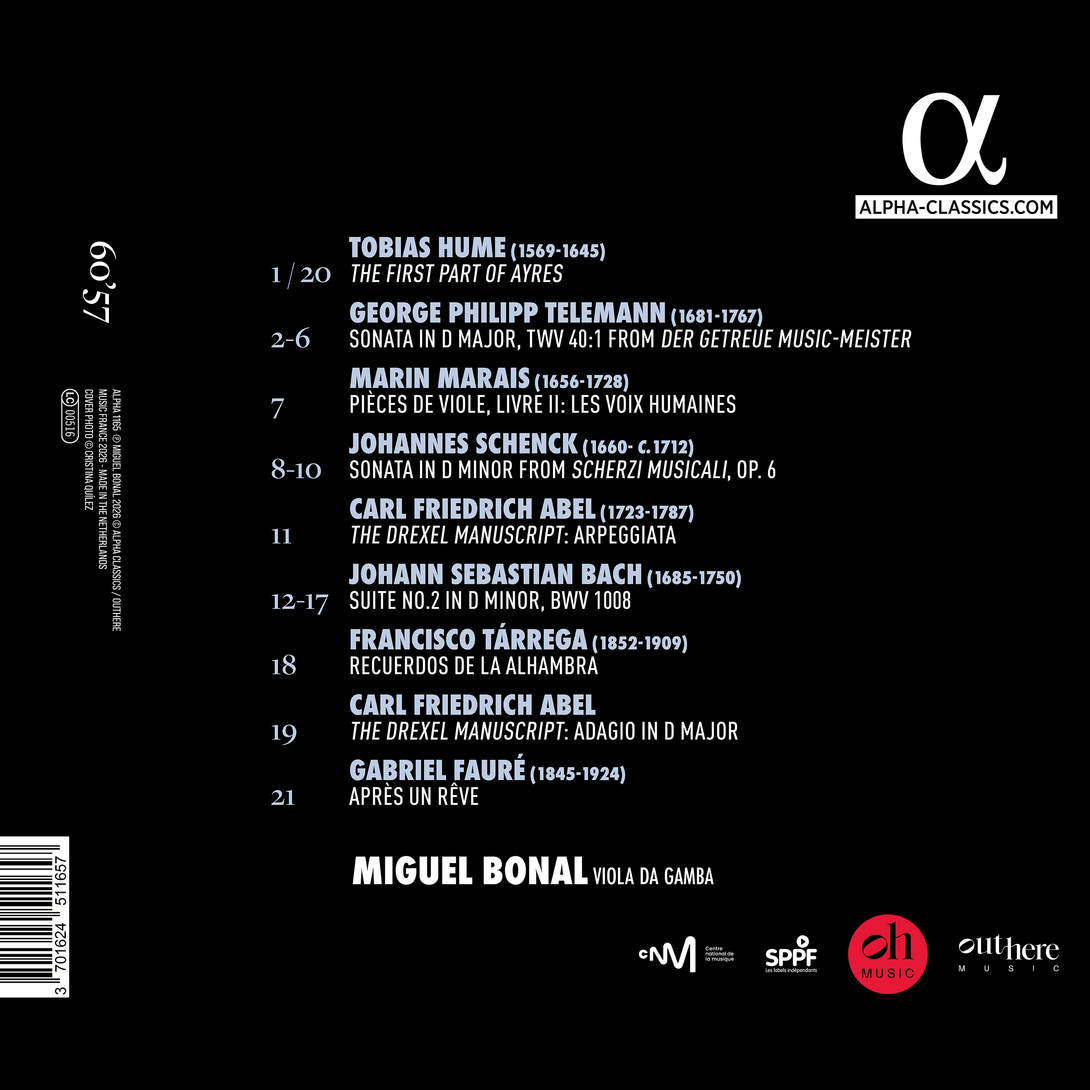
The program selection is initially surprising, but upon closer inspection, coherent. Captain Humes Pavin by Tobias Hume (1569-1645) opens the disc with taut rhythmic force that immediately strips the gamba of its delicate image. Bonal plays this with a direct yet warmly charged energy that makes the composer's almost military-tinged rhetoric tangible. From the opening bars, the tone is set: the instrumental voice cuts sharply through the space, supported by acoustics that let every detail breathe without ever losing clarity.
Next comes the Sonata in D major by Georg Philipp Telemann (1681-1767), in which he, as so often, blends French elegance, Italian cantabile, and German contrapuntal clarity into a single stylistic language. Bonal seizes on precisely that hybrid nature as the starting point for a playful yet controlled interpretation. In the five short movements, a broad palette of character changes unfolds: the Recitative takes on something of spoken rhetoric, while it Briskly culminates in a resilient, almost dance-like flow of energy.
The Human Voices by Marin Marais (1656-1728) undoubtedly forms the emotional heart of the first half. Bonal plays this understated character piece with an effortless mastery that immediately convinces. He doesn't seek effect, but an inner stillness in which the music is allowed to unfold itself. The tension seems not constructed but inherent in the music itself, as if it were already woven into the fabric of sound. It comes and goes without emphasis, but in doing so leaves behind a subtle resonance that continues to work its effect.
The Sonata in D Minor from the Musical Jests by Johannes Schenck (1660-ca. 1712) makes different demands: double stops, downward shifts, and a declamatory expressiveness that is typical of this German-Dutch idiom. Bonal transcends these technical challenges with remarkable ease and never loses sight of the musical line.
Between these larger gestures unfolds a more intimate, galant layer: the lyrical Arpeggiata from the Drexel manuscript of Carl Friedrich Abel (1723-1787), which prepares the transition to the Bach suite with a soft, almost improvisatory character.
Bach as the Crowning Achievement
Suite No. 2 in D Minor, BWV 1008, by Johann Sebastian Bach (1685-1750) is the only work on this program that everyone knows – or thinks they know. That is precisely what makes this choice interesting. For on the viola da gamba, the familiar suddenly sounds different: the instrument has more strings, a different bowing technique, a different physicality. Not an imitation of the cello, but a reinterpretation – and Bonal seizes that space.
His reading avoids any sense of reconstruction and turns the Suite rather into a study in breath and weight than in virtuosity. The Prelude unfolds less as a motoric gesture than as a series of subtly shifting tension fields. The Largo withdraws to an almost immaterial core, in which each note doesn't so much sound as linger in the space. In the Gigue that introspection is not broken but unfolded: the movement remains clear, but carries an undercurrent of restraint that colors the entire work.
Bold Moves Rewarded
The greatest leap in the program comes with the two transcriptions at the end of the recording. Souvenirs of the Alhambra – that famous guitar piece by Francisco Tárrega (1852-1909) whose tremolo technique is its hallmark – is performed by Bonal with a bow, transforming the tremolo into a sustained, flowing bow movement. The effect is surprisingly convincing: the hypnotic atmosphere is preserved, and a sound world emerges that doesn't imitate the guitar version but opens it toward something new.
This is followed by the contemplative Adagio in D Major (also from Abel's Drexel manuscript) and Hume's elegiac Love's Farewell, which after the excursion into Tárrega returns the program to a more hushed, lyrical atmosphere.
The closing with After a Dream by Gabriel Fauré (1845-1924) – accompanied by Jeremy Nastasi on theorbo – is the most lyrical moment of the entire recording. The viola da gamba sings the melodic line with a softness that recalls the finest mezzo-sopranos, and the accompaniment supports without overwhelming. Whoever thought that viola da gamba and late-Romantic song made an unlikely marriage will hear here how naturally this repertoire translates to the gamba.
After the Silence
From Silence is a debut that makes an immediate statement. Miguel Bonal proves himself not only as an instrumentalist with complete command of his craft, but above all as a musician with a clear artistic vision. The album was recorded in the Capella de la Esperanza in Barcelona with acoustics that allow the viola da gamba to shine brilliantly—warm, clear, without the reverb that often dominates baroque recordings. Carlos Bonal Asensio's accompanying text situates the repertoire expertly and avoids the usual hagiography. Alpha Classics has made it a quality production.
In short: an album that doesn't get old on repeated listens, but opens up further with each hearing. Rarely have I heard a viol player of this generation debut with such musical maturity. Miguel Bonal is a name to remember.