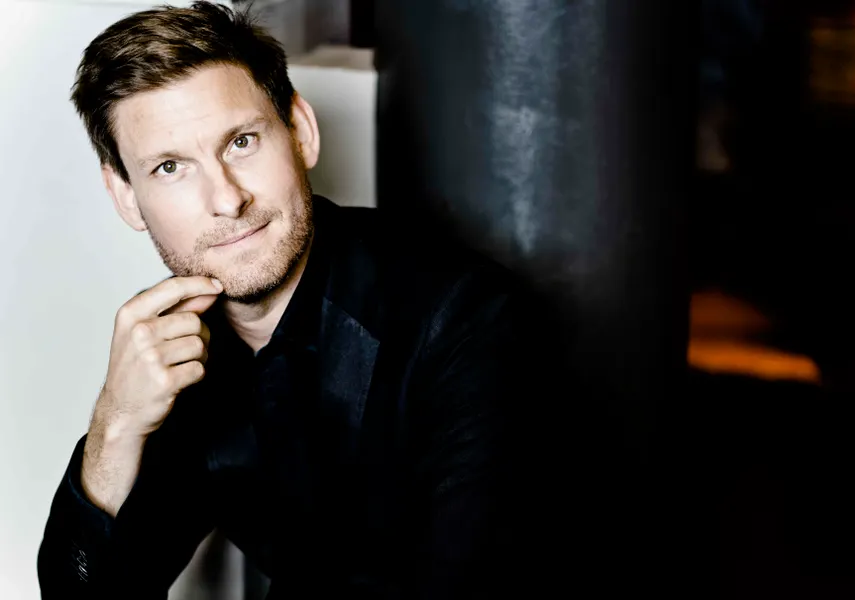
When an evening of Mendelssohn and Schumann appears on the program, you enter familiar yet richly layered territory. In the Queen Elisabeth Hall, the Antwerp Symphony Orchestra demonstrated on Thursday, April 30th, under the baton of honorary conductor Philippe Herreweghe, how clarity and vision can still guide this music. With Kristian Bezuidenhout as soloist, the evening gained a distinctly personal profile.
The overture to Felix Mendelssohn's A Midsummer Night's Dream (1809-1847) received an interpretation that immediately struck the right tone: light, luminous, and naturally flowing. Herreweghe deliberately kept the music lean and buoyant, allowing it to sparkle effortlessly. The strings provided a supple foundation, while the woodwinds moved through the sonic fabric with an almost playful ease. What stood out was how refined and precise the entries sounded, giving the impression of an orchestra that finds itself without effort. The fairy world unfolded in all its lightness and refinement, with an unforced charm that immediately won over the audience.
This tension found a natural continuation in Mendelssohn's Second Piano Concerto – a work that all too often receives stepmother treatment, when in fact its melodic richness possesses such direct charm. Kristian Bezuidenhout chose not the grand gesture, but the intimacy of musical dialogue, positioning himself from the outset as a partner within the whole.
His playing had something disarming about it: light, resilient, and carried by a soft, refined touch that gave the music an almost effortless elegance. In the second movement, where the pianist is given more room to take the lead, this approach became particularly tangible. The solo passages unfolded with natural breathing, like a musical thought that lets itself be followed without emphasis – a moment of stillness, almost timeless in character.
In the faster sections, Bezuidenhout kept the discourse clear and playful without losing sight of the line. Herreweghe, meanwhile, watched over an accompaniment that never became merely supportive: the orchestra enveloped the piano with a warm, transparent sound and allowed the dialogue to develop organically. Thus emerged a performance in which soloist and orchestra found each other as if naturally, flowing in breath and evident in cohesion.
For an encore, Bezuidenhout chose the intimate Duetto from Mendelssohn's Songs Without Words – a choice that could hardly have been more apt. The hall slowly dimmed, light withdrew to the piano alone, and everything that remained of the concert bustle fell silent.
In that silence, Bezuidenhout let the two voices of the piece move around each other like shadows: seeking, touching, releasing again. The playing took on something fragile and yet inevitable, as if the music unfolded and dissolved right before us. The audience held its breath, caught in a moment that resists being pinned down. It was the kind of conclusion that wishes to add nothing, but rather summarizes everything – and at the same time reminds us of how much unobtrusive beauty still lies hidden in Mendelssohn's piano works.
After the intermission, the focus shifted to Robert Schumann's Symphony No. 3 'Rhenish' (1810-1856). Where this work too often sprawls in broad Romantic brushstrokes, Philippe Herreweghe chose an interpretation that from the start remained inwardly tense: not rhetorical gesture for gesture's sake, but a steady search for coherence, breath, and direction.
What particularly struck us was the almost self-evident familiarity between conductor and orchestra. Herreweghe barely needed to shape the music: small, almost invisible gestures sufficed to let the sound breathe, shift, and color. This gave the symphony from its very first entry a natural flow, clear and supple, yet with an undercurrent of tension that continued throughout the entire work.
Within that movement, a remarkable coherence unfolded across all sections. The more lyrical passages were given space and warmth, while the more animated moments remained light and transparent, without losing their direction. Subtle tempo shifts – small accelerations and retardations – were not experienced as interventions, but became part of the natural musical breath.
In the fourth movement, with its hushed evocation of Cologne Cathedral, this approach became almost tangibly concentrated. Herreweghe avoided any hint of monumental emphasis and kept the music rather austere and inward-looking, which actually gave it a deeper intensity than is often achieved in this symphony.
Then the finale opened not as contrast, but as a logical continuation of what preceded it. The built-up tension found its outlet in movement and lightness, the music redirecting its energy outward without losing its inner coherence.
Thus emerged a Schumann that consisted not of loose episodes, but of one continuous breath – sustained by an orchestra and conductor who had clearly found themselves in this score, and allowed it to speak with effortless clarity.
What ultimately characterized this evening was the consistent choice for clarity, balance, and structure, without the Romantic breath ever being lost. Everything served a transparent reading that gave the music room to speak. It did not deliver an overwhelming spectacle, but rather a performance that convinced through its integrity and inner logic. Mendelssohn and Schumann sounded here not as vehicles for emotional excess, but as composers of nuance and precision.
Beyond that, throughout the evening the pronounced joy of music-making of the Antwerp Symphony Orchestra was evident: a palpable commitment to these scores, in which craftsmanship and enthusiasm reinforced each other.
Ultimately, it was not an evening of originality that distinguished itself, but one of consistent choices. Herreweghe and his musicians sought not effect, but meaning; not grandeur for grandeur's sake, but music that in its own clarity came fully into its own – simple, honest, and convincing in every detail.