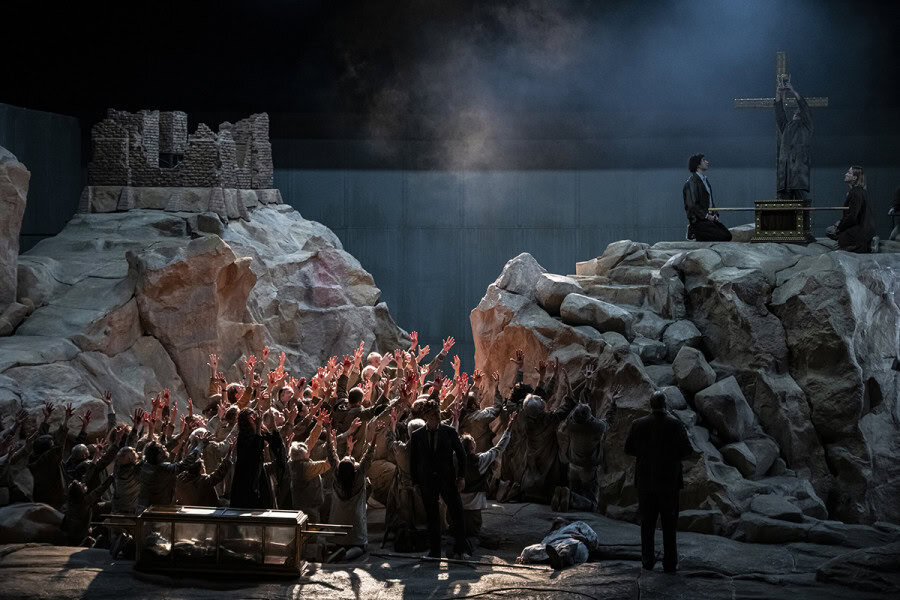
With Richard Wagner's (1813-1883) Bühnenweihjestspiel Parsifal, the Deutsche Oper Berlin presented on Saturday, April 11 not an evening of entertainment, but an almost liturgical ordeal – an experience that laid itself upon the audience with inescapable gravity and seemed to unsettle time itself. Under the musical direction of Tarmo Peltokoski, no linear narrative unfolded, but rather a sonorous space in which duration and meaning slowly merge into one another.
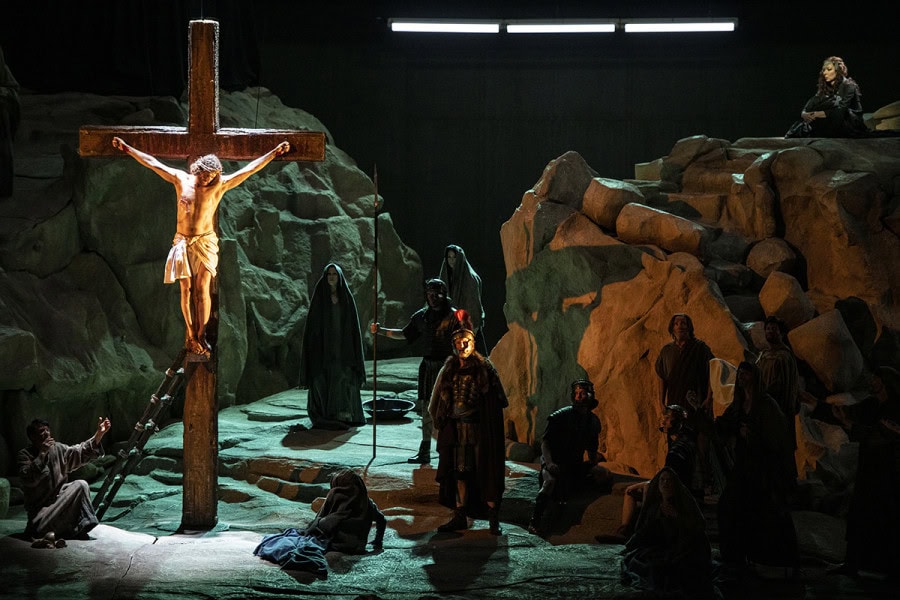 Already in the prelude, the tone was unmistakably set: not an abstract introduction, but a prelude as a foreshadowing of the Passion narrative. In a compelling tableau vivant, a Golgotha image unfolds – suffering, dying, the lance thrust, the blood caught in the chalice, Kundry at the cross – as if myth here finds its origin in a collective memory that cannot be suppressed.
From the first measures, it became clear that Peltokoski kept his distance from the heavy, dragging Wagner idiom that so often reduces this work to inertia. His reading possessed a remarkable breathing quality: phrases opened themselves, arcs of tension grew with a naturalness that seemed organic rather than constructed. The orchestral sound achieved a rare transparency, giving Wagner's often clogged layers an unexpected clarity – as if the work were articulating itself anew. Especially in the great transformation scenes, Peltokoski builds tension without falling into stagnation, allowing the long dramatic arcs to retain their direction.
A World in Decay
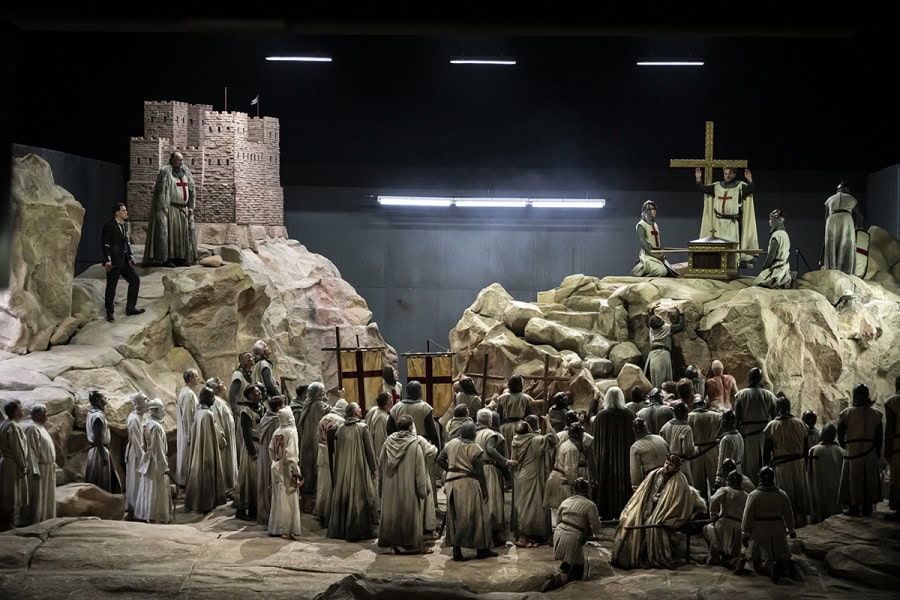 The first act is set in a desolate wasteland, with the Grail castle in the distance as an unreachable promise. Two hills serve as dramatic anchor points in which fragments of the Grail story and the suffering of Amfortas, caused by Klingsor, are depicted in tableaux vivants. Director Philipp Stölzl chooses a visual language rooted in the iconography of the Crusades: knights in medieval attire, trapped in a worldview that has long since outlived its usefulness. Against that backdrop, Parsifal (Attilio Glaser) appears in a contemporary suit: an outsider, visible and unmistakable.
When the knights gather around the Grail, Stölzl shows not an elevated brotherhood, but a community in decay: outcasts, the sick, men who mortify themselves – the bitter legacy of an exhausted order. What follows is as disturbing as it is telling. After the confrontation with the Grail, devotion turns into ecstasy, ecstasy into madness. Like figures escaped from the universe of Hieronymus Bosch, they reach for their weapons and go to war – an image that remains chillingly close to both history and the present. Religion, this reading suggests, proves helpless when deployed for destructive purposes. Not every scenic intervention maintains the same dramaturgical conviction, but the consistency of the reading remains intriguing.
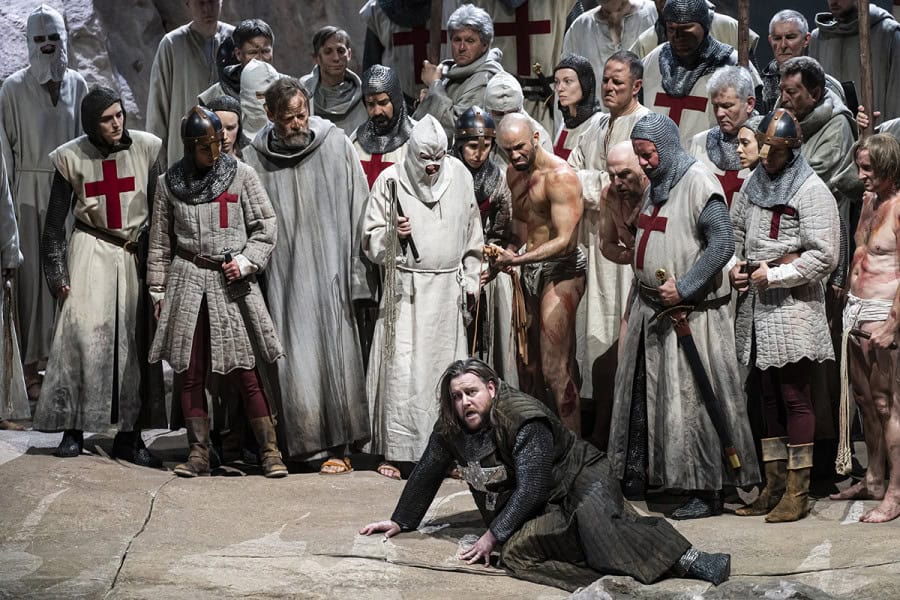 Vocally, the act rests on an exceptionally solid foundation. Albert Pesendorfer carries the dramatic weight as Gurnemanz with a deeply felt, warm bass that effortlessly spans the long narrative lines, with "Titurel, der fromme Held" unfolding especially as an inner monologue in which memory and time converge. Thomas Lehman gives Amfortas a gripping physicality, while Tobias Kehrer as Titurel sounds remarkably fresh and resonant for the old man he must portray. Glaser convinces as the "pure fool" without knowledge – a Parsifal who credibly grows from ignorance.
Seduction and Unmasking
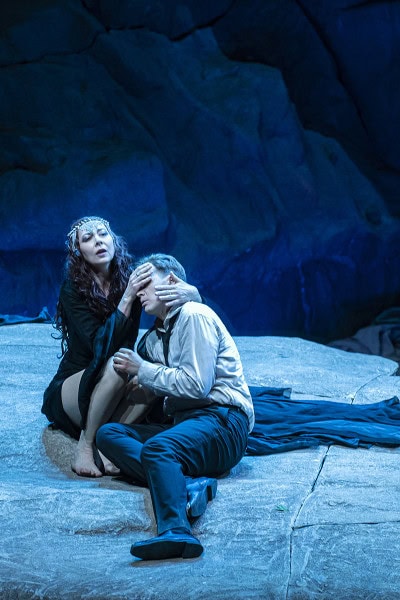
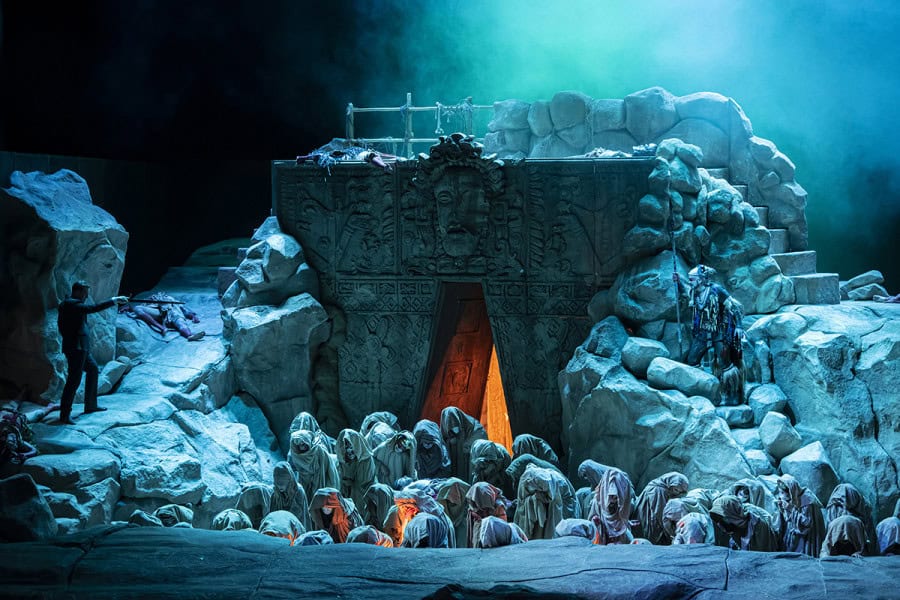 The second act opens in an exotic-seeming temple space, where a blood sacrifice sets the tone – an image evoking associations with adventure aesthetics à la Indiana Jones, but here takes on a sinister charge. At the command of Klingsor – sharply drawn by Lawson Anderson – Kundry appears. Notably, this world has nothing to do with a traditional "magic garden": the women remain veiled, restrained, as if sensuality is suppressed here. Only when Parsifal makes his way inside do the veils fall and color reveal itself – a visual moment of liberation all the more powerful for the preceding austerity. Orchestra and flower maidens' chorus shine with a sensory richness that gives the scene an almost intoxicating quality. The confrontation between Parsifal and Kundry forms the emotional heart of the act. Irene Roberts makes Kundry a layered figure in which seduction and despair merge seamlessly. Her experience resonates in every phrase, with the haunting climax "Ich sah das Kind," which sounds not as mere confession but as a feverish memory beyond control, and the subsequent "Grausamer! Fühlst du im Herzen," in which seduction and despair converge to an almost unbearable intensity. The kiss – which seduces Parsifal not but rather brings him to insight – becomes here a turning point of rare intensity. That Glaser has only recently added this role to his repertoire is scarcely believable: his portrayal possesses a naturalness rarely heard so early in a career, with a poignant moment in "Amfortas! Die Wunde!" that sounds more disenchanted than heroic.A Future Without Redemption
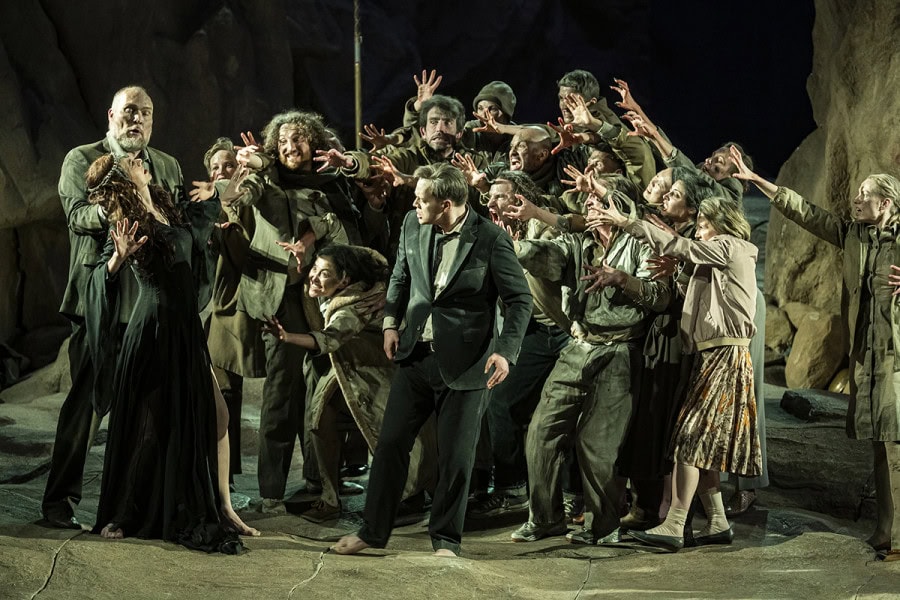
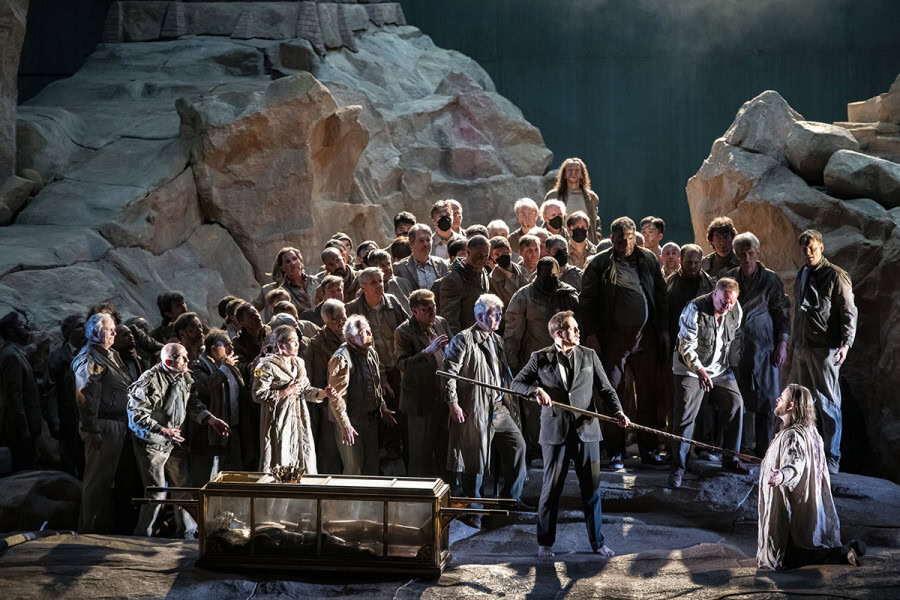
 The third act returns to the wasteland, but this world is unrecognizable. The Grail castle lies in ruins, the landscape has become a toxic emptiness, shrouded by a threatening green haze. We are no longer in mythic time, but in a distant, exhausted future. The remaining knights wear contemporary, soiled clothing – remnants of a civilization that has hollowed itself out.
When Parsifal appears on Good Friday, Gurnemanz unfolds – once again with impressive eloquence – the history of this decay, crowned by a hushed intensity in "O Gnade! Höchstes Heil!," in which all rhetoric gives way to contemplation. Strangely, Parsifal is crowned not by him, but by the crowd itself: power shifts from ritual to the masses. His first act – a collective baptism – quickly degenerates into a new frenzy, a repetition of the same destructive pattern from the first act. During the Good Friday magic, this ambiguity returns painfully when Kundry is baptized by force: redemption as an act of violence.
In the final scene, the Grail knights force Amfortas – after Titurel's death – to unveil the Grail. His refusal, intensely and movingly sung by Lehman, culminates in a plea for death. When Parsifal appears ("Nur eine Waffe taugt"), a moment of insight seems to announce itself, but Stölzl undermines any expectation of catharsis. The spear becomes an instrument of death, not healing. Parsifal is crowned, the Grail unveiled – but what follows is no enlightenment. Remarkable is how the musical spirituality does not always coincide with the scenic disenchantment, creating a tension that lends the interpretation a lasting ambiguity.
 The long-drawn-out final passage, realized musically without parallel, leaves behind a world shrouded in darkness. There is a new leader, but no new order – only the continuation of a cycle in which religion and power continue to feed each other. With that, this Parsifal becomes not an answer, but a question: what remains of redemption in a world that has anchored its foundations in fanaticism?
That makes this production unmistakably topical. Where Wagner, after his Götterdämmerung, still sought a perspective for humanity, this reading offers no comfort, but reflection. Not everyone will find themselves in this interpretation – the division in the hall was palpable – but its intriguing power is difficult to deny.
 The drawn-out final passage, realized with musical brilliance, leaves behind a world shrouded in darkness. There is a new leader, but no new order—only the continuation of a cycle in which religion and power continue to feed each other. With this, this Parsifal becomes not an answer, but a question: what remains of redemption in a world that has anchored its foundations in fanaticism?
This makes the production unmistakably timely. Where Wagner, after his Götterdämmerung, still sought a perspective for humanity, this interpretation offers no comfort, but reflection. Not everyone will find themselves in this interpretation—the division in the audience was palpable—but its intriguing power is hard to deny.
Redemption without answers
Musically, the evening stood like a cathedral: Tarmo Peltokoski confirms himself as a Wagner conductor par excellence, the orchestra played with rare intensity and precision, the choir excelled in diction and commitment. Among the soloists, Roberts' masterful Kundry and Pesendorfer's compelling Gurnemanz particularly linger in the mind – alongside genuine admiration for Glaser, who brings this Parsifal with an effortless authority that far exceeds his brief experience in the role.
Irene Roberts (Kundry), Attilio Glaser (Parsifal), Albert Pesendorfer (Gurnemanz), Thomas Lehman (Amfortas), Tobias Kehrer (Titurel) and Lawson Anderson (Klingsor)