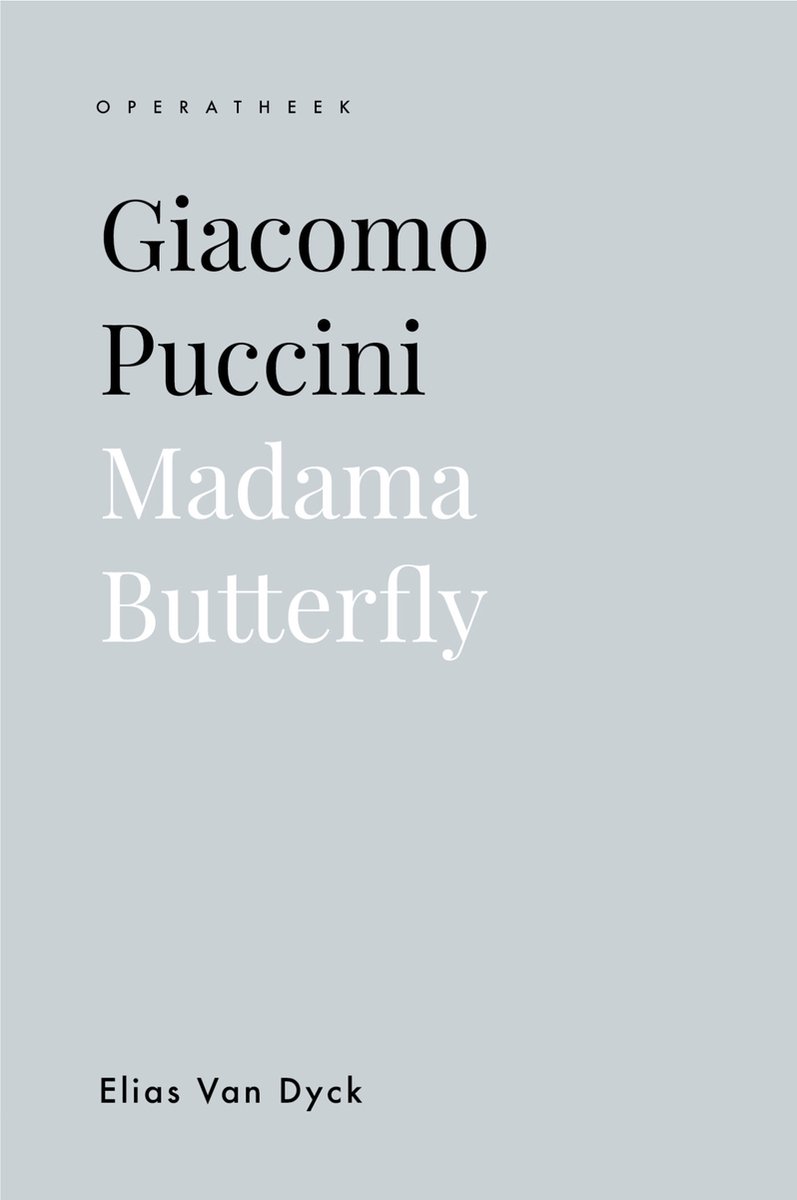
In the Opera Library series, a collaborative effort between Opera Ballet Vlaanderen and Universitaire Pers Leuven, a sixth edition has been released. It is dedicated to Giacomo Puccini, as Puccini died one hundred years ago in Brussels on November 29, 1924. The publication coincides with Opera Ballet Vlaanderen's production of one of his most popular operas Madama Butterfly.
The title of the introductory chapter immediately grabs attention: "An Immoral Piece"! The tragedy of the naive young geisha, seduced by an unscrupulous American lieutenant, indeed has an immoral ending that has much to do with the "discourse on race, identity, and victimhood". Aspects that are explored further with great interest in the booklet.
The first part of the listening guide: "The Birth of a Myth" is an extremely thorough and penetrating analysis of both the historical facts that determine the place and period in which the story unfolds, and the literary approach by Western authors to that very exotic world of the East. Sailors are unmasked as disreputable sexual exploiters of young Japanese women, assisted by matchmakers. Van Dyck discusses the literary sources on which Puccini's librettists based themselves and the fashion of interest in exoticism, fueled by the 1889 Paris World's Fair. Madame Chrysanthème, the novel by Pierre Loti (pseudonym of Lieutenant Julien Viaud), is but one source of inspiration. Van Dyck cites other authors and of course the play by David Belasco Butterfly, which Puccini saw in London when he was there for the premiere of Tosca in that city. From all sources of inspiration, Van Dyck precisely clarifies how the figure of Cio Cio San is at the epicenter of her own drama. A compelling analysis with several unexpected dimensions.
In the second chapter, Italian Opera at the Fin de Siècle, the author delves deeper into the evolution of stylistic characteristics of the opera genre, which breaks away from strict formal structure in favor of dramatic content. He points to the influence of French and German opera, with composers such as Massenet and Wagner. The historical context is also explained. Madama Butterfly receives a critical reception on February 17, 1904. Puccini makes repeated revisions to the opera until the final performance in Paris in 1907 results in a virtually definitive version, one that also provides the published score that is universally performed.
A third chapter delves deeper into "Butterfly's Music" and discusses how Puccini creates a unique musical profile meant to evoke the Far East. Exotic stylistic elements are meant to contrast with the familiar "Western sound." The diversity of Puccini's orchestral color is analyzed in detail, passage by passage throughout each act, complete with musical examples. What's particularly interesting is how the emotional and social impact of each scene is consistently revealed. One of the finest examples of this is undoubtedly Butterfly's great aria Un bel dì vedremo.
This detailed third chapter best fulfills the mission of the "Opera Library" series: it is a perfect guide to understanding the opera in its deepest essence, both its context and the characters' reactions, and above all the tragedy of the protagonist.
The author has conducted an in-depth study of the composer and his era. The references to bibliography and musicological sources demonstrate this. In my opinion, this edition thus appeals not only to the casual opera-goer looking for a simple guide to be better prepared, but also serves the interested reader with some prior knowledge of both Puccini and early twentieth-century opera.