

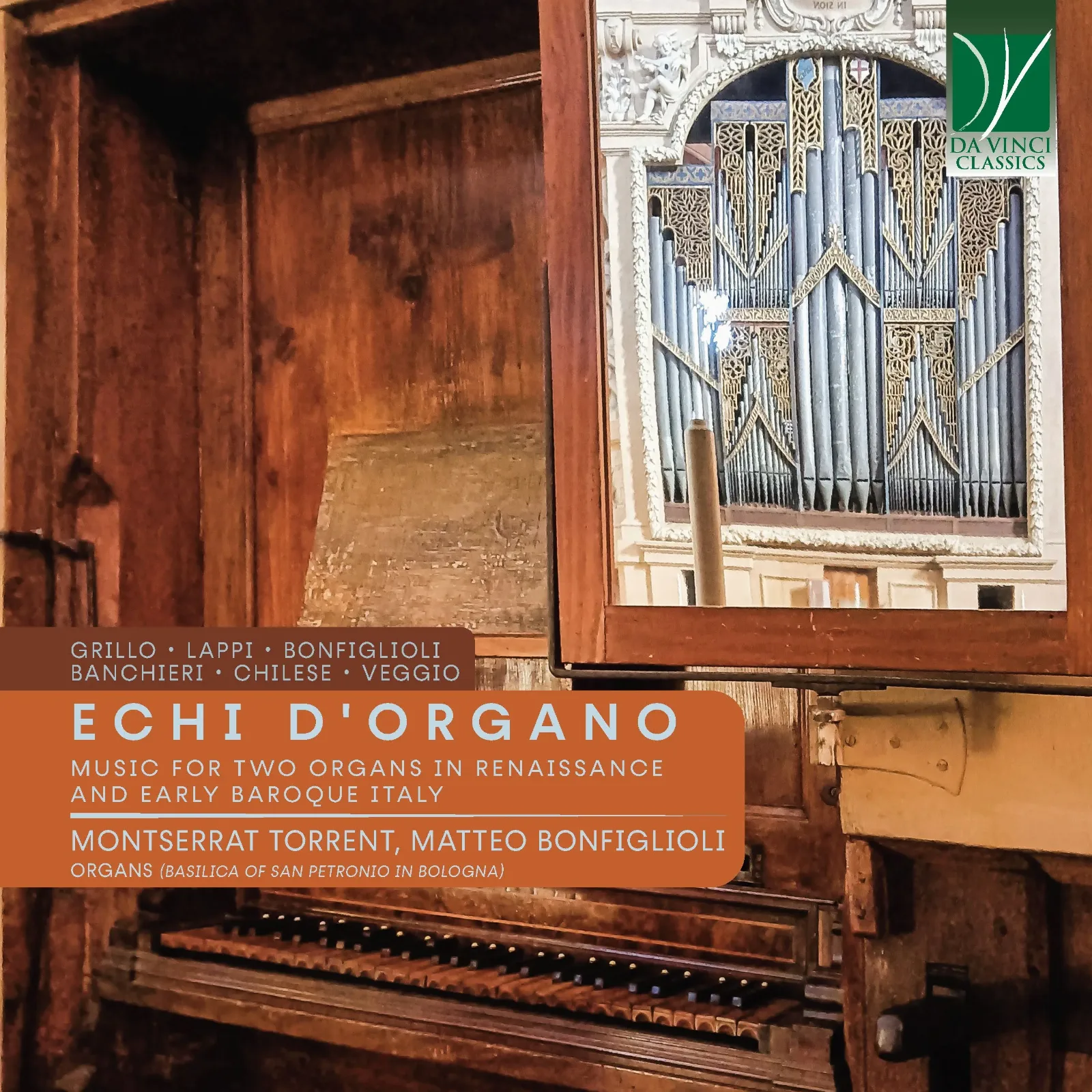
Some CDs start from a repertoire, others from a composer or performer. Echi d'Organo starts from a space. And more precisely still: from two instruments that were placed side by side centuries ago so that they could speak to each other. In the Basilica di San Petronio in Bologna stand the organ of Lorenzo da Prato from 1475 and that of Baldassarre Malamini from 1596. On this CD they are not used merely as historical witnesses, but are once again brought together in music that calls above all for dialogue, answer and echo.
Music that travels through the space
Montserrat Torrent and Matteo Bonfiglioli take us to the sixteenth and early seventeenth century, when in the great Italian churches two organs increasingly stood side by side. The organs could perform together with the various choirs, alternate with one another and sometimes also answer from a distance. A specific repertoire for two organs would only emerge later, but this music already reveals the possibilities such an arrangement offered. For a number of pieces the original eight voices were divided between the two organs, so that the music here can literally sound from one side to the other.
The beauty is that you almost hear the space making music too. A motif sounds on one organ and receives an answer from the other, sometimes close by, sometimes from a greater distance. The music thus moves not only in sound, but also through the space.
A fine appetizer is the Canzon pian e forte a 8 by Giovanni Battista Grillo (?-1622), with which the CD opens. The title refers to the well-known pian e forte principle that Giovanni Gabrieli had already explicitly notated in his Sonata pian e forte some ten years earlier. With Grillo it becomes above all a lively conversation between the two organs. The difference between the two instruments is a real asset here: the fifteenth-century Da Prato organ and the Malamini organ, more than a century younger, remain clearly recognizable and immediately set the tone for the rest of the CD.
The Toccata in Ecco per l'Elevatione, from the archives of the cathedral of Como, has a very different atmosphere. The piece was originally written for a single organ, but here the division over two instruments gives it an additional dimension. It is a restrained, almost meditative work, in which the organs seem to gently answer each other. A pleasant resting point.
Then it becomes playful with the anonymous Pavana, Saltarello de la pavana, La Coda, from the manuscripts of Castell'Arquato. The various sections flow together very naturally and are played here, as it were, as one piece. Especially the transition into the dance-like saltarello is infectious. The light, graceful sound even has something Christmassy about it, which makes this short piece one of the most charming moments of the CD for me.
Canzon XVII 'L'Allé' in Ecco by Pietro Lappi (1575-1630) brings us back to the echo effect. Here too it is not a matter of loud versus soft, but of two organs seeking and answering each other. One instrument introduces a musical idea, the other takes it up and gives it its own colour. You constantly have the impression that both organists listen closely to each other and know exactly when to add something or step back. In this way this atmospheric music is given every space to speak.
From old sources to a new Ave Maria
At the heart of the programme stands a work that does not come from the old sources: Tiento sopra Ave Maria by Matteo Bonfiglioli (b. 1977). It is an interesting addition, because Bonfiglioli does not try to imitate the sixteenth or seventeenth century. He does choose the Iberian tiento form, but develops the Gregorian Ave Maria in his own searching way. The well-known prayer sounds here as if reborn, in an almost timeless atmosphere. The birdsong – during the recording provided by Benedetta Bonfiglioli – is a small but surprising detail and gives the piece something unexpected.
With Dialogo Acuto & Sopra'Acuto by Adriano Banchieri (1568-1634) we return to early seventeenth-century repertoire. The short piece gets its character from the exchange between the two instruments: a musical idea is introduced, answered and finally brought together in a shared conclusion. Precisely because of that compact form, it works as a small dialogue within the larger whole.
In Canzon XXXI 'Risposta dell'Eco' by Bastiano Chilese, included in Raveri's collection of 1608, the echo idea is literally in the title. Here it is not a simple contrast between loud and soft. The answer lies mainly in the space. The two organs react to each other and in doing so come ever closer together. Moreover, the piece ends unusually abruptly, so the music is not neatly rounded off but, as it were, broken off in the middle of its movement.
That the CD then switches back to a single instrument provides a pleasant contrast. O gloriosa Domina by Adriaan Willaert, in a keyboard arrangement from the Castell'Arquato manuscripts, shows how much richness there is to discover in a polyphonic composition when it is transferred to one organ. The original six-voice texture is of course simplified, but the music loses none of its character. On the contrary: on this organ it gains a clarity that makes you hear some lines and details differently. I suspect that next time I will listen to Willaert with different ears because of this.
Das technisch anspruchsvollste Werk ist Recercada per B quadro del primo tono von Claudio Veggio (1504/1505–1553/1557). Die schnellen Skalen und virtuosen Passagen folgen in hohem Tempo aufeinander und werden von Bonfiglioli eindrucksvoll gespielt. Nach den eher ruhigen Stücken früher auf der CD sorgt dies für eine kräftige Dosis Tempo und Energie. Dass diese virtuose Passage auf der ältesten der beiden Orgeln gespielt wird, macht es noch besonderer: Das Instrument klingt hier überraschend kraftvoll und lebendig.
Die CD schließt mit einem weiteren Werk von Giovanni Battista Grillo, der Canzon in Ecco a 8. Damit kehrt das Programm zu dem Prinzip zurück, mit dem es begann: zwei Instrumente, zwei Positionen, ein musikalischer Gedanke.
Die Stärke der Interpretation
Montserrat Torrent, die am 17. April 2026 ihren hundertsten Geburtstag feierte, bringt ihre enorme Erfahrung in diese Aufnahme ein. Sie wirkt in den sechs Stücken für zwei Orgeln mit; die Solostücke übernimmt Bonfiglioli, der als Organist von San Petronio mit den Instrumenten und dem Raum, in dem sie klingen, bestens vertraut ist. Ich konnte nicht immer ausmachen, wer an welcher Orgel spielte, und das ist vielleicht das schönste Kompliment für ihr Zusammenspiel: Die Instrumente bleiben erkennbar, doch die beiden Organisten bilden eine überzeugende Einheit.
Auch die Aufnahme selbst trägt zu diesem Erlebnis bei. Die Akustik der Kirche ist deutlich präsent, ohne dass der Klang in übermäßigem Nachhall verschwindet. Man hört die Unterschiede zwischen den Instrumenten und auch den Abstand zwischen ihnen, während der Musik genügend Raum zum Atmen bleibt.
Echi d'Organo ist eine CD, zu der ich gerne zurückkehre. Bei jedem neuen Hören fallen andere Details auf: eine Antwort, die mir zuvor entging, eine andere Klangfarbe oder ein kleiner Unterschied in der Art, wie die beiden Orgeln aufeinander reagieren.
