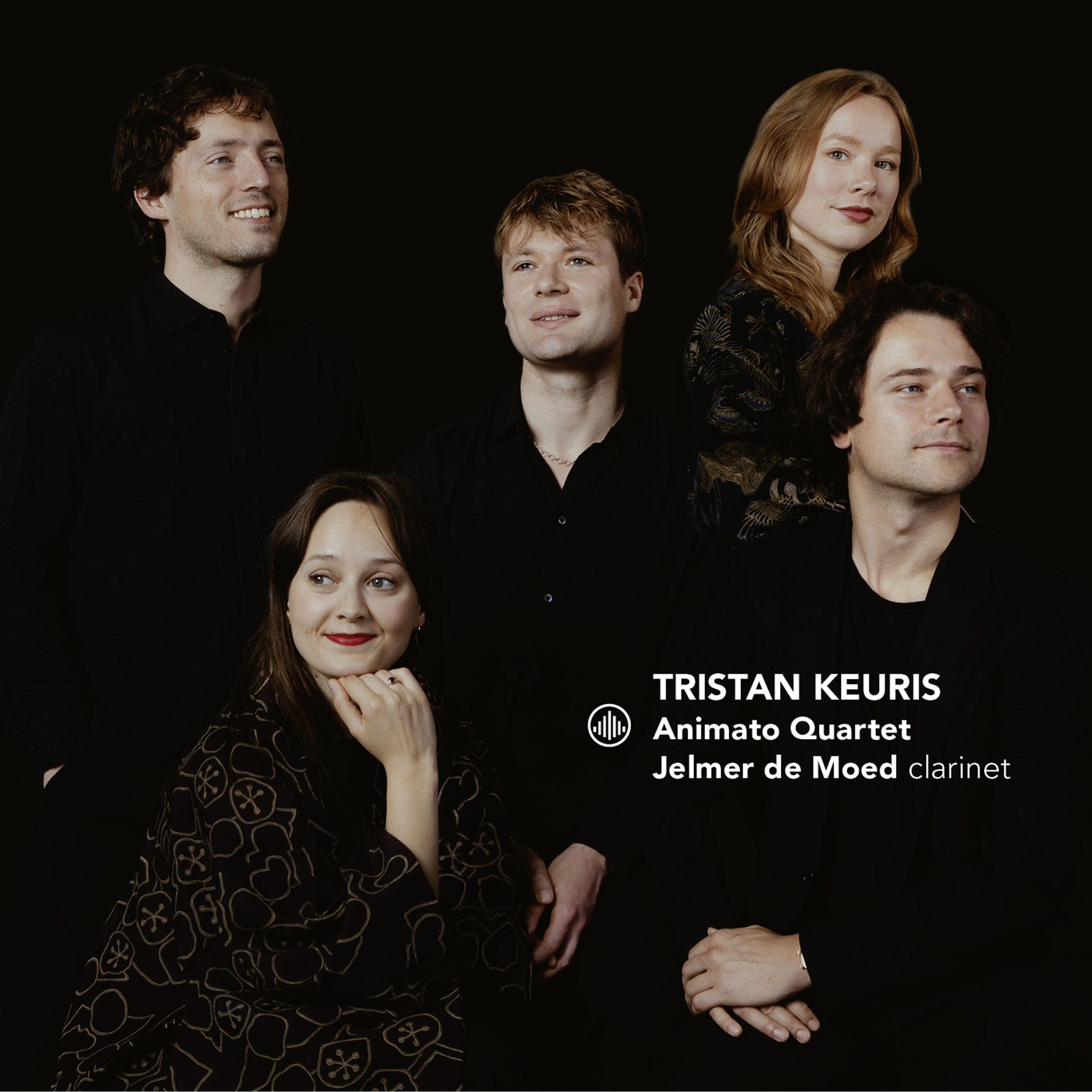
Some music intrigues immediately, yet reveals its secrets only gradually. With Tristan Keuris (1946-1996), these two qualities go hand in hand. His music is contemporary and at times unruly, but also lyrical and rich in tone colour. The Animato Quartet and clarinettist Jelmer de Moed bring together three works from the period 1982-1990 on this CD. They show how Keuris evokes diverse moods with compact musical ideas and regularly surprises the listener with unexpected turns.
Keuris was one of the most important Dutch composers of the second half of the twentieth century. He studied with Ton de Leeuw and in 1976 earned considerable recognition with his Sinfonia, for which he received the Matthijs Vermeulen Prize. His chamber music also deserves considerable attention. It is precisely there that his feeling for tone colour and his ability to reconcile lyricism and musical unrest become clearly apparent. The three works on this CD reveal different facets of that musical language.
From cutting sounds to hushed lyricism
The CD opens with Canzone for solo clarinet. Jelmer de Moed immediately shows how fascinating this piece is. His warm clarinet tone and the crystal-clear recording do justice to the various facets of the music. De Moed keeps the listener engaged by constantly letting the sound change character. Even the shrill, almost cutting tones sound entirely logical in his hands. They are not effects in themselves but form part of the musical argument and give extra relief to the more lyrical passages. It is precisely this alternation that makes Canzone so compelling.
The immediate transition to the String Quartet No. 1 from 1982 is particularly successful. Where Canzone explores the possibilities of a single instrument, the quartet distributes the musical unrest across four voices. In the Introduzione the whole initially sounds melancholic and searching, with a slightly grating undertone. Gradually the musical ideas become ever more interwoven and the mutual relationships continually shift.
The Animato Quartet keeps this multiplicity clear without smoothing over the angular edges of the score. Then the music gathers speed: the short motifs sometimes almost seem to interrupt one another, giving the first movement a distinctly nervous character. Towards the end the music briefly withdraws, after which the energy flares up again and the movement gradually culminates in a hushed close. The quartet shapes these contrasts carefully, with an ear for both the nervous outbursts and the moments of stillness.
In Calando the centre of gravity shifts to lyricism. The melodic lines unfold in an almost narrative motion and seem to hesitantly seek each other out. The quartet gives these lines full scope while preserving the hesitant character of the music. The first violin comes forward as the leading voice, while the other instruments comment incisively on her line. In this way a compelling dialogue of question and answer arises, in which the voices complement and respond to one another.
In Quasi agitato the unrest returns, with sharp rhythmic accents and rapid exchanges between the instruments. The quartet plays with momentum but keeps the individual lines recognizable. The nervous energy comes fully to the fore, while the musicians preserve the coherence of the whole.
Between lyricism and unrest
The Clarinet Quintet from 1988 was written by Keuris for clarinettist George Pieterson and the Orlando Quartet, on the occasion of the centenary of the Concertgebouw in Amsterdam. De Moed plays the clarinet part on the A clarinet, whose warm sound suits the lyrical and melancholic sides of the score well. Yet the music does not remain constantly in a contemplative mood.
From the first notes of the Lamento a certain friction is audible that immediately sharpens the attention. The long lines of the first violin and the clarinet, like the dark tone colours, are given full scope. De Moed lets the clarinet sing, while the strings support the melodic line and at the same time create a layer of tension of their own. The musicians let the phrases resonate calmly, which reinforces the restrained atmosphere of the movement. With their great sensitivity, they make the Lamento an emotional centre of gravity of the work.
In the Scherzo misterioso e passaggio the contemplative mood gives way to a more nervous and restless course. Short musical ideas follow one another and the accents shift, so that the music seems to take a different turn each time. The clarinet comes to the fore here, but just as easily blends again with the strings. The musicians keep this interplay clear and lively and let the tension build gradually. Striking is the calm ending, which contrasts sharply with the restlessness that precedes it.
In the Elegia lyricism returns, with a striking solo passage for the cello. Yet the stillness sounds different from that in the Lamento. The dark tone colours give the music a sombre character, while the unrest of the preceding movement remains palpable. Clarinet and strings seek each other out, only to drift apart again. Particularly moving is the moment when the clarinet asserts itself and the strings respond. In this way the melancholy remains charged with emotion, and the Elegia becomes more than a merely contemplative resting point.
Nach dem Leid des Lamento und der Melancholie der Elegia schlägt das Finale, Impetuoso, einen anderen Weg ein. Die Musik gewinnt einen ausgeprägten Vorwärtsdrang und bildet so ein kraftvolles Gegengewicht zu den eher verhaltenen vorangegangenen Sätzen. Die Klarinette klingt mitunter ätherisch und scheint sich über das Streicherensemble zu erheben, während die Streicher untereinander gleichsam diskutieren und sich dann wieder verständigen. Die Klarinette mischt sich in dieses musikalische Gespräch ein, tritt zu anderen Zeitpunkten aber deutlich hervor. Nach einer bewusst länger gehaltenen Pause kehrt für einen Moment die Stille zurück: Die Klarinette klingt zurückhaltend, getragen von der intimen Unterlage des Quartetts. Der Kontrast zwischen den stürmischen Passagen und diesen zurückgenommenen Momenten verleiht dem Finale zusätzliche Plastizität.
Eine Einladung zum weiteren Hören
Die im Juni 2026 in der Sint-Pieterskerk in Maasmechelen entstandene Aufnahme lässt die einzelnen Instrumente gut zur Geltung kommen. Bei Keuris ist dies ein Gewinn, da die expressive Kraft seiner Musik zu einem großen Teil in der Wechselwirkung zwischen den Stimmen und ihren Klangfarben liegt. Die Klarinette behält ihren eigenen Charakter, bleibt zugleich aber eng mit dem Streicherensemble verwoben. Gelegentlich ist ein Nebengeräusch eines der Musiker zu hören, etwa zu Beginn des Streichquartetts. Es ist ein kleines Detail, das das Hörerlebnis nicht wesentlich stört.
Im Booklet der CD äußern die Musiker die Hoffnung, dass die Hörer sich ebenso wie sie in die Kammermusik von Keuris verlieben werden. Diese Aufnahme macht deutlich, warum dieses Repertoire mehr Aufmerksamkeit verdient. Das Animato Quartet und Jelmer de Moed zeigen, wie Keuris Lyrik, Widerspenstigkeit und eine reiche Palette an Klangfarben miteinander verbindet. Wer den Komponisten vor allem von seiner Orchestermusik kennt, erhält hier eine überzeugende Einführung in sein kammermusikalisches Schaffen. Eine CD, die dazu einlädt, weiterzuhören.