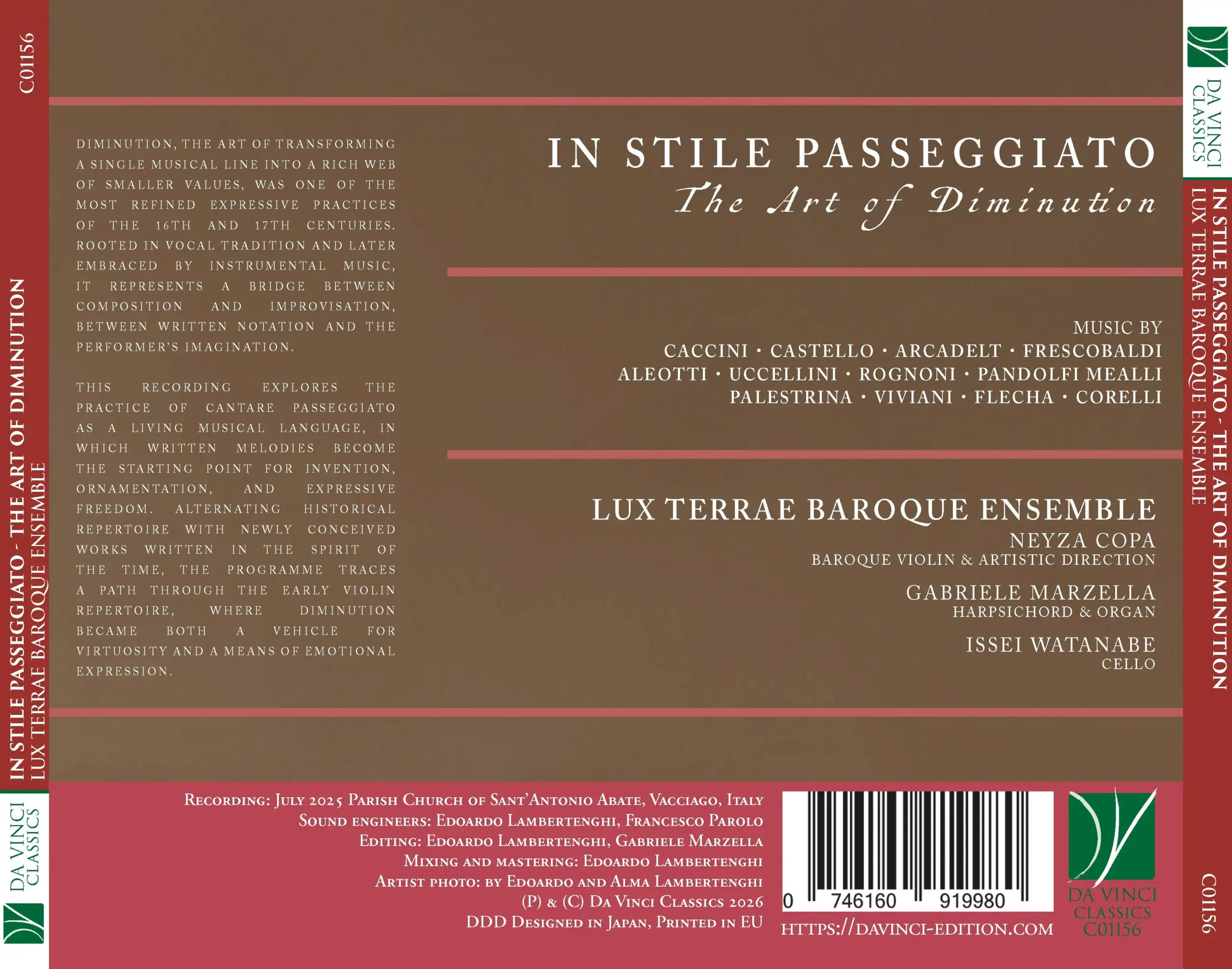
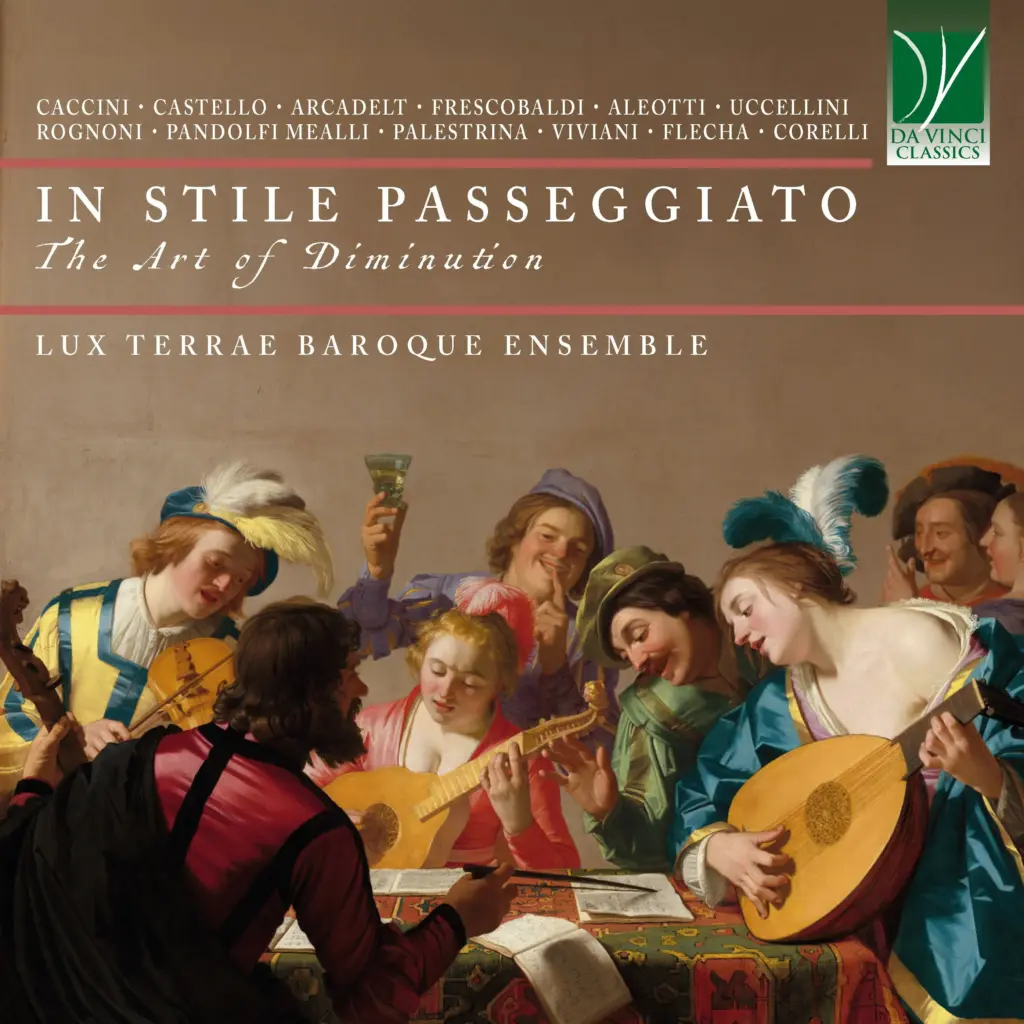
In stile passeggiato – The Art of Diminution.
Diminution, or replacing a large musical value with an equivalent amount of smaller values, is a technique that dates back to numerous treatises from the 16th and 17th centuries. These treatises teach this technique through the presentation of many diminished passages and examples of complete musical pieces. The treatise by Christoph Bernhard (1628-1692) is one of the most valuable sources for understanding the art of diminution in 17th-century Italy. He writes: "The manner of singing in passeggiato or alla Lombarda is a manner in which one does not dwell on the notes one encounters, but changes them with diminutions or coloraturas. (...) A diminution is when a note, respecting the correct beat, is divided; that is, a note worth half a beat is divided into four fusas, eight semifusas or sixteen subsemifusas, without dwelling on the note, but gliding over it in an elegant manner." This recording is intended as a tribute to this artistic technique, which marks an important step in the development of instrumental music for the violin and a testing ground for composers to experiment with new writing techniques.
The project was inspired by the study of fundamental texts on the diminution technique by Rognoni (Ricardo and Francesco), Dalla Casa, Bassani, Ortiz and others, as well as by the study of the improvisatory style of authors such as Giovanni Battista Fontana and Marco Uccellini. For the original compositions, which were written entirely fresh based on existing madrigals, we sought a middle ground between the written tradition of the treatises and the freedom of composition. In the playlist, the alternation of repertoire pieces and other works, written as if by composers of that era, represents a virtual embrace of the spirit of the age—a blend of nostalgia for the past and the taste of creativity.
Dario Castello (Venice, 1602–Venice, 1631), who lived in the first half of the 17th century, was a violinist at the San Marco Basilica, where Monteverdi was maestro di cappella. His sonatas in Stile Moderno are fundamental to the musical literature of that time and enjoyed considerable distribution. Castello was strongly influenced in his instrumental music by the revolutionary trend in Monteverdi's music, with whom he worked closely. Monteverdi's music from the Seconda Prattica aimed to use all musical means to emphasize the emotional content of the dramatic text and move the listener through alternating musical genres, rhetorical elements, dissonance, and uninhibited use of alterations. All these elements can be found in Dario Castello's music. We note in particular how in the toccata sections of his sonatas a refined form of diminution, characteristic of vocal music, and the technique of cantare passeggiato come explicitly to the fore.
Girolamo Frescobaldi (Ferrara, 1583–Rome, 1643) was a composer, organist, and harpsichordist and is considered one of the greatest composers for harpsichord and organ of the 17th century. The style of Frescobaldi's instrumental music aims to evoke emotions through sound, following the techniques of the Seconda Prattica that were characteristic of the vocal music of that time. The Toccata for Spinetta and Violin is unique in its genre, as the violin and harpsichord play together, sometimes imitating each other in fugue-like imitations and sometimes as soloists in lyrical sections.
Marco Uccellini (Forlimpopoli 1603 [or 1610]–Forlì, 1680) was a virtuoso violinist and explorer of the technical and expressive possibilities of his instrument. His musical innovations, in which he combined contrapuntal and improvisatory style, often presented bold and extreme musical solutions, a natural continuation of Monteverdi's ideas in purely instrumental music.
Francesco Rognoni Taeggio (Milan, second half of the 16th century–after 1626) is best known for his work "Selva de varii passaggi," a treasure trove of information for the study of both vocal and instrumental music, and one of the most important treatises on the technique of diminution. It contains complete polyphonic pieces—motets and madrigals by composers such as Pierluigi da Palestrina and Orlando di Lasso—that are diminished for various instruments.
In the music of Giovanni Antonio Pandolfi Mealli (Montepulciano, 1624–ca. 1687), lyrical sections alternate with dance sections. The latter provide a suitable stage for virtuosos to display their improvisational skills, while the lyrical sections are rich in diminutions. These diminutions, which, with the development of an increasingly idiomatic instrumental technique, transcend the boundaries of singing and give way to bold and rapid figures.
The Sonata Prima by Giovanni Buonaventura Viviani (Florence, July 15, 1638–Pistoia, after 1692) is a work in which the diminution technique is fully realized. The lyrical and toccata sections with which the sonata begins and ends, with their alternately tight and then cantabile diminutions, frame the extended variation section, in which the composer displays his creative and technical abilities.
The CD concludes with the Fourth Sonata by Arcangelo Corelli (Fusignano, February 17, 1653–Rome, January 8, 1713). Estienne Roger and John Walsh published the diminutions of the Adagios in 1710 and claimed they were based on Corelli's own performances. After studying Corelli's various techniques, we wanted to add our own diminutions to the two Adagios of the Fourth Sonata, just as a performer of that era would have done."