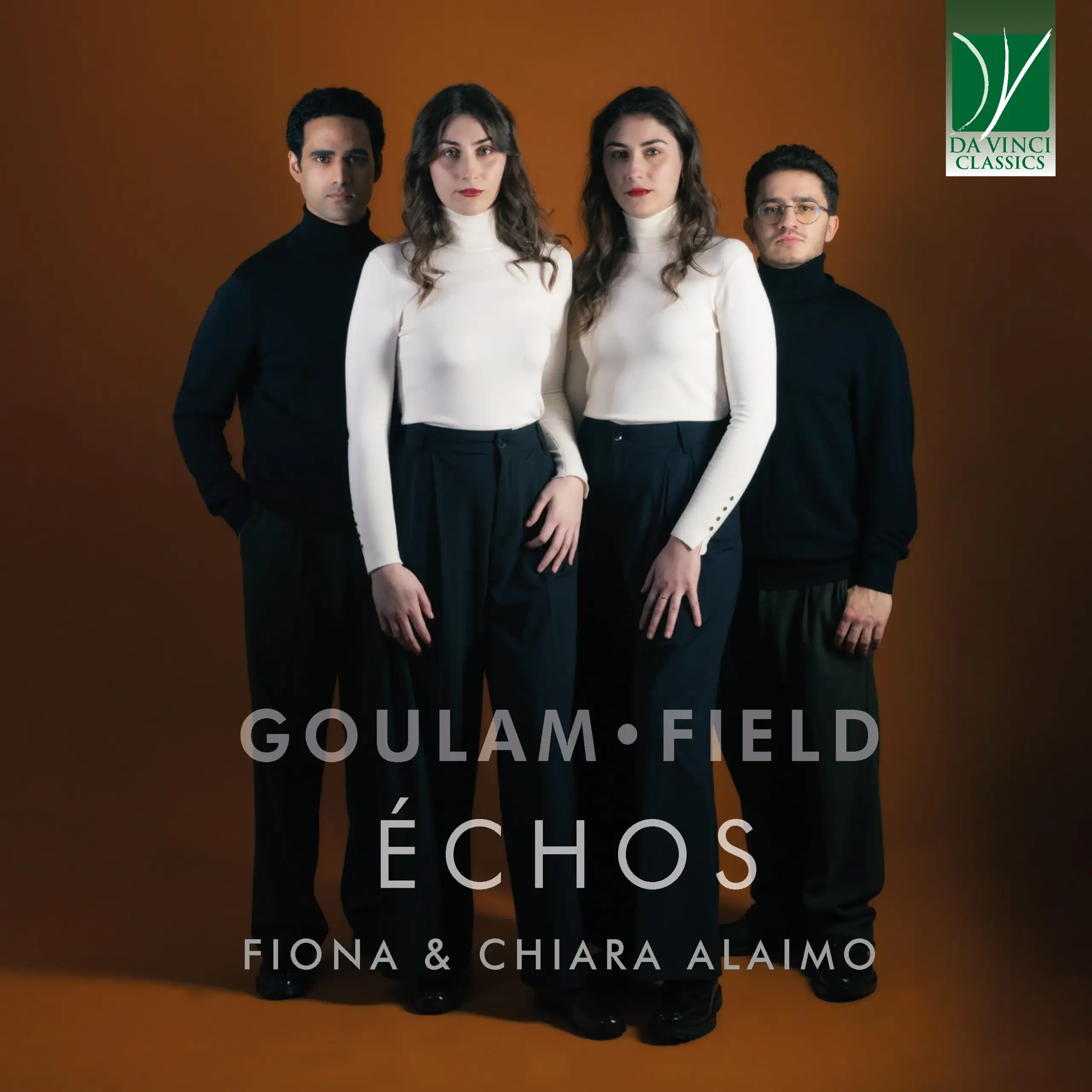
It was perhaps inevitable that the music of Gabriel Field and Sharad Goulam would come together on a single album. Their friendship formed long ago, and they have often shared the stage; but what matters here is not their biography, but their kinship: a shared dedication to vibrant tonality and modality, colorful harmony, and crucially, the expressive power of dissonance. Échos sets these affinities against their differences, creating a program in which two personal idioms mirror and illuminate each other without falling into monotony. The result is a sequence that must be heard as a dialogue of temperaments, a series of responses in which gesture and reverie converge, and substance and shadow meet.
Goulam's scores feel more carved than written, with a focus on counterpoint and a sense of discipline. The opening melody, the Toccata Furiosa, is no mere display piece; it is a motoric declaration of intent, whose relentless propulsion gains weight through layered voices and an inexorable pulse. The Prélude V directs that kinetic force inward through unstoppable and resolute harmonic waves, while the Marche carries a strict stride whose painful counterpoint rejects rhetoric and thereby acquires dignity. The Deux Nocturnes open into a wholly different landscape, one shrouded in dark smoke that never quite lifts, the other with livelier and more impassioned measures. The Arabesque provides one final shift in atmosphere with a mysterious quality, subtle harmonies, and exotic rhythms, whose ornamentation is not decorative but contemplative—a symbolist line that spirals around itself like a thought.
Field, by contrast, writes from silence toward sound. His eight chorales are concise and severely constructed, without superfluous flourishes. They conduct themselves as miniature engravings, crafted with tender precision, yet without any ecclesiastical proclamation. Harmony is never imposed in these works; it is allowed to unfold, a measured bloom from which melody emerges with effortless balance. The four Berceuses deepen that inner world. Their rocking, subtle, and almost light-footed gestures share the same breath and energy, mingling solace and wistfulness. The three Pièces Joyeuses complicate the picture with an irony that is anything but frivolous. The first sketches a severe, almost hopeless image, ending in the depths of the piano. No. 2 descends ever further, the repeated descents coloring so-called joy with a distinctly bitter tint; No. 3 breaks through the surface entirely with a capricious, restless line, as if happiness, forced to reveal itself, can only appear as a rupture. Finally, Péché d'époque speaks with a clarity that is both wry and inexorable: a confession of the age that smiles even as it accuses.
The architecture of the program allows these contrasts to speak. The worlds of Goulam and Field do not cancel each other out; they function as complementary lenses. When the pieces are heard in sequence, they form panels of a diptych whose hinges are invisible. Energy in Goulam hardens into structure, as if sound were a substance to be worked; line in Field dissolves into memory, as if sound were the trace of a thought nearly vanished. Each composer serves as a sounding board for the other, as the other's afterimage; similarity breeds difference, difference clarifies similarity. The listener is not asked to choose sides, but to recognize a spectrum: from chiseled, swift material to hovering song, from granite to vapor, from will to whisper.
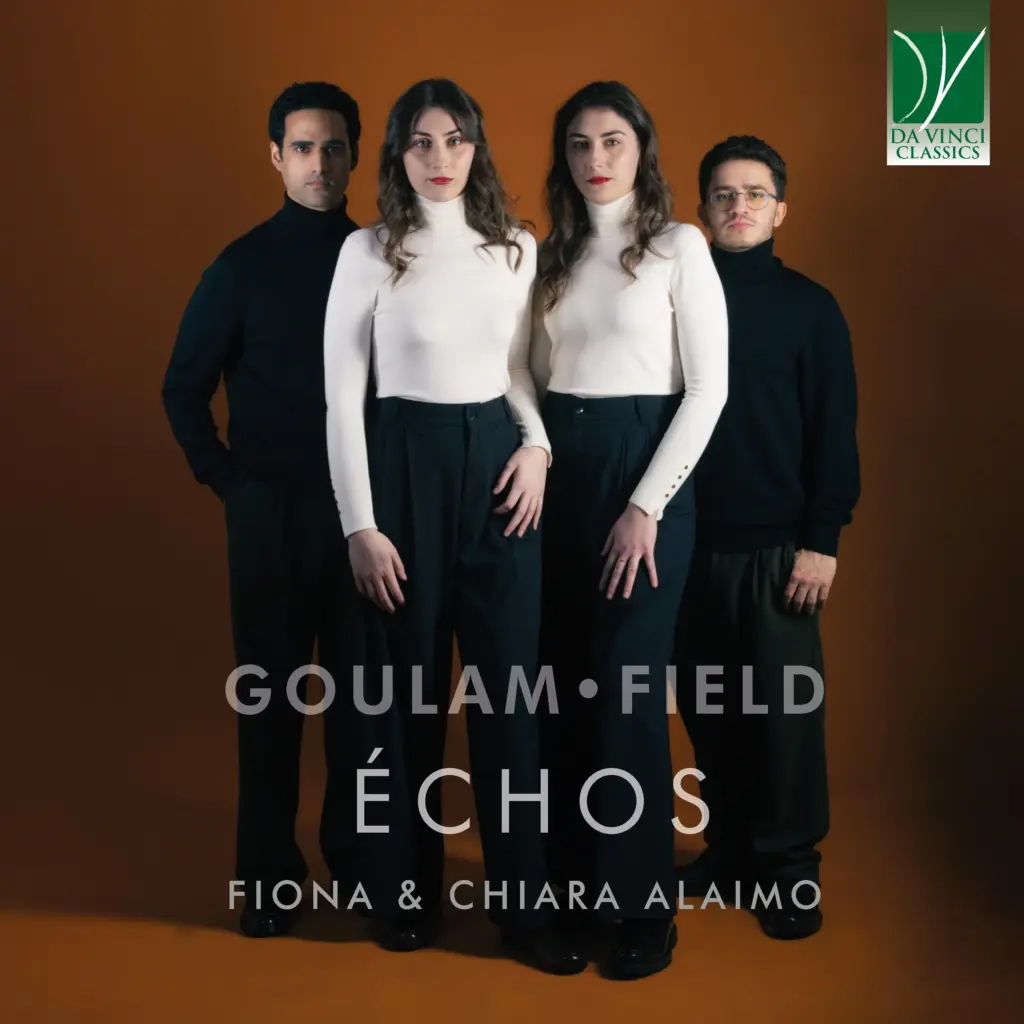
Such a design demands performers who command both viewpoints. The twin pianists Fiona and Chiara Alaimo bring precisely that dual focus. Trained in classical European disciplines and experienced on international stages, they play with a blend of structural clarity and imaginative tact. Where Goulam demands endurance and architectural control, the sisters provide that with stability and a refusal of harshness; where Field asks for openness and inward listening, they temper the line with the subtlest nuances, allowing soft colors to emerge and fade again. They make audible the axis around which the program turns.
As the album opens with the sounds of the world upon the keyboard, it closes with memory. After the nocturnal mists of Goulam and the crystal-clear miniatures of Field, Péché d'époque offers one final glimpse of the sun. Memory, as tradition teaches, is a source of patina: it warms, idealizes, and forgives. That warmth floats like gilded dust over the final measures, not to deny the shadows that precede it, but to make them readable, almost cherished. What remains is a document of difference in harmony, an hour in which two piano composers exchange glances across the same instrument and in that exchange itself find a truth that neither could have expressed alone.
Échos is therefore more than a meeting; it is a clarity achieved through listening, a study in resonance, and an invitation to return, for the echo deepens with each hearing.