

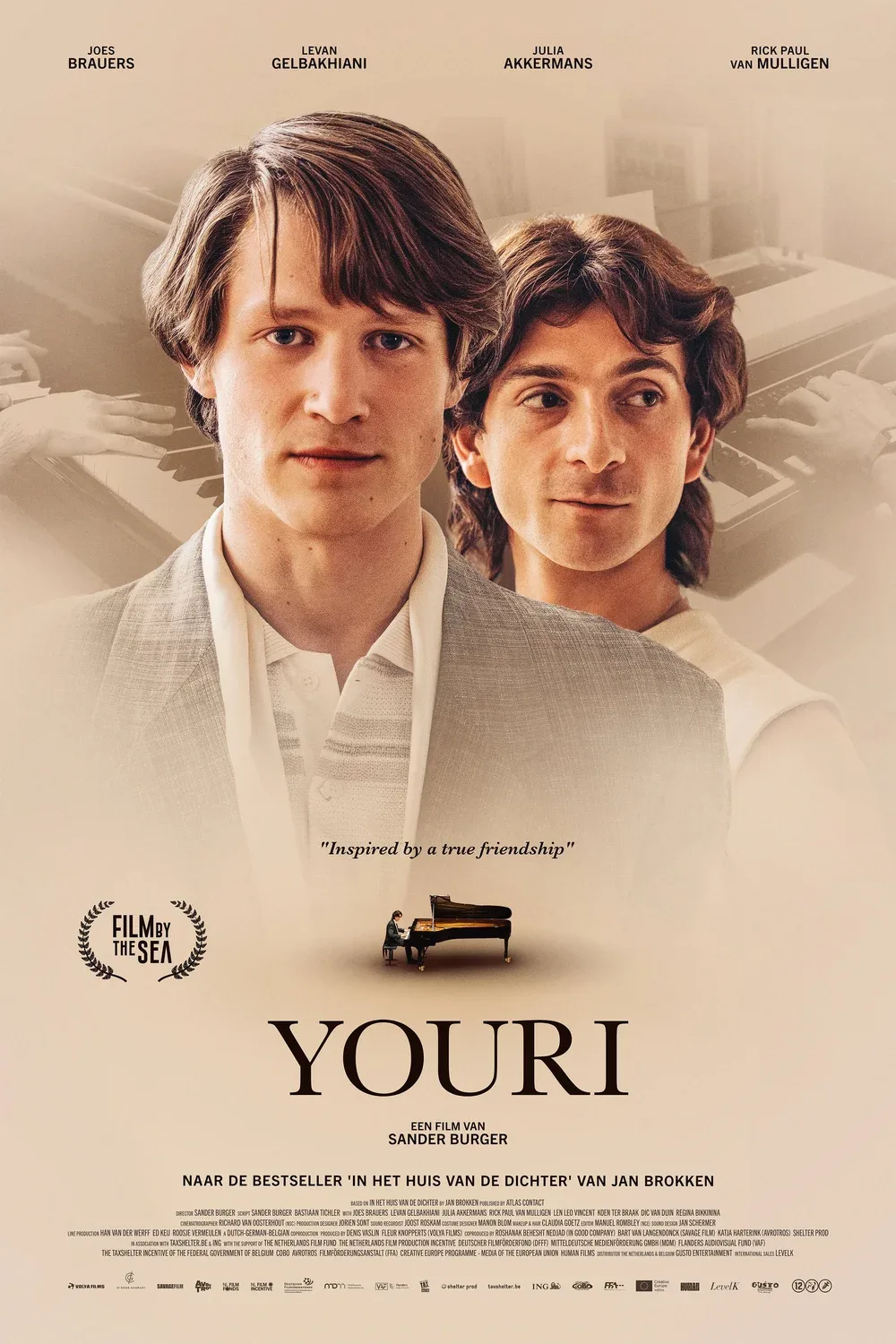
We see how Brokken, played by actor Joes Brauers, after Egorov's legendary Chopin recital in the Grote Zaal of the Amsterdam Concertgebouw (30 January 1980; we see Brokken watching breathlessly as Egorov plays Chopin's Etude op. 10 no. 1) awkwardly tries to make contact with the Egorov who is five years younger (played by actor – and dancer – Levan Gelbakhiani, who fled from Georgia). Egorov has no interest in him or in an interview and brushes him off through his manager.
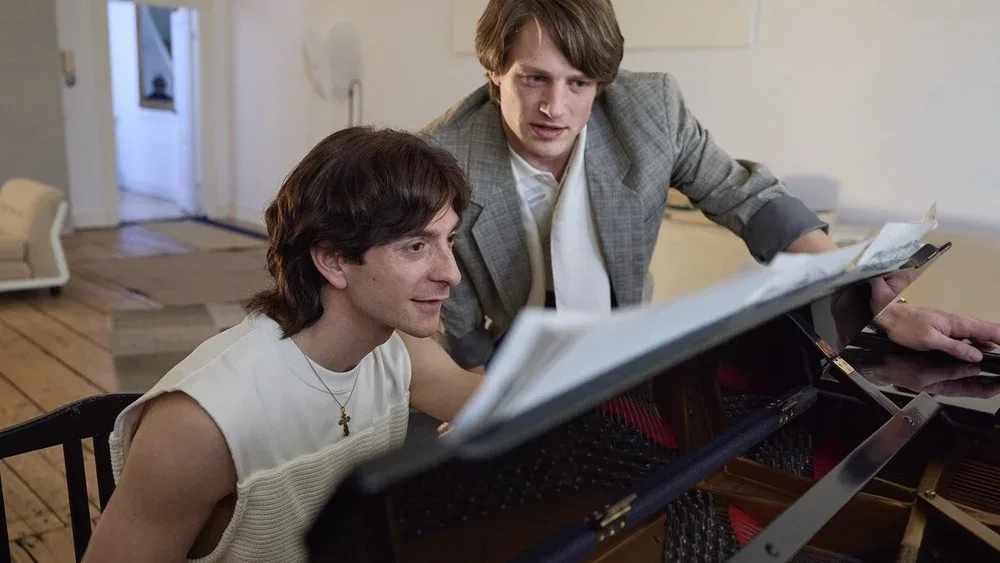
Through that manager (Rick Paul van Mulligen) a conversation is nevertheless arranged, at Egorov's home. (Egorov had settled in the Netherlands in 1976 as a Soviet refugee.) Even that could hardly have started worse: Egorov does not want Brokken to record the conversation on tape, and Brokken then turns out not even to have a pen with him. Brokken begins talking about his teacher at the conservatory, whereupon Egorov asks him why he wants to speak with him if he already knows everything. And about politics, the reason he left Russia, he doesn't want to talk at all. End of conversation.
At some point the manager nevertheless arranges a second chance, although the pianist knows nothing about it. Then the ice breaks, when Brokken recognises on the piano the portrait of Shostakovich, signed and all, from the time Egorov played Shostakovich's second piano concerto in Moscow with the composer present. Brokken knows the anecdote that Shostakovich wrote that concerto as a birthday present for his son, and that wins Egorov over. Even more so when Brokken guesses that the woman in the other photo is Egorov's mother. In fact the roles seem to reverse, and now it is Egorov who seems to be interviewing Brokken. Among other things about where Brokken was born, namely the village of Rhoon just outside Rotterdam, and whether he always wanted to become a journalist; no, a writer. Brokken's father was a minister in a small village but very well read, including Russian literature, which Brokken has also read, which wins Egorov over even more. And Brokken's mother played the piano, lots of Schubert, so double bingo! The first main theme in the film: family. Family is everything, says Youri, while he lives so far away alone. Jan has not visited his parents for nine years.
Meanwhile the commissioner of the interview, the Haagse Post, then a leading opinion weekly, is not yet satisfied with the submitted text, and Brokken seizes the opportunity to accept Egorov's invitation to go with him to a concert in Munich.
 On the plane to Munich Youri says that he believes in providence, fate, while Jan, despite his Christian upbringing (of which, according to him, even his father no longer believes), is convinced that people determine their own fate. But Youri then tells Jan how he escaped from Russia: on his way from Moscow to a concert in Italy he hears on board that, thanks to favourable winds, the plane will arrive fifteen minutes early. The chance is then that the representative of the Russian embassy who is supposed to keep an eye on him will miss him, and that he can then escape. Which indeed happens. Jan thinks that is typically an example of taking matters into your own hands, while Youri says it was a typical case of providence. God had the plane arrive earlier, who else? We see a truly breathtaking flashback to the arrivals hall of the airport in Italy, where Youri walks out into the backlight, a great white world of which we can see nothing but where that longed-for freedom is. Predestination or not, that is the other great theme in the bond between the two, and a second major substantive theme in the film.
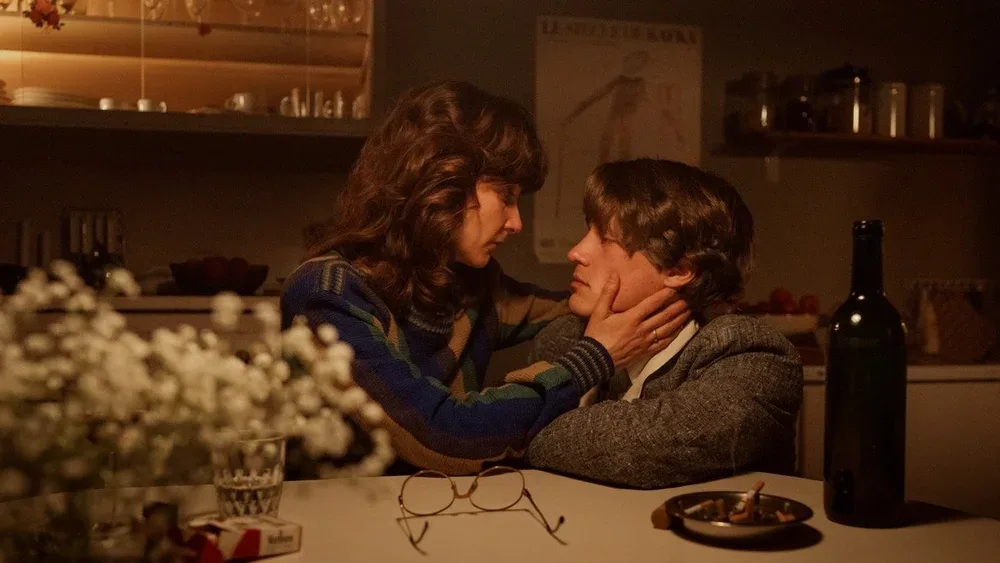
Brokken had spoken with Egorov about the reason why he left Russia, namely that someone threatened to 'out' him as a homosexual. In the hotel, Egorov knocks on Brokken's hotel room door in the evening before the concert and wants to come in for a moment, "because he is still too full of adrenaline". Now Egorov asks about Brokken's personal situation. Brokken is married, and, as the rest of the film indicates, also happily married, and by now we have already seen Jan at home a few times with his wife Suzanne. But in this beautiful scene a certain eroticism nevertheless hangs in the air, which perhaps is precisely reinforced by Brokken wearing a very unsexy singlet. I note that at that moment, precisely because the relationship does not become sexual, and a comradeship arises that will determine the rest of their friendship. Psychologising, I would also dare to state that Egorov is glad to encounter an adoring and adorable person who wants nothing sexual from him, unlike what is often the case in the gay nightlife, in which Egorov seems to have thrown himself with as much devotion as into the music.
In the concert hall in Munich we see Egorov rehearsing Schumann's Carnaval, during which an E-flat key proves to be defective, something that normally does not happen in concert practice. Most likely there was indeed something wrong with the piano in Munich, but for the film it had to be audible even to the less experienced viewer. Presumably this was done to make a character trait of Egorov clear, namely that he was gentle and shy, but perhaps precisely because of this could also explode in anger when something went wrong, in a way that might seem unreasonable to an outsider. In any case, Egorov storms off in fury and announces that he will quit if the hammer fails him during the recital. This provides a good link to the next scene, during the recital, in which we alternately see Egorov and the moving interior of the piano as he begins Carnaval: will the mechanism fail or not? Spoiler: everything goes well.
Brokken wants to become a writer and has started a novel set in Dutch aristocratic circles. Youri asks him whether he knows any noble people in the Netherlands. No. Why then is he writing about them? Brokken: "Dostoevsky didn't have to commit murder to write Crime and Punishment." Egorov: "But he did spend four years locked up in a Gulag labor camp among murderers." Youri recounts how, when he was studying Prokofiev's Eighth Piano Sonata, one of his "War Sonatas," written in 1944 when millions of Russians had already died in the war, he shut himself up for a time in Prokofiev's dacha to immerse himself in the composer's world of experience. In a following shot we see Brokken's manuscript crumpled up in the wastebasket.
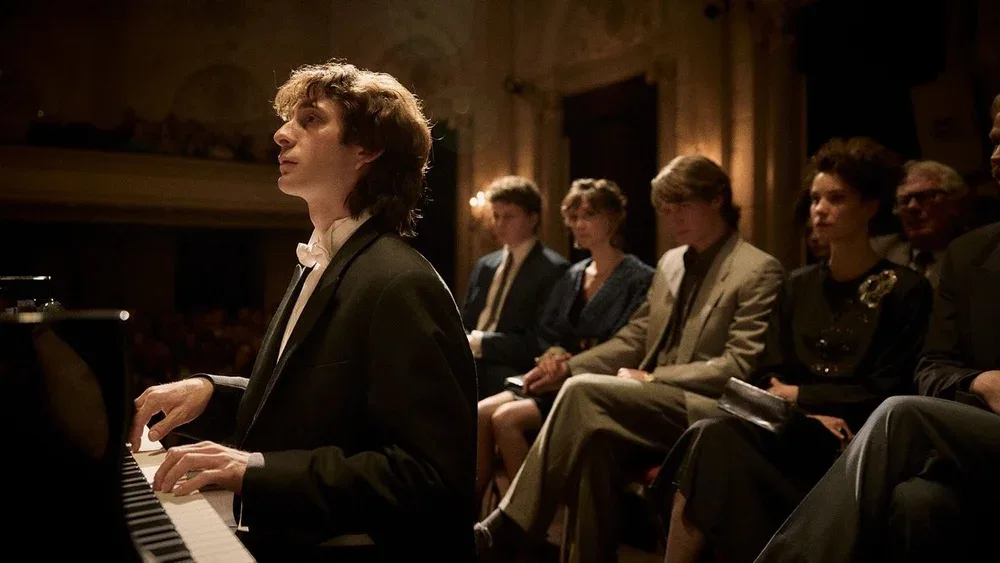
Egorov's recitals are impressively filmed. The basis consists of original recordings of Egorov, but we see Levan Gelbakhiani at the piano, who strongly resembles Egorov (and who, incidentally, fled Georgia for comparable reasons). The hands remain, and for those the hands of the young Ukrainian pianist Illia Fialko were used. Through film techniques, Fialko's hands could be attached to Gelbakhiani's arms. Some digital technique was perhaps used for this, but Fialko's hands and Gelbakhiani's body are real, so there is no Computer-Generated Imagery (CGI) involved. With the current state of the technology, CGI always remains visible, sometimes very obviously so, as in many Hollywood productions, and it would probably also have been beneath director Sander Burger to use computer simulation here. The way it was done, combining "really filmed" images, is close to a technique nearly as old as the medium of film itself; compare how convincingly F.W. Murnau and Fritz Lang superimposed "really filmed" (back then, of course, entirely analogue) images in Nosferatu and Metropolis respectively. "Sorry, but these are the kinds of tricks that make me very happy," the director said in an interview with the VPRO.
Meanwhile we also get a glimpse into Egorov's further Amsterdam life: the many gay friends who almost constantly hang around his canal house, the gay nightlife, Egorov's abundant alcohol consumption and equally abundant use of cocaine. In these circles the first alarming stories emerge about a new disease that seems to be confined mainly to gay men, namely the AIDS virus. We see discussions about safe sex and whether that is nonsense. And we also hear pop music from the early 1980s, in the gay bars and discotheques and at Egorov's home, including the 1980 song "Play It Safe" by Iggy Pop and David Bowie; a song with a fitting title, although AIDS had not yet appeared on the scene in 1980.
Jan has a new idea for a book, a biography of Egorov. But Egorov does not want it: "You don't really know me."
At a certain point the opportunity arises to perform in Russia again. By now it is the years of perestroika, and Russia is again seen as safe. Youri will finally be able to see his mother again. We see a phone conversation between him and his mother. She asks him to bring "his girlfriend"; she had always assumed that Youri had fled to the Netherlands because of this supposed girlfriend. She still had no knowledge of Youri's homosexuality.
With Jan he goes through suggestions for what he will play: Chopin, Schubert of course, Scarlatti. He is going to study a new piece, Ravel's Une barque sur l'océan. No, he will never play Schumann again, that is settled for him. In this seemingly casual remark about repertoire choice lies Youri's conclusion following the second leitmotif in the film, the question of whether things are predestined or not. Why does he say he will never play Schumann again? Is it a choice on his part, a choice of taste or preference, or does he think that choice has already been made for him? And that choice has become his destiny, precisely as a consequence of the freedom he had previously chosen, the freedom of the West and the freedom in his personal life. Does the viewer know that Egorov died of AIDS, and is he alluding to what he knows will probably come?
When Youri one day sits at the piano, tired and overstrained, Jan suggests that he should take some time off, to which Youri replies that he has already taken enough time off in his life.
The relationship between Brokken and his father had cooled, but he still kept in contact with his mother. When his mother dies, he goes with his wife and Youri to Rhoon to attend the funeral. The father behaves dazed, almost numb, but then piano music sounds from an adjoining room. It is Youri, playing the slow movement from Schubert's Sonata in C minor D 958, a composer whose music Jan's mother always played, as Jan had told Youri, and Youri had seen the sheet music lying there. The father is briefly confused, but then walks, moved, toward the room from which the piano playing comes. A consoling memory, and he is back in reality.
Jan's father goes to a care home. Jan comes to help clear out the parental house and sees that all the translations of Russian literature are already gone. His father had absolutely wanted to take those with him. And the father wanted Jan to take the piano.
One day Jan visits while Youri is studying Ravel. At a certain moment Youri suffers a terrible coughing fit and an epileptic seizure, symptoms of AIDS, and he collapses to the floor. He is quickly escorted to the hospital, and soon ends up on the ward for AIDS patients. But he comes home again. Everyone wants him to go to Russia anyway. But Youri cancels the tour: he is too ill, or considers himself too ill, and in this state dares no longer face his mother. He announces that he wants to commit euthanasia. Deciding for himself about what fate has done to him: free will and destiny.
We see him rehearse Prokofiev's Eighth Sonata again, pounding away fiercely, in a piece that indeed hammers relentlessly. At one point he asks Jan: "Am I playing too loudly?" and then again: "Am I playing too dramatically?" Both times Jan says no, but Youri stops, desperate, and says that it is too melodramatic.
There is one more concert, in the Small Hall of the Concertgebouw Amsterdam. That concert took place on 27 November 1987. His friends know that he has decided to end his life through euthanasia. Again we hear the second, slow movement of the Sonata D 958, by now a musical leitmotif of the film. The most honest composer, Egorov thought.
Afterwards he organizes a final gathering, with intimates, for the hour of his euthanasia. We see the manager and a few other friends, a Russian female friend who had also fled, and Jan's wife, but Jan did not want to be there. Jan goes to Youri's house the next day. From the canal he hears the third, slow movement of Schumann's Fantasy in C major Op. 17 sounding, a second musical leitmotif in the film; Jan had already heard it played from the canal before (and Prokofiev's Eighth Sonata is then the third musical leitmotif). Could Youri have decided after all to keep living? And to play Schumann again? He climbs the stairs, but it is a pianist who is playing. Youri lies angelically laid out in a white coffin. Historically it was the famous Soviet-Georgian Elisabeth Leonskaja, who had settled in Western Europe in 1978. In the film we see the Netherlands-based Nino Gvetadze take on this role and play Schumann's music.
How Levan Gelbakhiani plays Youri right up to death is phenomenal, including the months, weeks, of the definitive decline. I myself know a Russian Caucasian LGBTQI+ refugee, and it is striking how Gelbakhiani also resembles my acquaintance in his gentle manner of speaking and facial expression. And how this is directed and lit, and how the makeup has also done its work; as realistically as we see the terminally ill Egorov. Also bewildering is how Joes Brauers plays Jan Brokken, who during this dramatic process actually comes to true maturity, also as a writer, and by that I do not mean because of the biographical material, but also through what he learns about life's questions and authenticity in art. The film shows that too.
Jan visits his father in the care home. He has brought a gift, no, not his first book, De Provincie, which he had given to Youri when Youri was in the hospital. For his father he has brought a CD, of Youri, and he puts it on: Schubert, namely the slow movement from Sonata D 958.
I have seen the film twice, the second time to check whether I had correctly reproduced the music played and shown that I mention. It is one of the most striking biographical films I know. But it was also because the film asks for it; through the way the film lets you undergo Egorov's music - with a range of Egorov's recordings, of Schubert, Schumann, Prokofiev, Chopin, Liszt, Bach, Bartók, Ravel, plus thus a piece of Schumann's Fantasy played for the film by Nino Gvetadze.
I had recommended to Maurizio Fernandez that he go, former programmer of the Concertgebouw Saturday Matinee, where Egorov performed several times; among others already in 1974, two years before he fled the Soviet Union.
Maurizio went and let me know: "..just back from Youri: rarely seen such a moving and emotional film, brilliantly cast and without false sentiment. A great tribute to the producers and the outstanding actors, a film that stays engraved in your memory."
I of course completely agree with Maurizio; for two days now I have had the feeling that I know the people in the film. That is how close the film comes.
Wikipedia article about the film:
https://nl.wikipedia.org/wiki/Youri_(film)
Playlist of recordings used:
https://gusto-ent.nl/youri/soundtrack
Article about the film on the VPRO website:
https://www.cinema.nl/artikelen/youri-is-een-aangrijpend-eerbetoon-aan-een-geniale-pianist
Article from the Filmkrant:
https://filmkrant.nl/rubriek/actie-op-de-set-van-youri/
Youri Egorov 1954 – 1988 – documentary film by Eline Flipse:
Illia Fialko:
A Spotify playlist accompanying Jan Brokken's In het huis van de dichter:
https://open.spotify.com/playlist/2IWymXj8WhlfRE3xqoNaOh?si=0a73fa18505f41ab