The programme of the 67th Wexford Festival (19 October-4 November) was once again well-filled: three major opera productions, three operas in reduced form, a series of vocal recitals and various concerts. It has long been no secret that one must go to that remarkable and in its genre unique festival, in this small town on the Irish coast, to discover forgotten, lesser-known or … new repertoire.
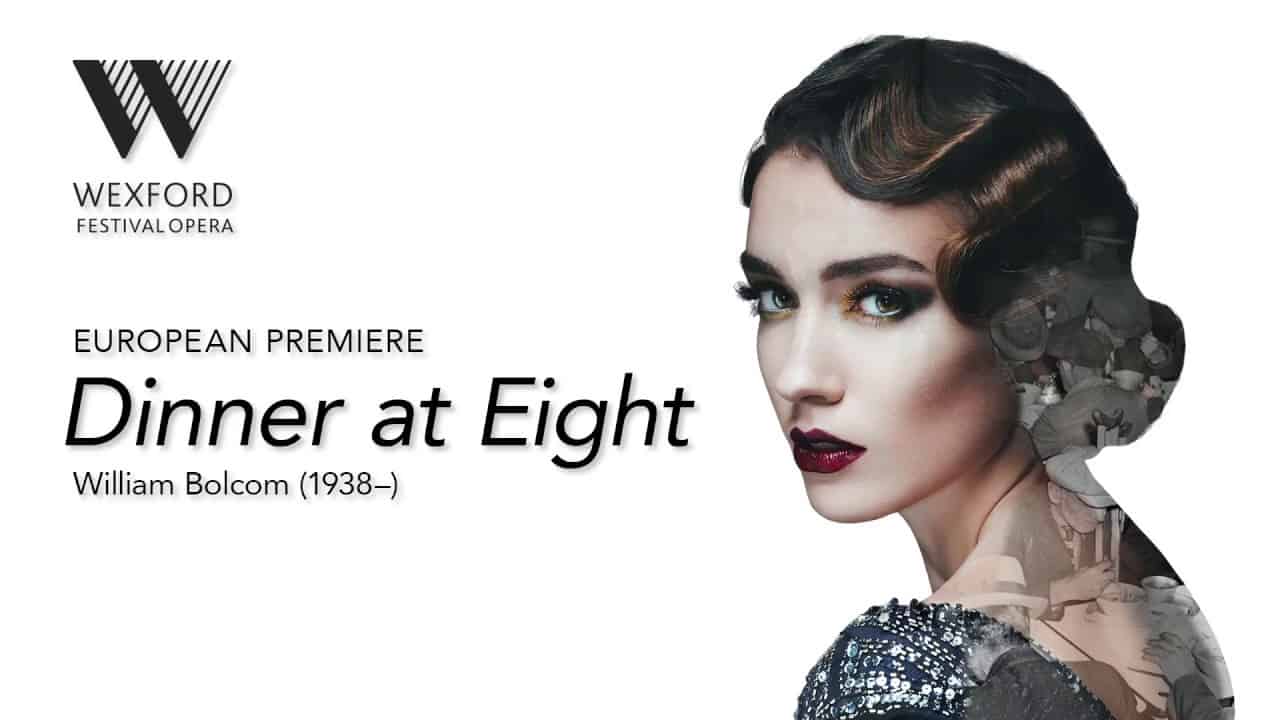
For Wexford not only rummages through the archives. It presented this year the European première of Dinner at Eight, the latest opera by American composer William Bolcom which had its première in March 2017 at the Minnesota Opera. Dinner at Eight is the fourth opera by William Bolcom (° Seattle, 1938) and the third to be performed in Europe. The libretto by Mark Campbell is based on a play by Georges S. Kaufman and Edna Ferber, performed on Broadway in 1932 and later filmed with Jean Harlow. Dinner at Eight is mainly a comedy about a disastrous dinner, richly laden with elements of greed, infidelity and addiction and performed by a series of characters who only worry about their own small problems while around them Manhattan groans under the Depression. Since the play is set in that period, the score carries very many musical influences from the thirties, especially from jazz and blues. Bolcom has attempted, not without success, to combine the best elements of European opera and the American musical. The result is a charming and entertaining performance in which the real dramatic moments are ultimately engulfed in the general maelstrom, the guests for the "dinner at eight o'clock" mingle their voices in a closing ensemble and the nervous hostess nevertheless shows much tenderness for her worry-stricken husband.
In his staging, Tomer Zvulun with the help of Alexander Dodge (set design), Victoria Tzykun (costumes) and Robert Wierzel (lighting) succeeded in creating a distinctive atmosphere for the various scenes and giving the action the necessary élan, aided by a cast that was convincing both dramatically and vocally, with great spirit and an expressive soprano voice led by Mary Dunleavy as Millicent Jordan, the hostess of the disastrous dinner. Stephen Powell was excellent as Oliver Jordan, her husband plagued by business concerns. Craig Irvin and Susannah Biller drew a convincing portrait of the unpretentious Packard couple, out only for their own advantage. Brenda Harris was a picturesque old diva Carlotta Vance and the hopelessly addicted Larry Renault found a credible performer in Richard Cox. But the entire cast deserves praise for the well-profiled characters and the homogeneous ensemble. David Agler conducted the orchestra of the Wexford Festival Opera with flair and a smooth hand.
Il Bravo: virtuosic duets
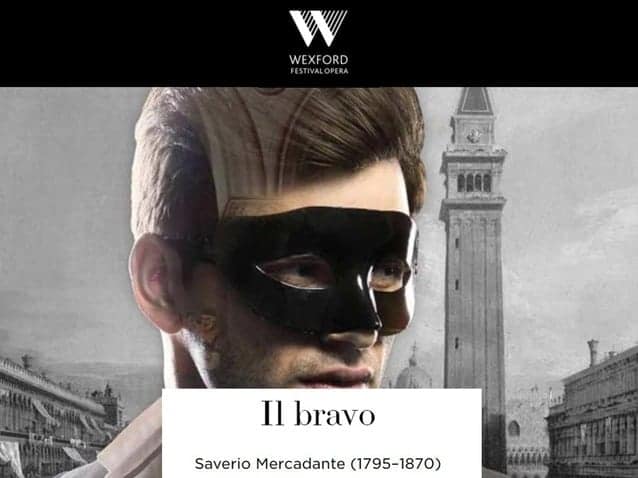
Although he is compared more than once to Verdi, Saverio Mercadante (1795-1870) is not a popular composer and today quite unknown. Not so in Wexford, where since 1988 five of his operas have been presented, this year supplemented with Il Bravo, an opera created at the Scala in Milan in 1839. The libretto by Gaetano Rossi and Marco Marcello is based on the play La Vénitienne by Auguste Anicet-Bourgeois, which itself was inspired by the novel The Bravo by James Fenimore Cooper. It is the fairly complicated story of Carlo Ansaldi, a tormented man who believes he has killed his wife and was forced by the "Council of Ten" of Venice to become their secret assassin, a "Bravo". He fulfills that task with great reluctance to save his father who is in prison awaiting his execution. Carlo helps a young loving couple, finds his wife back whom he thus did not murder, but will ultimately lose all people dear to him. Mercadante composed a score for this drama in which a musical development of the "recitativo accompagnato" stands out, whereby continuity and dramatic tension are enhanced. Remarkable is that he chose two sopranos (Violetta and Teodora) and two tenors (Il Bravo and Pisani) for the main roles, which yields more than one virtuosic duet.
The première of Il Bravo was well received and the opera had more than a hundred performances in the 19th century before nearly disappearing from the stage and making way for Verdi's operas. Conductor Jonathan Brandani and the festival orchestra gave much fire and colour to Mercadante's score. The choirs did so as well (in Wexford always composed of beautiful, young voices). Rubens Pelizzari lent his robust tenor to the brave but tormented Bravo and was more convincing than Alessandro Luciano (Pisani), with a lighter voice and a less well-profiled interpretation. Ekaterina Bakanova gave Violetta a very beautiful performance, giving youth, charm and a pure and expressive vocal interpretation. Yasko Sato had more difficulty with the character of Teodora, which she sang somewhat laboriously with a somewhat harsh soprano. Gustavo Castillo showed as Foscari a baritone with substance. Why the director Renaud Doucet felt the need to mix this 15th-century story with references to present-day Venice, flooded with tourists and besieged by cruise ships, is a mystery to me. What are the references? The set design combined styles and periods, the costumes (André Barbe) were historical except of course for the jeans and sneakers of the tourists. Setting off the alarm for "aqua alta" was completely unnecessary!
L'Oracolo and Mala Vita: additional dramatic elements
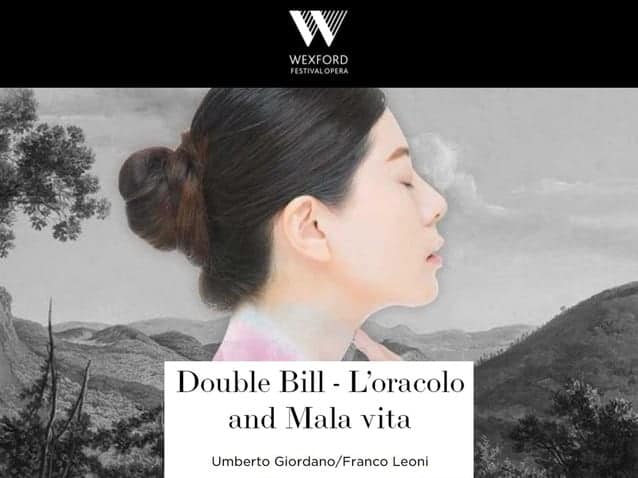
The Wexford festival has not only combined two short veristic operas, L'Oracolo by Franco Leoni (1905) and Mala Vita by Umberto Giordano (1892), in one evening. The directing team Rodula Gaitanou, Cordelia Chisholm (set and costumes) and Paul Hackenmueller (lighting) have situated them in the same context and setting: an American Chinatown and the Little Italy of New York in the early years of the 20th century. This would certainly have pleased the Neapolitans who at the time did not appreciate at all that the not very uplifting story of Mala Vita, set in the slums of their city, was shown on the stage of their prestigious Teatro San Carlo.
L'Oracolo, created at the Royal Opera House Covent Garden in London under the musical direction of André Messager, is a story that combines innocent love, greed, betrayal, shame, murder and revenge in sixty minutes, carried by a colorful score with a certain local color and exotic perfume. The staging has further emphasized the "Grand Guignol" character of the story, in a production full of movement and dramatic moments, supported by a homogeneous ensemble and a particularly active chorus involved in the action plus a picturesque children's choir. Cim-Fen, the boss of an opium den and a true scoundrel, had the presence and expressive baritone of Joo Won Kang. He was well surrounded by Sergio Escobar (Uin-San-Lui), with a sunny tenor, and Leon Kim (Uin-Sci), with sonorous tones and a homogeneous and convincing cast. With a few adjustments, Chinatown was transformed into a neighborhood of Little Italy where Vito lives, suffering from tuberculosis. He promises, if he can recover, to marry a fallen woman and gives his word to Cristina. But Vito cannot detach himself from his mistress Amalia and leaves Cristina in despair. Here too, Rodula Gaitanou has added an extra dramatic element to her staging: she has Cristina shoot herself in the head. Even without a suicide of Cristina, Italy judged Mala Vita to be too shocking. However, this was not the opinion of the renowned critic Eduard Hanslick who, after a performance in Vienna, was very impressed by the talent of Umberto Giordano and "verismo". Apparently he was especially moved by the role of Cristina, as performed by Gemma Bellincioni. In Wexford it was the soprano Francesca Tiburzi who lent her ample voice and expressive singing to the outcast woman who believes in a moment of happiness, an illusion shattered by the jealous Amalia, a sexy Dorothea Spilger, temperamental and full of vocal fire. Sergio Escobar was the weak, egocentric Vito and sang with supple tenor. Leon Kim presented a macho Annetiello, Amalia's husband, with gritty voice. The smaller roles were well cast and the choirs, which effortlessly transformed from Chinese to Neapolitans, celebrated each time with fire and vocal commitment. Francesco Cilluffo conducted the orchestra of the Wexford Festival Opera with a steady hand, achieved fine dramatic tension and gave temperament and color to the Chinese and Neapolitan festivities.
Opera reductions
The ShortWorks productions operas, reduced to approximately one and a half hours and accompanied by piano, are presented in a large hall of the Clayton Whites Hotel. This year those were Puccini's La fanciulla del West, Donizetti's Don Pasquale and a compilation "Bernstein à la carte". Although Fanciulla del West was perhaps the most difficult to reduce, it was the most successful production of the three, carried by the convincing Elisabetta Farris as Minnie and thanks to the excellent young singers who make up the Wexford choir, but they did fine as the various gold diggers. Don Pasquale offered, in the performance I attended, three performers for the role of Norina: the scheduled singer who that day was voiceless and played the role and alternately assisted by a colleague soprano and... the singing pianist who stepped in as needed. And in the smaller roles of the "major" operas, there were also two beautiful, sonorous voices to be heard: baritone Simon Mechlinski (Malatesta) and bass Toni Nezic (Don Pasquale).
- WHAT: William Bolcom (°1938) – Dinner at Eight | Saverio Mercadante (1795-1870) – Il Bravo | Franco Leoni (1864-1938) – L'Oracolo | Umberto Giordano (1867-1948) – Mala Vita
- WHERE: Wexford Festival Opera (19 October through 4 November 2018), Ireland
- WHEN: Thursday 1 through Saturday 3 November 2018
- WEBSITE: https://www.wexfordopera.com/