

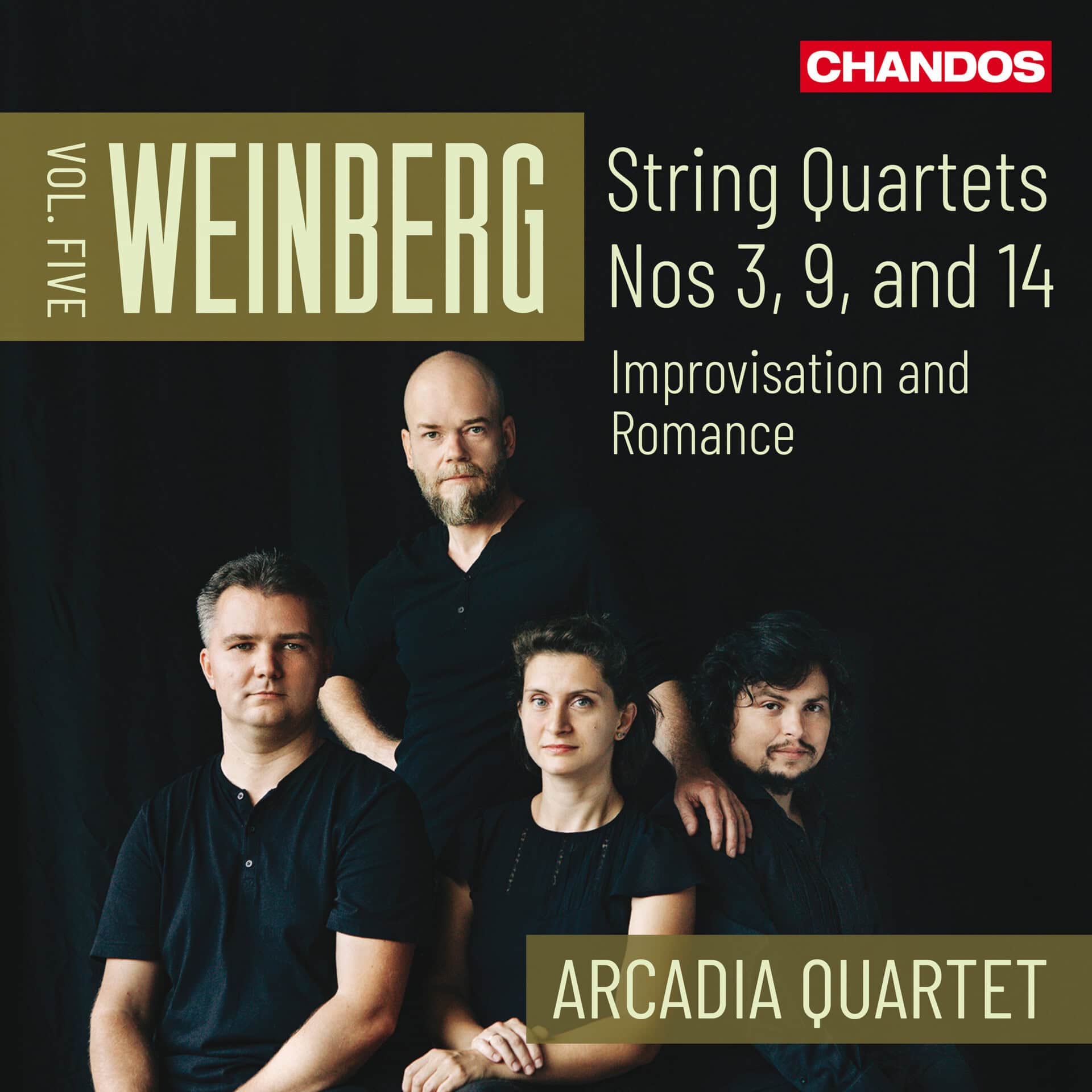
That the music of Mieczyslaw Weinberg (1919-1996) still finds itself in the shadow of that of his contemporary Dmitri Sjostakovitsj (1906-1975) cannot be adequately explained from a purely qualitative point of view, while the chances seem fairly slim that it will ever achieve a real breakthrough. That we have devoted relatively much attention to Weinberg and his music will, I fear, be able to change little about this in the long term. Even the many top musicians who have taken Weinberg's oeuvre under their wing will have to accept this as part of the bargain (and undoubtedly have). Even the phenomenally playing Arcadia Quartet, founded in 2006, finds itself confronted from the outset with this impregnable public stronghold.
With the performance of all seventeen string quartets (this is the fifth and also penultimate part in the series), it follows in the footsteps of the equally eminent Franco-Belgian Quatuor Danel (which has also acquitted itself most creditably in the complete string quartets of Sjostakovitsj).
Like the earlier parts, the program is not arranged in chronological order, but according to the different periods in Weinberg's development as a composer. That already provides considerable contrasts in itself. Among them also what is widely regarded as Weinberg's first 'mature' quartet, the three-part third quartet composed in 1944. The ninth quartet (1963) dates from a decade in which Weinberg's composing was highly praised by an influential group of musicians, including the Borodin Quartet, the conductors Kirill Kondrasjin and Rudolf Barsjaj, the pianist Emil Gilels and the violist Leonid Kogan. In the fourteenth quartet (1978), composed three years after the death of his good friend and mentor Sjostakovitsj, Weinberg's quest for his artistic identity is reflected. As a closing piece, though beautiful and out of step with the rest, the short Improvisatie en Romance from 1950 serves as the finale.
[caption id="attachment_43859" align="alignleft" width="457"] Weinberg (r.) and his wife Olga Rakhalskaja at the premiere of Sjostakovitsj's Fifteenth Symphony (l.) on 8 January 1972[/caption]
In the performance by Arcadia there dwells such artistic maturity and dedication that it makes for a remarkable listening experience. The mood swings, from melancholic or cynical to distinctly somber or even threatening, are sublimely 'captured' by the ensemble; and at an exceptionally high technical level at that. The razor-sharp articulation, the richly varied timbres, the dynamic intensity, the refined phrasing: it all contributes to truly outstanding performances that are not hindered for a moment by the brilliant recording.