

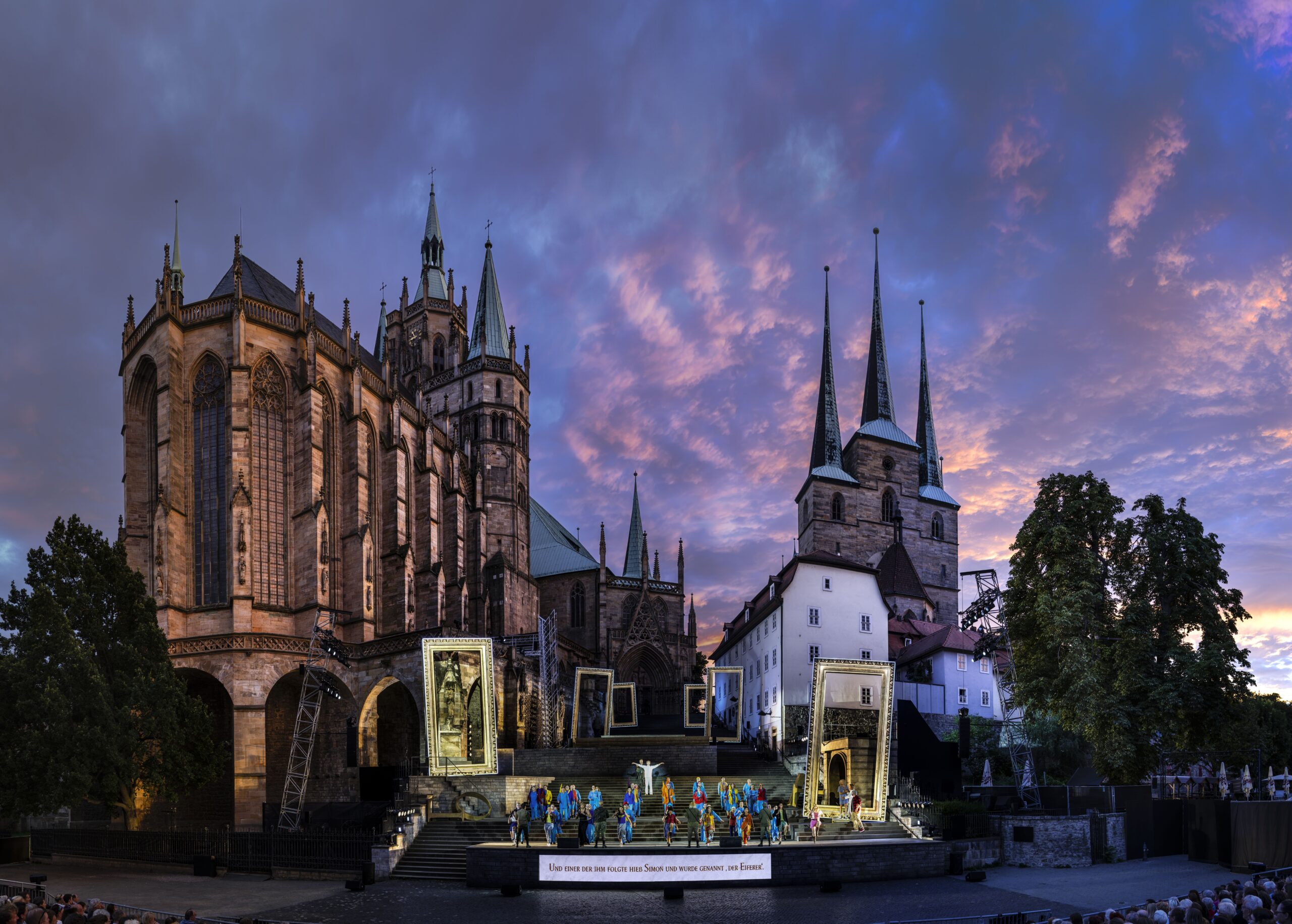
After experiencing a memorable performance of Puccini's La Bohème at the Domstufenfestspiele last year, I wanted to attend again this year, now that Theater Erfurt is bringing Andrew Lloyd Webber's (°1948) and Tim Rice's (°1944) Jesus Christ Superstar to the steps of the Dom.
There are performances that tell a story, and there are performances that make you think primarily about the way stories come into being. Jesus Christ Superstar belongs – especially in Theater Erfurt's new production – to that second category. Those who expect a religious tale about the last days of Jesus of Nazareth on the Domstufen get something different: a rock opera about power and manipulation, about admiration and fear, but above all about what happens when a human being is turned into an icon – and when someone who knew him closely begins to doubt the image that has formed of him.
Moreover, it is a special place to see this performance. The Domstufen are the steps along which believers climbed for centuries, seeking rest, hope, salvation, answers to their questions. At the very top, at the entrance to the Dom, hangs an image of Jesus on the cross; in front of it, a completely different version of that same story unfolds. The Dom and the Severikirche form the historical backdrop against which everything takes place. On the steps stand seven golden picture frames, scattered across the performance space, with one central frame in the middle where the most important events take place. At the bottom is the word Love as a kind of keynote for the performance. Love is the central message, but at the same time it is precisely what the characters continually come into conflict with each other about. That this production still manages to draw a large audience became evident on this evening too: the performance was completely sold out.
One technical point deserves to be mentioned beforehand, because it kept recurring throughout the evening. The orchestra and rock band do not play on the Domstufen themselves, but elsewhere in the theater; the music is fed in synchronously via loudspeakers, while the choir and soloists actually sing live on the steps. As soon as the rock band started playing, the orchestra often faded into the background; sometimes you almost got the impression that only the band was playing. In the sparse, restrained passages – dark strings, few instruments – the orchestra, on the other hand, could show what it really had to offer.
At the bottom hung a screen on which the musicians were visible at the beginning and on which the various events were announced during the piece. That immediately raises the question of why, if you're going to the trouble of naming the events anyway, there was no surtitling. The singers were frequently drowned out, even though they were amplified. For those unfamiliar with the work in German, the text was therefore not always easy to follow.
A Jesus who is losing himself
An ambulance arrives with sirens wailing and Jesus is thrown out of it. It is an image that only gains its full meaning in retrospect, but it immediately sets the tone for what follows. This Jesus is not the untouchable figure who stands above his surroundings; he himself sometimes seems not to know exactly what he is doing. And that is precisely what Judas seems to be the first to see through.
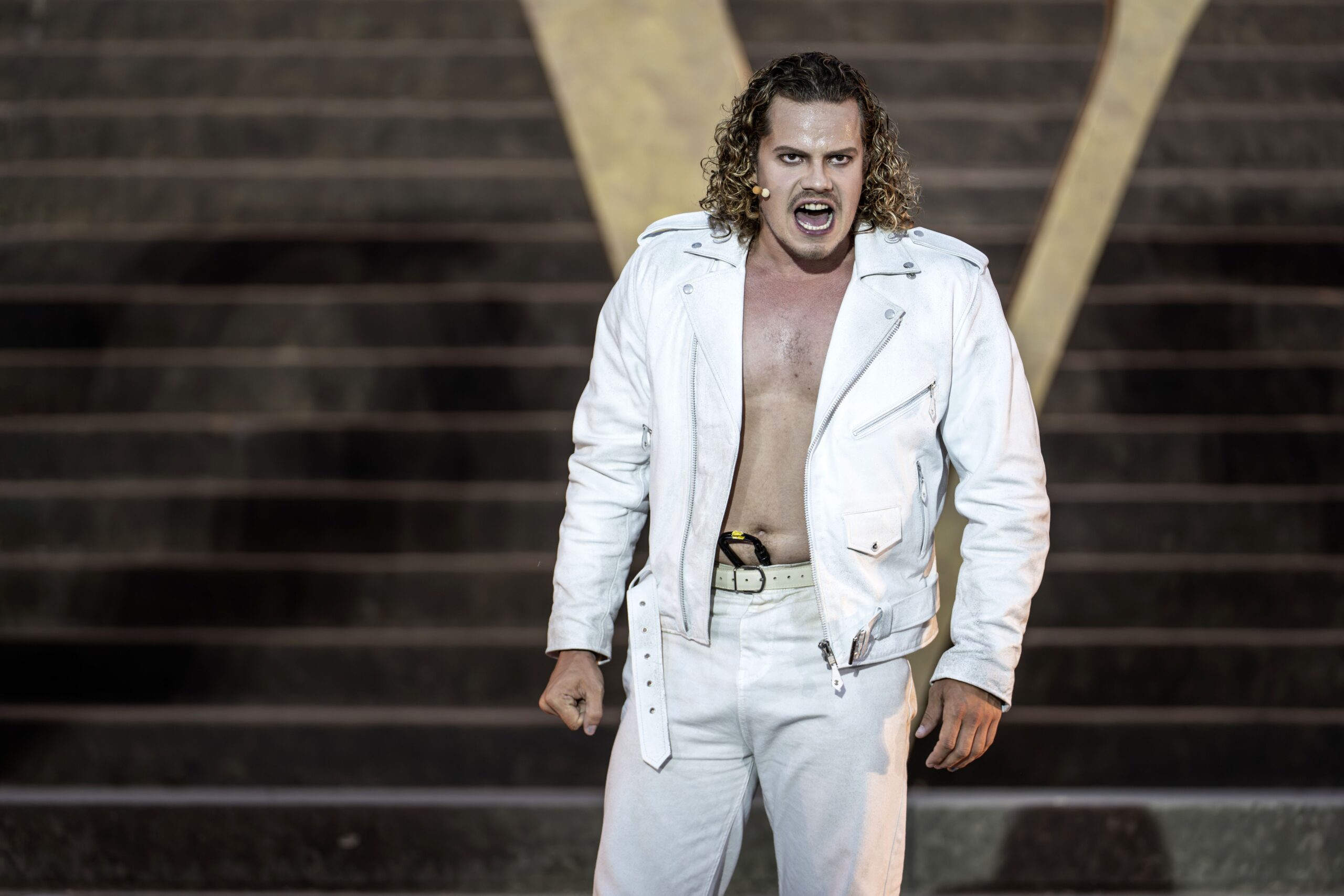 When the actual story then begins, Jesus is presented in this production as a kind of flower power guru: someone surrounded by followers, who sees the good and love in everyone. A shop with love for sale even appears on stage. The group moves almost like a community around a charismatic leader. Judas – played by Til Ormeloh, with a naturalness that would carry the whole evening – visibly does not feel at home there. You see him doubting before he sings even one word about it: can this really be the path they should follow? When Simon Zelotes (Lukas Witzel) – a small role with a pleasant voice – appears armed with soldiers, that doubt becomes more concrete. Jesus resolutely refuses: no war, no violence, no power struggle.
This immediately makes it clear that this production does not so much make Jesus the central figure, but especially Judas. He is the doubter, the one who ultimately betrays his best friend, but also the character with whom an audience can most easily identify. Because Judas is not only the man who commits betrayal; he is first and foremost the man who no longer understands what his friend is becoming. The longer he looks at Jesus, the stronger the suspicion becomes that the man he knew is in danger of disappearing behind the image that others are making of him.
This idea, moreover, has a much older tradition than the rock opera itself. When I saw this production, I could not help but think of the famous altar by Tilman Riemenschneider in the main church of Rothenburg ob der Tauber, in which Judas comes to the fore quite prominently as a central figure, alongside and not merely subordinate to Jesus. This makes Peter Lund's choice all the more interesting: Judas is not acquitted, but he is made human in whom human doubt, love and ultimately also failure become recognizable.
Lukas Mayer plays Jesus with full commitment and has a pleasant, at times even vulnerable voice. He clearly knows the role through and through. Yet he sometimes lacks that pronounced character needed to truly hold his own against the intensity of Ormeloh. The fact that Jesus is presented less strongly as an individual character gives Judas precisely the space to pull the drama towards himself.
 The temple scene itself also contains one of the simplest yet most powerful inventions of the evening: in all the painting frames appears the word sale, sale, sale. Everything is for sale, everything costs almost nothing. At the same time, Jesus's inner conflict is literally portrayed here when he drives the merchants from the temple: red ribbons hang from him, held by figures pulling at them – a man being torn apart, as it were, by everything demanded of him. The sale symbolism directly connects to the unrest growing in Judas from the very beginning: the message of love and community stands in contrast here to a world in which everything has become tradeable. It is not a complicated symbol, but it works no less effectively because of it.
Maria Magdalena, played by Ks. Katja Bildt, initially does not make much of an impression in the first part. In Everything's Alright she remains too much in the background. Only in I Don't Know How to Love Him, at the end of the first part, does she have her strongest moment. There Bildt convincingly conveys how strange her love actually is: she and Jesus are different from each other, but that does not make her feeling any less strong. She does not know how to love him, but she knows she cannot help it.
The first part ends with the blood money that Judas receives. In hindsight, that proves to be a significant turning point. The first half is mainly preparation: the characters are introduced, their relationships are built up and Judas's hesitation gains increasing weight. Only after the intermission does it become truly clear why Judas comes to his betrayal and why Jesus can or will not adjust his vision.
And the puzzle pieces fall into place
After the intermission, the direction takes a slightly blasphemous but highly effective approach to the Last Supper. The apostles lie drunk at the table or stagger about, admittedly sung with precision, while Judas and Jesus conduct their own reckoning at the front. Betray me then, Jesus seems to say. Judas replies that Jesus does not understand why he is doing it, that he has disowned himself. The contrast between the celebrating, unknowing group and the two men who seem to already know their fate is among the most impressive things the direction showed that evening.
Then comes Gethsemane, the moment when Jesus explicitly asks if the cup may pass from him. It is a compelling moment, because the rock opera falls almost completely silent here and only a human with his fear remains. Jesus tells how long he has been dealing with this: three years, thirty years, at one point even ninety years – a timescale that no longer seems to be reality, but a measure of the exhaustion that is taking hold of him. The superstar disappears; what remains is someone who realizes what awaits him and, despite everything, cannot avoid it. Lukas Mayer finds more of the character that was sometimes lacking earlier in this scene. Here Jesus is no longer the charismatic guru, but the human behind the image.
The betrayal itself then gains particular power through the choir. From a distance comes Warum, warum, as if a voice outside the events reacts to what is happening on the steps. The choir is not always visible, which gives it something intangible: sometimes it seems a voice from above, sometimes a collective conscience, sometimes simply the reaction of a community that does not understand what is happening.
In the interrogation scenes there are two strong supporting roles. Rainer Zaun as Pontius Pilatus initially has little to portray in his military uniform, but when he must condemn Jesus and washes his hands in innocence, despair becomes palpable – the look of someone who no longer knows what to do with the man before him. That human doubt makes this Pilatus more than a functionary simply carrying out a decision.
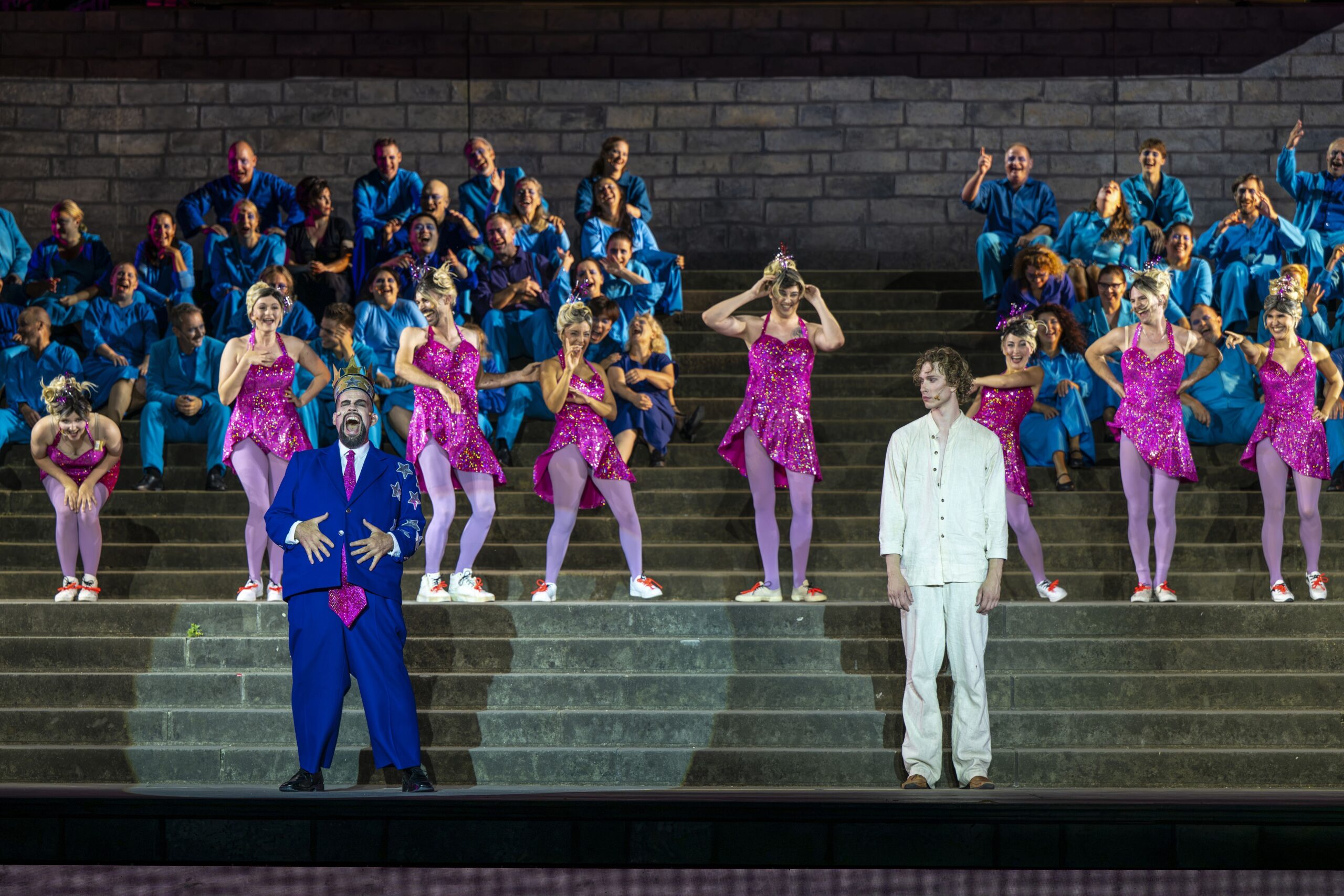 Máté Sólyom-Nagy makes Herodes something entirely different. Herodes' Song becomes almost a grotesque show number, with a colorful ensemble around him. Jesus is not treated here as a king, messiah or special human, but as an entertainer who must amuse his audience. In this way, the scene makes visible, in an almost absurd manner, what the entire production ultimately revolves around: what happens when someone is no longer seen as a human, but as spectacle?
Finally, two choices regarding Judas are particularly striking. His death is not shown here, as is traditional, as suicide, but as murder by one of the high priests. At first glance, this seems like a minor directorial choice, but it genuinely changes the way you look at the character. Judas becomes not the man who succumbs to his own guilt, but someone who is ultimately destroyed by the same power mechanism he himself helped to perpetuate.
After his death, he returns once more, for an iron-strong dance moment in which he mocks Jesus. Stylistically, this fits seamlessly with the rest of the performance. It is as if Judas, even when the story has already written him off, claims one last time the right to determine how he is seen. It is a final, almost ironic confirmation of the fact that this production is ultimately as much about Judas as it is about Jesus.
The crucifixion itself, depicted in the middle painting frame, is remarkably restrained. Because the production elsewhere engages so inventively with images and symbolism, this scene feels almost surprisingly conventional. You might wonder whether the crucifixion should not have been more than this; on the other hand, that simplicity, after the bling-bling at Herod's, hits hard, especially when Jesus asks for his mother.
What follows after Jesus' death is musically very impressive. The instrumental finale takes on an intensity that the crucifixion itself did not have. The music takes over where the image falls silent and makes the ending not a grand spectacle, but a kind of retrospective on everything that preceded it.
Who is the superstar here, then?
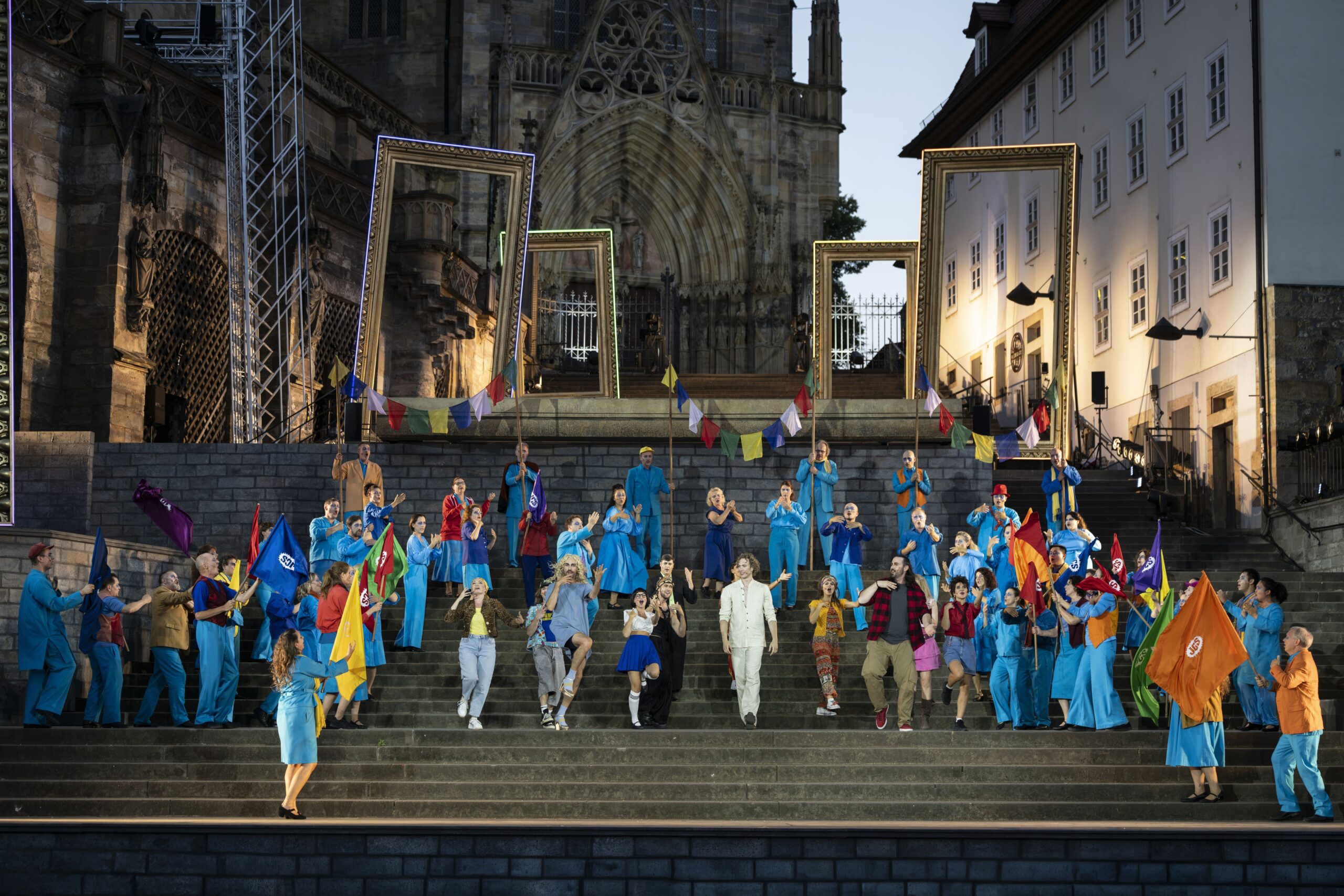 What ultimately makes this production strongest is the shift in focus that Peter Lund maintains from beginning to end. Not Jesus, but Judas becomes the figure in which the audience most readily recognizes itself – and that makes Til Ormeloh the undisputed center of this production. His naturalism, his constant doubt and his visible dissatisfaction with the direction in which Jesus evolves, make him credible without exonerating him. He is neither a hero nor a classical villain, but a man who thinks he can still control a situation and only too late discovers that he himself has become part of the mechanism he wanted to stop.
In contrast stands Jesus: the title makes him a superstar, the masses elevate him to icon, those in power make him a threat and ultimately a victim. But in Gethsemane, all of that falls away. Then there is no icon anymore, no guru, no messiah and no superstar. There is only a man who is afraid.
And perhaps that is precisely what makes this production on the Domstufen so gripping. Behind the rock opera, behind the masses, the seven golden frames and the monumental churches rises a simple but uncomfortable question: what do we do with a human being when we make him a superstar?
And what remains of him then?
PS: For the recognition of the readers, I have chosen to name the songs in English, even though the production is sung in the German translation by Timothy Toller (2023).