

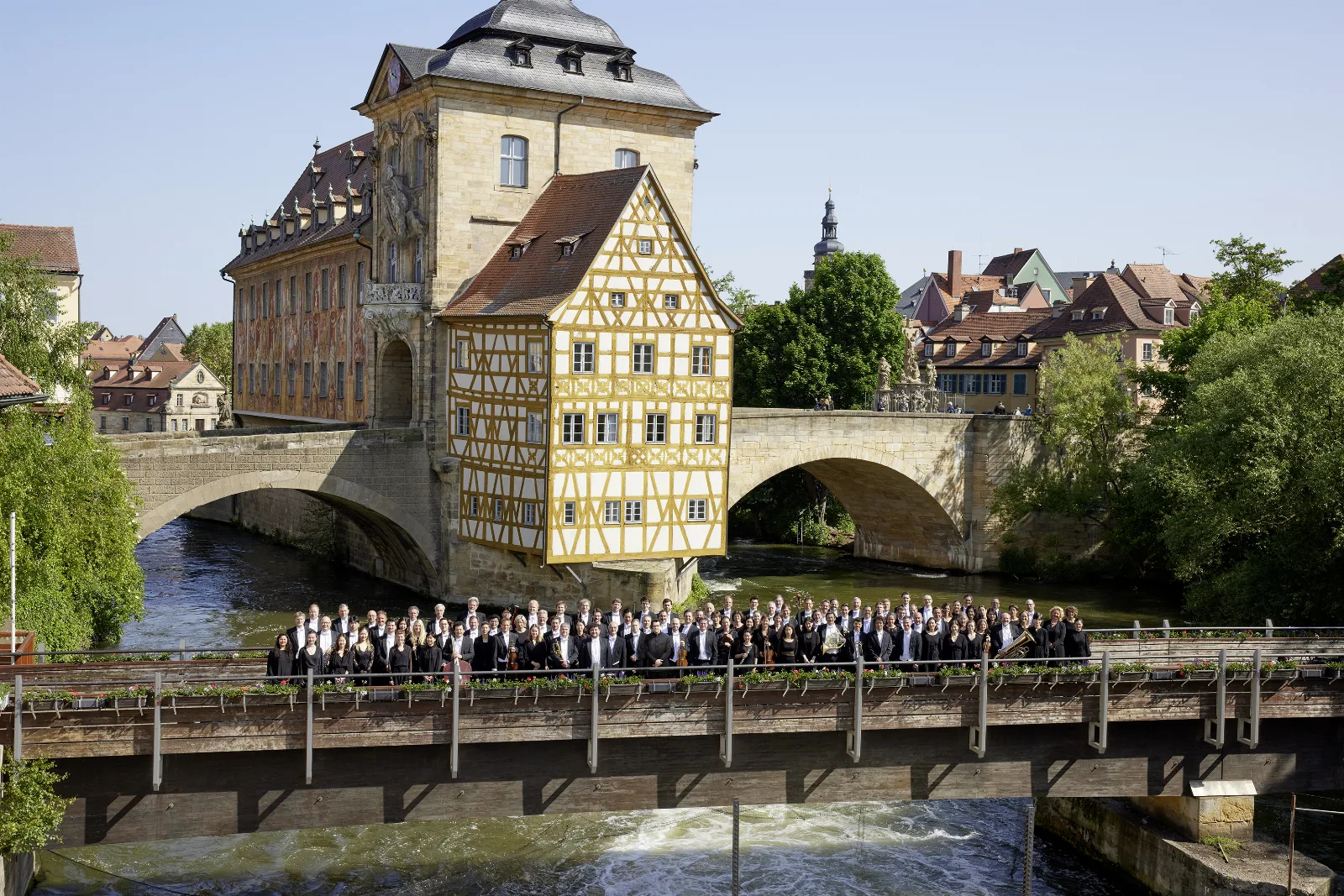
On Friday 16 October, Cofena and the Antwerp Symphony Orchestra welcomed the Bamberger Symphoniker to the Gouden Zaal of the Koningin Elisabethzaal. The German orchestra is celebrating its eightieth anniversary this year and was recently named Orchestra of the Year 2026 by Gramophone. Under the direction of Manfred Honeck, the orchestra returned to Antwerp. With Midori as soloist in Mendelssohn's Violin Concerto and then Bruckner's Ninth Symphony, the programme featured two works whose musical worlds could hardly be further apart.
Midori Takes Her Own Path
With his Violin Concerto in E minor, Op. 64, Felix Mendelssohn (1809–1847) wrote a work in which lyrical spontaneity and virtuoso brilliance constantly flow into one another. Midori gave this contrast a very personal interpretation. She placed her own accents in tempo and ornamentation without losing sight of the overall coherence. Precisely because she did not smooth everything over, the music continually surprised, while Mendelssohn's melodic lines retained their natural momentum.
That freedom also asked something of Honeck and the Bamberger Symphoniker. Conductor and orchestra responded alertly to Midori's phrasing and tempo, while the warm orchestral sound gave the soloist all the space she needed. At the transition into the third movement, a strikingly long pause held the anticipation for a moment longer, before the finale broke loose with renewed energy.
As an encore, Midori chose the Largo from Johann Sebastian Bach's (1685–1750) Third Violin Sonata. After the restlessness of Mendelssohn, this introspective music brought a world of stillness.
A Cathedral of Sound
Anton Bruckner's (1824–1896) Ninth Symphony is for me the nec plus ultra of music history. In the late Bruckner performances of Herbert Blomstedt, I heard how the music can dance and how, as a result, the composer acquires something profoundly human. With Bernard Haitink, the drama built up carefully, with a natural mastery. Manfred Honeck, by contrast, takes his time to unfold the great arches and lets us hear how the symphony grows from its inner coherence.
I had been eagerly anticipating this performance, as I have long treasured Honeck's recording with the Pittsburgh Symphony Orchestra and had wanted to hear his interpretation live. In Antwerp, what struck me most was how seamlessly all the elements came together. The orchestral sections were carefully attuned to one another, without the music losing its spontaneity. The Pittsburgh recording is remarkably successful in its own right, but with the Bamberger Symphoniker the details and tensional arcs acquired a different dimension in live performance.
In the first movement, a vast musical edifice unfolded. The deep strings laid a dark foundation, above which the various voices gradually emerged. The horns sounded full and round; when the brass joined them, the tension increased without the music losing clarity. Honeck chose spacious tempi and gave the long lines all the time they needed to develop. Yet the music remained constantly in motion, carried by an undercurrent of momentum. I searched in vain for a weak spot.
The Scherzo brought a very different energy. The rhythmic sharpness and massive orchestral sound made it a tempestuous whole. Through its brisk tempo, the Trio acquired an almost feverish momentum.
After the Scherzo, Honeck let a long silence fall before the Adagio began. The hall waited. That stillness did not feel uncomfortable but gave the following movement its weight. This Adagio is for me the heart of this symphony, and Honeck made clear why.
Between Despair and Stillness
The horns and Wagner tubas gave the Adagio a dark, almost human warmth. Beneath them sounded the deep string tone, now consoling, now ominous. From this layered texture, Honeck built towards several climaxes. Some seemed briefly to reach for joy, others grew ever sharper and more threatening.
In the great dissonant climax, the music reached an almost unbearable point. The despair in this passage was almost physically palpable. Then followed a long silence, in the middle of the movement, before the music continued its path towards the close. The hall remained motionless, as if space had first to be created to absorb what had just sounded.
The Adagio continued towards its final, hushed passage. When the sounds had faded away, another exceptionally long silence followed. Honeck deliberately held his hand in the air to hold back the applause. No one seemed willing to let go of the music just yet.
It was precisely this moment that made the difference with a recording palpable for me. You do not only hear the music but share the waiting with the entire hall, without knowing how long it will last. I listened with a lump in my throat.
Bruckner died before he could complete the finale. Yet I did not experience the Adagio as an unfinished thought. It had something of a farewell in it, in which, after all the struggle, a profound resignation resounded.
Only when Honeck lowered his hand did the applause break out. It grew into a standing ovation lasting several minutes, a reaction I have rarely experienced in the Gouden Zaal, certainly not after Bruckner.
There are concerts that you admire for what the musicians can do. And there are concerts where the music holds you so completely that you forget where you are when the last sounds die away. On 16 October, that is what happened.