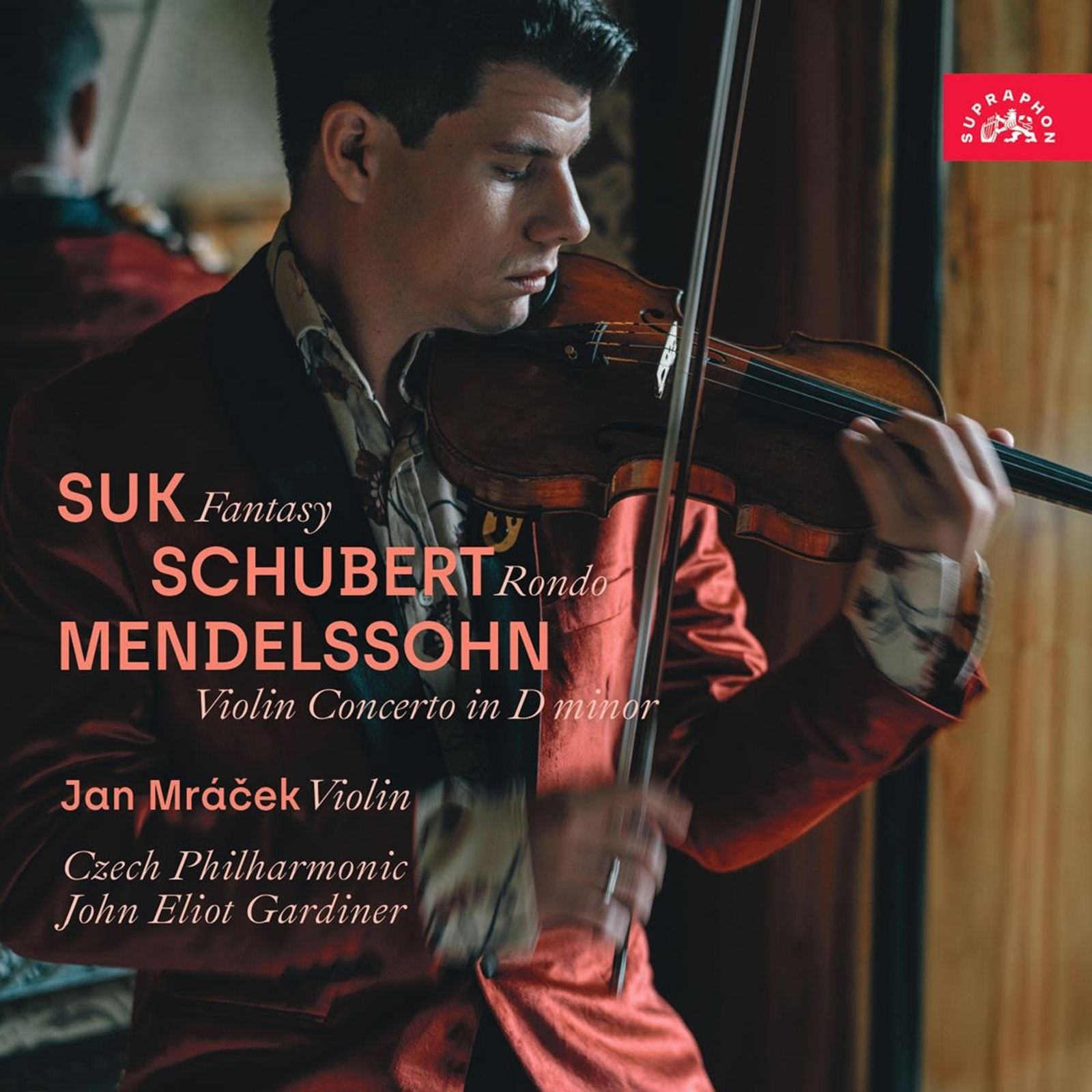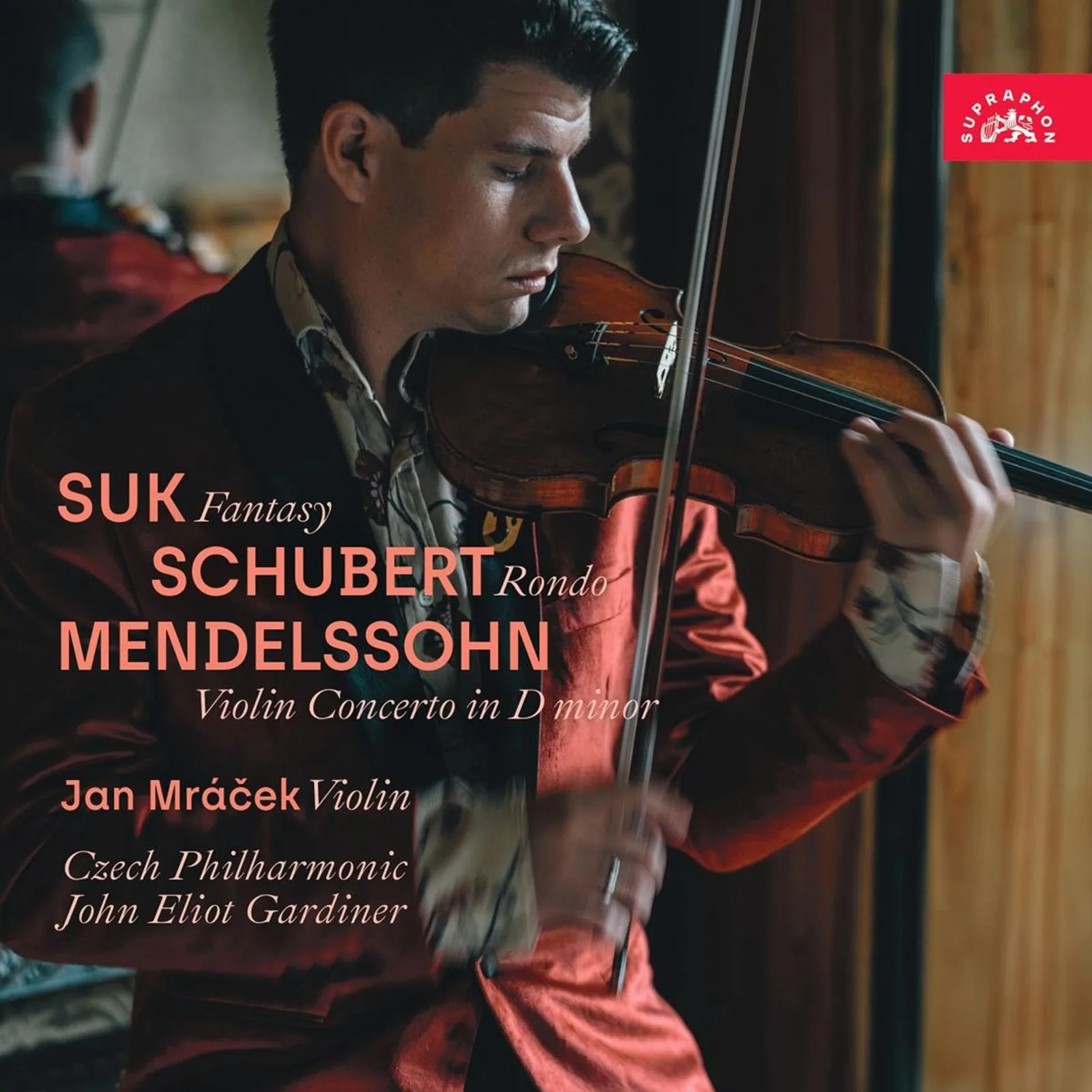
A program featuring Josef Suk (1874-1935), Franz Schubert (1797-1828) and Felix Mendelssohn (1809-1847) may at first glance seem an unusual combination. Yet on listening, the three works prove to have more in common than their differing stylistic worlds would suggest. Violinist Jan Mráček links Suk's Fantasie op. 24 with Schubert's Rondo in A major and Mendelssohn's early Violin Concerto in D minor. Suk and Schubert are not only far apart in time and style; Mendelssohn's juvenile work also occupies a very distinct place within this program. It is precisely in this unexpected combination that room emerges for three different sides of Mráček's music-making.
Tension and stillness
Suk's Fantasie begins forcefully right away. The orchestra opens with a striking urgency, after which the violin brings a sense of stillness. This contrast continues to fuel the performance: movement and restraint, tension and lyricism alternate without the whole falling apart. The orchestral contributions are dynamic and colorful, but never overdone. Especially in the way the different instrumental groups respond to the violin, a constant sense of movement arises. The music is never overplayed; it is precisely the dosage that makes room for the many shifts of mood in the Fantasie.
Mráček captures the atmosphere of the work with great musicality. His violin playing combines technical mastery with a strong feeling for sound and phrasing. In the virtuosic passages his confidence is evident without the music losing its tension, while in the more restrained and playful moments he leaves room for nuance. Also notable is his sense of proportion: he knows when the violin should step forward and when it is better to blend into the orchestra. The result is a performance in which the great contrasts of the Fantasie remain palpable without being exaggerated. The violin remains an independent voice, yet is never detached from the orchestra. It is precisely this interplay that makes Mráček's interpretation convincing.
John Eliot Gardiner also plays an important part in this. He does not simply accompany but responds to the soloist and gives the orchestral part its own profile. The accents in the woodwinds stand out in particular: they not only answer the violin but sometimes seem to steer it in another direction. As a result, the orchestral part gains an independence that goes beyond support. Gardiner and Mráček, moreover, performed Suk's Fantasie together for the first time. The recording carries something of the alertness such a first collaboration can evoke: not as demonstrative freshness, but as a constant listening to what is happening musically.
Music-making with one breath
With Schubert's Rondo in A major D. 438 the scale changes. The orchestral richness of Suk gives way to a smaller, more chamber-like ensemble. Remarkably, the Chamber Orchestra of the Czech Philharmonic plays here without a conductor. Mráček takes the lead and does so with remarkable naturalness. He directs the musicians from the violin, yet at the same time remains fully part of the ensemble. A phrase is taken up by the orchestra, a motif returns in the violin, and musical movements pass almost unnoticed from one group to another.
This way of making music produces a fine homogeneity. The different instrumental groups respond attentively to one another and place their accents precisely where needed. This gives the performance an elegant mobility: the music is constantly in motion, yet never gives the impression of haste. Mráček keeps the musical line clear, while violin and ensemble continually respond to each other. Even in the more lyrical passages this mutual attunement remains audible, with room for nuance.
At the same time there is a great deal of playing pleasure. The virtuosic moments gain momentum and sparkle, while the more singing passages leave room for expression. The violin can step forward and then rejoin the ensemble. The chamber orchestra not only responds to the soloist but also actively carries the musical movement itself. It is precisely this combination of elegance, homogeneity and joy in playing that makes this performance especially successful.
Youth without frivolity
Mendelssohn's Violin Concerto in D minor, written when the composer was thirteen, is not treated here as a curiosity either. Mráček plays it distinctly cantabile. Especially in the Andante the melodic line is given full scope. The violin sings without the phrase being weighed down, while the chamber orchestra supports the line with a transparent sound. Here too the ensemble plays without a conductor, with Mráček taking musical leadership from the violin.
This makes the performance interesting in comparison with the 2026 recording by Elvin Hoxha Ganiyev, who also recorded the D minor concerto. Ganiyev's reading stood out for its freedom, ornamentation and sometimes almost improvised impulse. Mráček takes a different path. His playing sounds even lighter and therefore more convincing: the music never seems to have to search for spontaneity, but simply possesses it. The phrasing remains natural, the virtuosity effortless, and the collaboration with the chamber orchestra remains strikingly cohesive.
The approach is at its strongest in the finale. Here it is pure joy in playing. The virtuosity takes on something playful and agile; passages seem to chase one another without ever sounding hurried. Mráček's technique is fully in the service of that energy, while the chamber orchestra follows the movement with remarkable suppleness. The music here seems to take pleasure above all in its own motion. It is precisely the youthful energy one might expect from a thirteen-year-old Mendelssohn, but without being thickened or romanticised.
A thoughtful whole
The strength of this disc ultimately lies not in a stylistic unity, but in the way Jan Mráček repeatedly positions himself anew in relation to the music and the ensemble. He plays with complete technical control, never presenting his virtuosity as an end in itself. In Suk the violin takes on a distinctly dramatic role within a rich orchestral texture; in Schubert a refined chamber-music dialogue emerges, although the great control leaves little room for the unexpected; in Mendelssohn the same playing attitude becomes younger and more playful, with a finale in which virtuosity and pleasure coincide.
In this way, the seemingly unusual combination of Suk, Schubert and Mendelssohn proves to be a carefully considered programme. The three works retain their own character, while Mráček does not attempt to fit them into a single interpretative mould. It is precisely there that the persuasive power of this disc lies: the differences remain audible, yet together they form a clear portrait of a violinist who succeeds in capturing both the dramatic expressiveness of Suk, the chamber-music refinement of Schubert and the youthful joy of Mendelssohn.