Futurism has always struck me as
– with some exaggeration –
the moment when humanity
invented art. […]
as an expression of hope and promise.
G-W Raes, Logos@50, p. 156.
Godfried-Willem Raes in conversation with Philippe Grisar
Bio Godfried-Willem Raes, born and raised in Ghent, studied musicology and philosophy at Ghent University. He also attended the Royal Conservatory of Music, which in 1968, after the performance of an original composition commission (piano, clarinet, percussion and composition, among others with Louis de Meester), showed him the door. He subsequently founded the Logos group together with a few accomplices. As a student, Raes already travelled (hitchhiking) to the Darmstädter Ferienkurse für Neue Musik. Thanks to his fluent German he became the interpreter of many formal and informal conversations. This sought-after translator got to know, among others, Karlheinz Stockhausen and György Ligeti. Alongside his musical career, Raes pursued an interesting path. In 1982, for example, he began working as a teacher of new music at the conservatory that had previously thrown him out. Meanwhile, in 1969, together with Walter De Buck and other Logos collaborators, he breathed new life into the Gentse Feesten. That modest beginning, with artists singing on beer crates, grew into a far too large fairground. For years the Logos Foundation provided new acts. In 1988 he became programmer for the Filharmonische Sociëteit of the Paleis voor Schone Kunsten (Bozar). Some five years later Raes obtained his doctorate in musicology with a dissertation on the "invisible musical instrument". This short and incomplete biography is supplemented by Raes himself in his book Logos @50 – Het kloppend hart van de avant-garde muziek in Vlaanderen (Stichting Kunstboek), which appeared last year. It is practically impossible to list all the innovative projects of Godfried-Willem Raes and the Logos group in this brief introduction. In the book he lists them himself, with the necessary anecdotes, context and names. You can read the enthusiasm, the unceasing thinking and the disappointments. Electronics proves to be a constant source of inspiration, as does the human capacity to renew, even if this is (increasingly) against the current. On Passages we hear an important project on which this inventive rascal is still working. With the élan of the futurists and the spirit of '68, this master storyteller, mathematical mind and musical genius continues to work on the future.
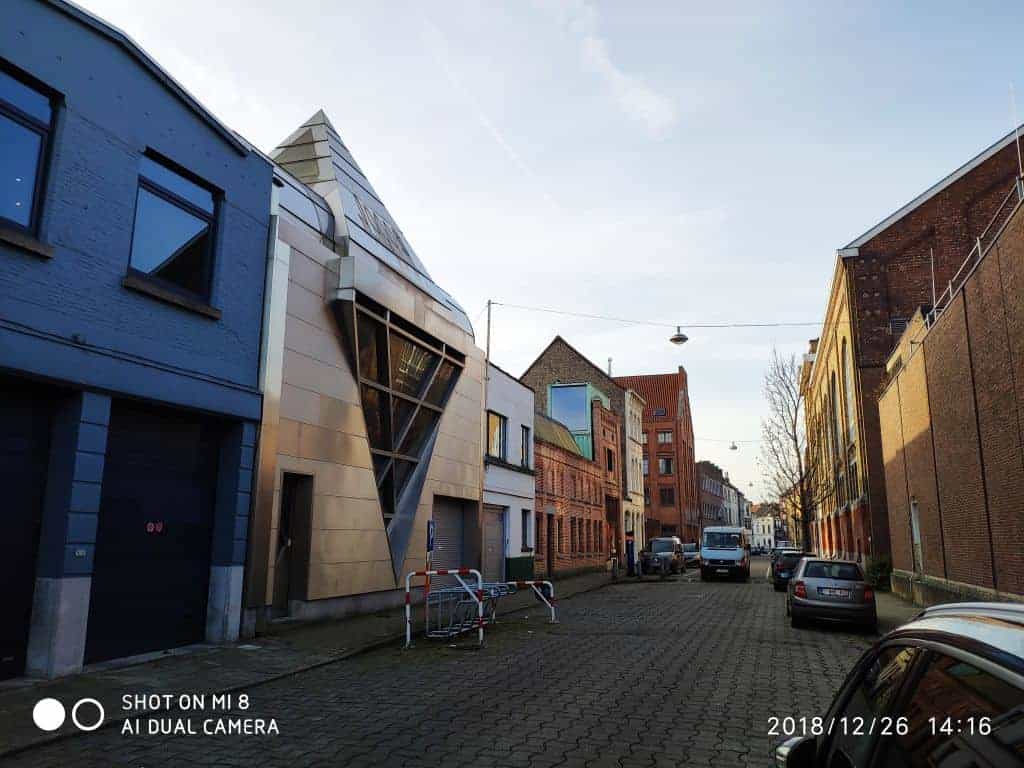
Visiting the Mephistopheles of music The twin-headed building lies not far from the great Centrale at the former outer harbour of Ghent, a neighbourhood where many colonials lived and were active. Because the entrance on the Kongostraat looks more like a house than the one on the adjoining Bomastraat, I rang there. An invisible dog barked watchfully until the door swung open. With a pipe in his smile, Godfried-Willem Raes let me in. He jovially led me to the middle of the two buildings, which connect like yin and yang. The same breath flows through both. A long hallway adorned with a display cabinet full of kitschy little sculptures and two well-known heads opens onto a small desk. One head has the artist's smile, the other belongs to Monique Darge, his life partner and fellow accomplice. That little desk resembles an old library of cassettes and tapes. The wall cabinets are truly stuffed with old recordings neatly numbered into a logo- or sonotheque. We passed through a kind of antechamber with, on one side, a clavichord pushed against the concrete wall and, on the other, all sorts of electronics of varying newness, with a large computer screen on the table in the middle. Here it was quiet. I was immediately taken through to the small theatre room (annex museum, annex studio, annex bar) beneath the famous Tetrahedron of the Logos Foundation, Bomastraat. From the corner opposite the seats, robots stood displayed on either side like a jolly yet time-frozen procession. Godfried-Willem Raes disappeared among them into a corner behind a large support structure that props up the pyramid. Before I had fully realised in what Faustian spectacle I had landed, the orchestra of cheerful musical golems blared the overture of Monteverdi's Orfeo. And then one of Boulez's Notations (1945), served as an amuse-gueule for a conversation about renewal. Or as a teaser, because my host is no stranger to provocative teasing. A moment ago we were in the enthusiasm of the Baroque; now I tasted the twentieth century. Lights flickering, numbers lighting up, mechanical fingers pressing keys or striking pitches, a bronze plate rattling like a large timpani; more or less all real instruments played by musicians from Mephisto's laboratory. It is not magic but ingenious mechanics driven by brilliant electronics and software. Robots play the scores that were meticulously entered into the computer: note by note, with every indication from O to D and so on. I thought it was a magnificent spectacle! We settled at the table, tête-à-tête between the electronics and the clavichord. Usually I have a few questions in my head, but the book Logos @50 is quite complete and very readable. I had just finished it, like a box of tasty pralines. The chapters are short and powerful, some very personal or irritated. Raes unrolls the history of Logos (and of himself) through the many encounters with innovators, creative spirits and others. Some passages testify to patiently pushing back against the uncertainty and/or know-it-all attitude of policymakers. Much happened between the small revolution of May '68 and December 2018. Now it seems as if a counter-revolution is slowly taking shape. A person all too eagerly looks back nostalgically to a past in which everything seemed manageable and a God or the like, like a good father, ran his house – however cruel and unjust that often was. The "now" never lets itself be grasped, unlike the stories afterwards. Despite the futurists' promise, progress did not bring hope alone. Fortunately, not everyone stares into the dark. Working on a future means daring to renew. And openly enjoying the new. Enjoying the surprising inventions of the impish Godfried-Willem Raes. ….YOLO…
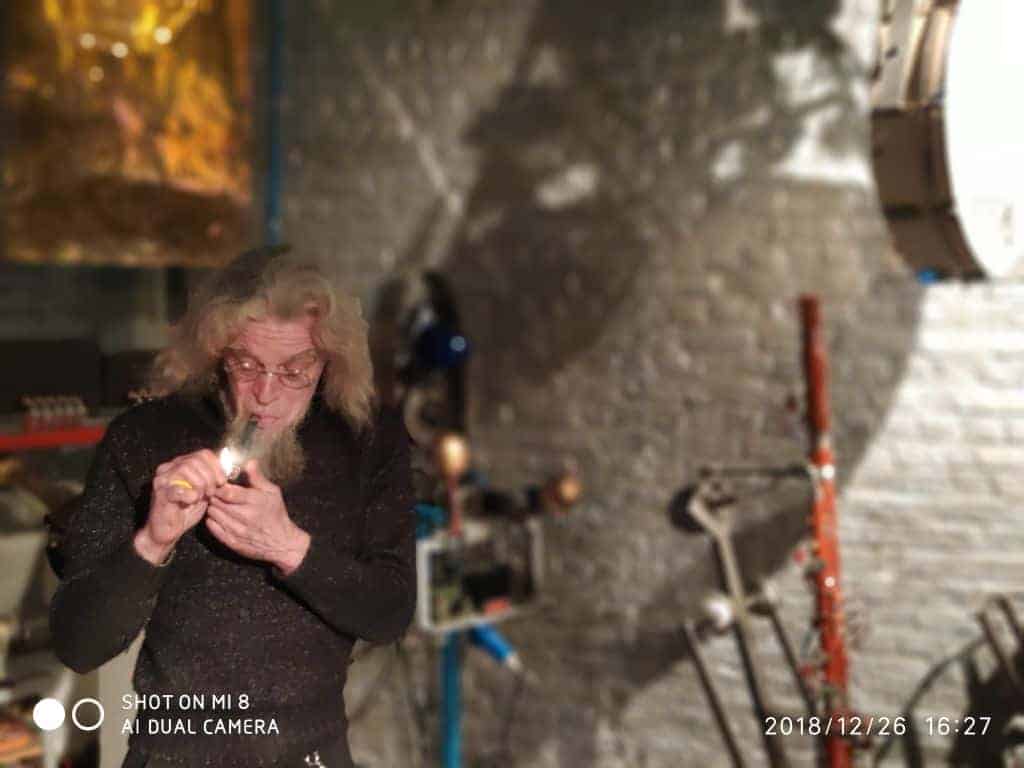
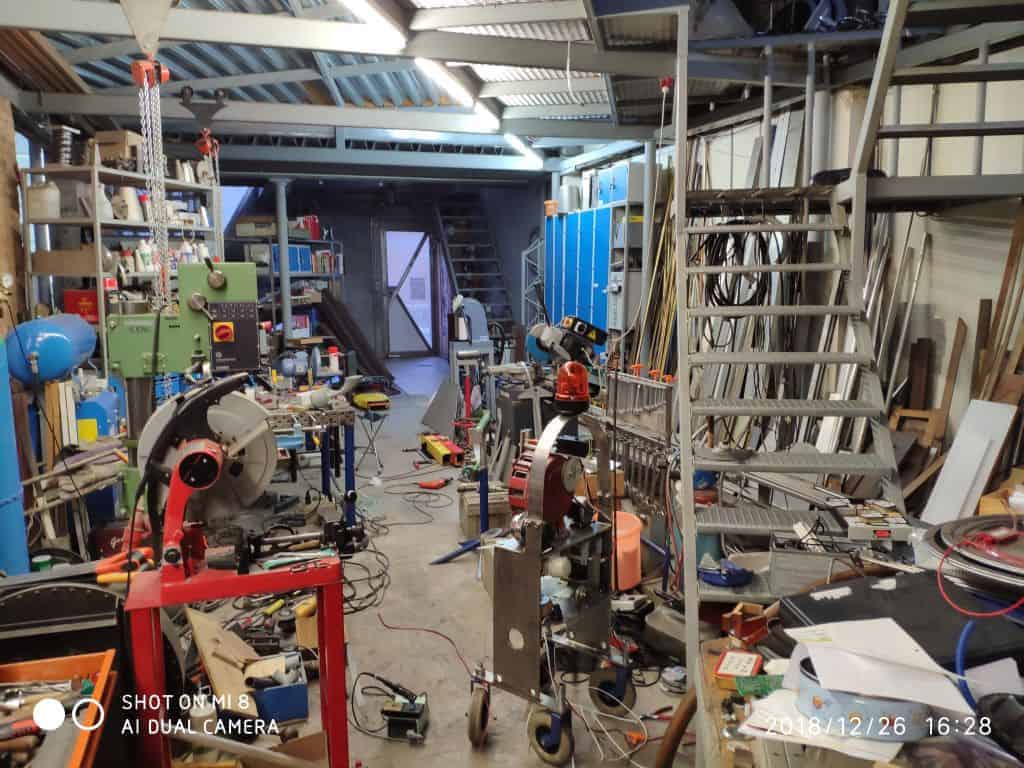
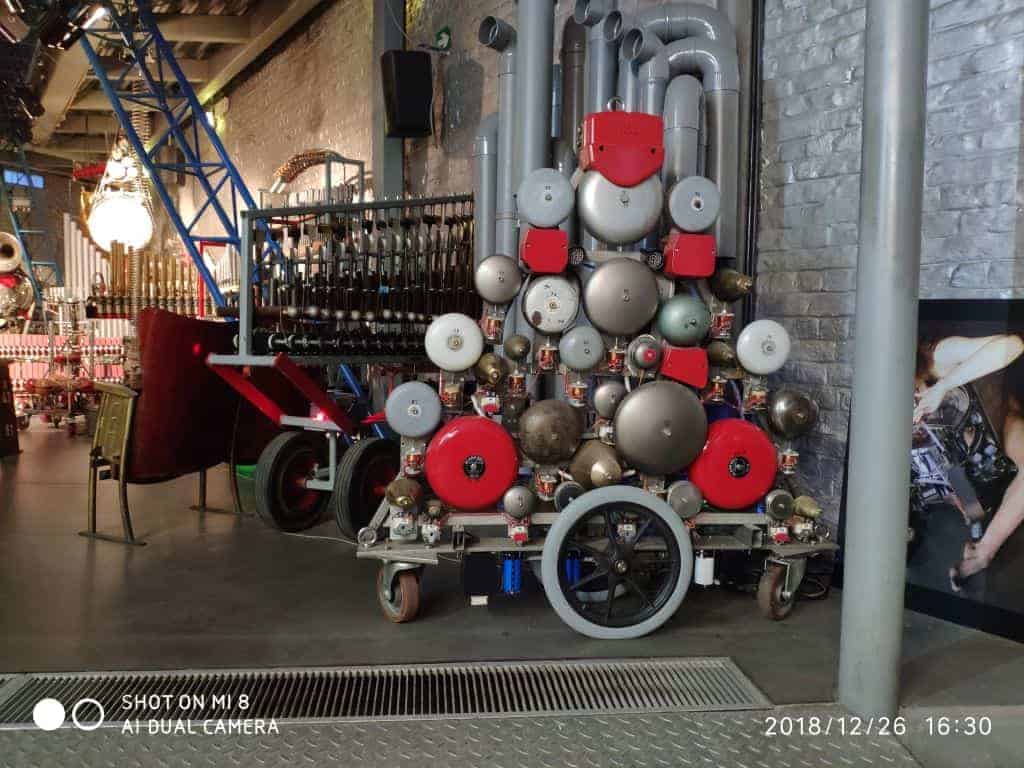
In conversation with Godfried-Willem Leibniz… er… Raes "If I had wanted to tell my full story, it would certainly have been 500 pages," replied the composer when I complimented him on his fairly complete book Logos@50. And so the conversation began, wandering from "Pier to Pol". It seems Godfried-Willem Raes is himself a book, though you cannot always choose which pages to read. Thus I immediately landed from Japanese – my interest – with Mao or, how could it be otherwise, the robots. The progressive spirit of '68 still hangs in the house like the sauced tobacco scent that now smells homely. I feel at ease at once. On Japan, inflection and rhythm I could have told much more about the ethnic music of Japan or Thailand and the background of that fantastic culture. We have been there often. I even took Japanese lessons to make myself a little understandable. I did not want to play the tourist but to penetrate as far as possible to the core of local culture, which is not easy in Japan. It all goes through introductions. People introduce you, but eventually you build up contacts slowly. Because it is formal and distant, it is best to know the rituals. Some insight into the structure of the language seems handy. In fact, Japanese syntax is extremely simple, but you have to know it. For example, they use different counters depending on the object being counted: people, animals, and things such as tables. An object does not exist without having a place. So a Japanese person must always say: it is that table here or that chair there. We have abstract concepts, but for them a place belongs to the word. You find that in Chinese too: a property cannot exist in itself. A property is always bound to an object. We have the reification of a property and can say: a puppy is sweet, a baby is sweet. So something like sweetness must exist. Sweetness is thus a construct of language. For a Japanese or Chinese speaker it is always sweetness of or for something. A property cannot be thought without a thing. A Chinese speaker cannot say "the danger" because "danger" does not exist on its own. That is why, in the sixties, when everyone had to read Mao Zedong, we read in puzzlement: "capitalism is a paper tiger". That is how it stood in all the translations. Why not just: capitalism is a danger? A Chinese speaker can only express that through an image. A paper tiger is not a real one, but like paper it can, for instance, catch fire. That says it all. It has to do with the structure of the language. In fact the translators did badly by translating everything literally. And musically? What strikes me in Oriental and especially in traditional Japanese music is that it has no periodic rhythm. Much of that music does not go [rhythmically] 1 2 3 4, but has a loose time division: [slow and then ever faster] tak – tak – tak tak taktaktak toededoelum. [GWR gestures the flying away of notes in the increasingly irregular rhythm] That is traditional music, not avant-garde! It has nothing to do with that. We do not know that time division in our music. With us it always sits in a metre, in a metric grid – except in experimental things. Japanese music, however, is very simple and mostly pentatonic or something similar. One plays with few intervals but very many micro-inflections. As with the shakuhachi [a Japanese flute played especially by Zen Buddhist monks]. One ornaments the few principal notes. Those inflections are not notated. The monk must study with the master for years. Just as in our classical scores, a score is an indication. For example, automatons, robots, do not do the same as human performers. If a classical score has a series of sixteenth-quarter notes written one after another, nobody plays it that way because you cannot play it. For example, it says you must press a C for the duration of a sixteenth note and then again for the duration of a sixteenth note. If you really do that, you hear an eighth note. The notation does not say you should lift your finger and thus play a rest: in reality they become thirty-second notes. Every musician knows that but nobody ever stops to think about it. If you give that score to a robot or a player automaton you do not hear sixteenth notes but quarter notes. The automaton plays it exactly right. [Laughs] Renewal is as old as the hills… With contemporary Japanese composers, even those who write more Western-style, one always finds traditional influences. And when they adopt the idiom of that Western post-serial music of the Darmstadt School, they compose more radically than Pierre Boulez or Karlheinz Stockhausen. Mathematical? Oh, no, mind you. All music is thought out! [irritated] That is again one of those myths we are stuck with in contemporary music: it is mathematical because there are calculations in it. Exactly as if there were no calculations in Bach's music. There is coherence and that is algorithmics. The Romantic idea – you know it – that music must come from the belly or the soul is no more than a boutade. I fear that brings us to the most pronounced academicism and conservatism. If you do not think a composition through and simply let it well up from you, you get all your conditioning back. From childhood on we are constantly surrounded by music with 1-4-5 relations and counting 1, 2, 3, 4. So whatever was spooned into you with the pap wells up from the Romantic soul. Unfortunately you cannot think that away anymore because music is everywhere. Otherwise you may only listen when it is performed. And then we are back in the 16th and 17th centuries. The technical reproduction of music has, in my view, broken a lot, i.e. it has made originality very difficult. By enlarging your frame of values you can escape it. One of the means for that is a technical and formal approach to music. With that baggage you can experiment. Beauty is what is familiar? I myself have never been interested in beauty as such. I try to make something as fascinating as possible so that it also enriches musical worlds… If need be, the audience too must make an effort. Once originality was a requirement. Patrons always wanted a new piece. Bach was not supposed to come along each week with the same cantata either. "Dear Elector, that one was lovely, shall we play it again?" Ah no! He was paid to make a new one. So he wrote a new piece every week. Nothing was recycled, except from one's own technique and sometimes a theme. The prince would not notice anyway. [Laughs] Lully and all the others did the same, because they were expected to seek novelties. Keeping up with the times and renewing. Towards the end of the 18th and the beginning of the 19th century music began to be sold in the form of concert tickets and so on. That is relatively recent in history. If you offer music as a commodity, you kill renewal. You cannot sell something unknown. Marketing is commercial. If you offer something new, you sell people a pig in a poke. What they know, they find good. We saw that in the 19th century, when the whole concert life became reproductive. Soloism arose. And now I make a leap when I refer to Franz Liszt [1811–1886]. He sold his virtuosity coupled with well-known pieces and melodies. So in his concerts he played variations on Verdi and on Wagner. What people knew. Then he did his thing with it. Concert life consisted of soloism. And symphonies? In the past a symphony was never performed in one piece. It was cut into various movements. In between perhaps a clown, a ballet show, a vaudeville or another orchestra would perform. People did not want to get bored. A concert programme in the mid-19th century lasted about four or five hours. For example, a Beethoven symphony was programmed. It was played in pieces because that was commercial. Poor Beethoven never heard a symphony in its entirety. Now, with a new work, one always programmes well-known pieces alongside it. With us that came about because of subsidies. At a certain moment an obligation arose to programme a certain percentage of new works from one's own country. I worked for the Philharmonic Society [Brussels] for a long time; the public does not ask for new work. They mostly get annoyed by it. A little Piet Swerts can still pass, but if you add something truly experimental, you get half a revolt. You will never find a programme with a Beethoven symphony and then a piece by Xenakis in it. And with Xenakis we arrive at '58, where technology, architecture and music acquired a special significance. Yes, Xenakis was a great gentleman, I thought. Always had enormous admiration for him. I knew him personally, a pity he suffered from dementia at the end. But those works from the late 1950s to the 1970s – Pithoprakta, Eonta, Pléiades etc. – are all brilliant pieces. In 1958 was also your first encounter with Iannis Xenakis [1922–2001] at the Expo. Yes, that is a remarkable story which I also briefly recount in my book. My parents sang in the Gentse Auditorium Vereniging. The Expo was a typical Brussels affair: La Belgique, ça se présente en Français. But there were a few Flemish days. And there they played Flemish music such as August De Boeck [1865–1937] and who knows what else. And that Flemish choir in which my parents sang was asked for it. They had to give performances there regularly. I was five then. They took me along and deposited me in the children's garden. It was a painful and pitiful sight, because I did nothing but cry. Those good girls at the childcare of course spoke only French. I am of German origin, so I spoke Dutch and German but not a word of French. The girls at the childcare had a brilliant idea: they took me to the Dutch pavilion. And that was the building designed by Xenakis under the name of Le Corbusier. Edgar Varèse [1883–1965]'s Poème électronique was played there. I was allowed to sit in the front row and heard the Poème several times, evening after evening. Sessions of hours at a stretch until the choir concerts were over. That made a deep impression on me. For me it was a wondrous world, of which I only became aware later. I have been occupied with sounds since my youth, but only in the sixties did my penny drop. Sounds were fascinating apart from the fact that they were sometimes music. Little bourgeois boys are always enrolled at a music school, surely? I had to learn piano anyway. The worlds of the Poème Électronique and the piano lessons were totally different. As a five-year-old boy I knew some classical music but did not yet have that cultural background. At home only classical music was played: Bach, Telemann and goodness knows what up to the nineteenth century. Pop music was taboo: that noise has to go! They were busy with classical music and sang in a choir. And I sang too. I am one of those rare specimens who sang the St Matthew Passion in all voices. Classical, but no opera. Opera was not popular at home. It was a bit of a moan. As soon as Etienne Van Neste (1918–1974) came on with his radio broadcast "Opera en Belcanto" with [sings] the opening of Mozart's Fidelio, the radio had to go off. That was unbearable. I still have that: an aversion to opera, as soon as they open their mouths: that wailing. It is such an artificial genre. I have seen many operas, so do not think I know nothing about them. With Monteverdi's Orfeo or even Mozart I have no problems. But bel canto! Dreadful! A feeble story always with the same boy-meets-girl theme leading to an impossible love. It is failed theatre without a dramatic arc, hanging together with hooks and eyes. You can hardly follow it because they are singing it. A singer you can understand is extremely rare, except in early music. But with those endless recitatives I think: we already know it! Real contemporary opera is very rare. There are the pseudo-contemporary ones: Piet Swerts made two… André Laporte's (b. 1931) Das Schloss (1986) is unbearable. Karel Goeyvaerts (1923–1993) had to review it for Radio 3 but he did not think much of Laporte. He wrote: "it is very colouristically orchestrated". But he thought it was a farce with superfluous pathos, in short a lost cause… His own opera, Aquarius, was also an impossible production. Not that he was sick in the bed of Laporte or Swerts – not even Van Parijs. Aquarius is far too static. Nothing happens. There is no scenic build-up. Goeyvaerts had no theatrical scene in mind whatsoever. They are musically strong slide shows in a concertante performance. They once performed it with the singers on tall legs; I saw that in Leuven. [Aquarius was revived some ten years ago at the Vlaamse Opera with Warre Borgmans in a concertante version where the singers sat on a kind of large, high children's chairs.] There are other operas I am fond of. Mauricio Kagel's Staatstheater, but you cannot call that an opera either, because there is no orchestra in it and no singers. There is a great deal to see and it is witty, but it is not a piece for an opera house. [Mauricio Kagel (1931–2008): chamber musical theatre piece in one act for speaker, mime, singer, and three instrumentalists (1959/1960).] Faust rather than Mephisto You have written an opera yourself… Yes, that is true, but it has never been performed; well, I will never finish it. It is nearly finished. It is for robots, of course! [laughs] In the opera, based on Goethe's Faust, all sorts of things happen. I am rather a Goethe fan because the poet balances on the rejection of faith. Incidentally, the most sympathetic figure is without doubt Mephisto [the devil]. Faust is not. Faust is sick. Goethe could not write it openly at the time, but between the lines he lets it show that he is an atheist – or a pantheist. In the second part of Faust he makes use of the classics. The first book had been raped into a sentimental tale of the old man who wants to get together with a young girl. That is what Charles Gounod [1818–1893] made of it [in 1859]. He knew no German and probably based himself on a summary of a French translation. Everything was in there to make an opera: a duel, a potion, a love scene… The second part is more complex. For example, with the homunculus episode in which man, in hubris, creates life. That is in fact the privilege of God. That lies close to my heart because of my developing of my robot orchestra, which some people cannot cope with. In our culture creating out of nothing is a privilege of God. That is what the Bible and the Koran say. As soon as man imagines himself a creator of life, he transgresses a divine law. That gave rise to the tales of the Golems, great men brought to life from clay, which always turn against their creators. They collapse and the maker dies. In Frankenstein too the creation turns against its maker. And you notice that always when it comes to robots or artificial intelligence. People are frightened of it. In Japan they play with robots because there they have no fear of robotics. They know that "God" is nothing other than a human construct. A machine is really an extension of our body, like an instrument. A continuation of the mechanical arts we have practised for 800 years. So they do not fear that robots will become more intelligent than humans? No. That possibility that it may one day be so is no issue for them. Moreover, we are still very far from that. I do not rule it out. What I do rule out, albeit with some caution, is that at some point man makes machines that surpass us. Whether they can ever design and reproduce themselves? That is another matter. That is yet another level higher. The robot orchestra Of course that is also one of the criticisms and partly the reason why we lost our subsidy. It seems as if they do not want it. The advisory committee also argued that we are not renewing. We have been doing robots for so long. That is literally in the report. It is an absurd remark. As if you could build robots for a few weeks and then that is that. It is a project in development. I also always try to make new automatons and improve old ones. [with much annoyance] You could equally say to a painter that he has already made a painting. What nonsense. This year [2018] we have a lot of productions, including a number of children's projects that toured through France among other places. And the Pneumafoon, an older project with air cushions, is now sailing at sea and is due back from Ottawa in Canada in April. It is a large container because the project covers 300 m². We made that in the early '80s and it is now 38 years old. And it is still running. Recently I was with it in Antwerp and at Bozar. Parents came who said they must definitely show it to their children. "I played with it myself as a child," they told me. There are not many artistic productions that keep running so long. Another interactive project, of which there is a video on YouTube, lets children interact with the robots. Yes, I will demonstrate that too. I have radar and sonar installations that trace movement. By moving you can make them play all kinds of things. They listen, as it were, to musicians and so you can improvise with them. You can also dance. So they are fully interactive. In concert I do it live. The dancing itself drives the technology and not the other way round. The system watches the expressive, expansive or slowing movements and translates them into corresponding musical passages. So you can really work musically. One of the problems with robotics is that you lose the live performance aspect. You turn a knob and it plays its little piece. I am really a stage animal and try to seduce people. If you only make automatons, you cannot do that. That interactivity is fundamentally important in a concert. Through that interaction with, for example, musicians you preserve the future of the musician. That is how I save the profession of musician. I studied at the conservatory and played all sorts of instruments. Learning to master a musical instrument by craft is increasingly becoming an anachronism. Let me be clear, I am not against that. But playing an instrument is a constant source of irritation. You have to keep practising. And when you get older, those fingers no longer want to cooperate. One fine day you fall off your bicycle and that violin you studied for so many hours you can no longer play because your left hand has become unusable. Hours of study and not becoming better than historical examples? Instead of occupying myself as a musician with the mechanics of playing an instrument, I let my robots intone it precisely. And achieve a lot of expressive things. That way you detach the instrument from the motor input. In the past those were necessarily connected, but thanks to radar and sonar it works quite well to do expressively relevant things. We translate human motor activity into streams of information which are then applied to sound generators. The craft of playing the instruments shifts to the robots but the input remains with the human who programmes or moves. That is the bonus and the philosophy of the orchestra. I thought they were simply robots playing music… If you do not give the robots instructions on how to play (crescendo, pizzicato), it is unlistenable. It sounds as mechanical as a barrel organ or a Decap. [Decap of Antwerp and Herentals, founded by Aloïs Decap in 1902, mainly made barrel and dance organs. A well-known example stands in café Beveren (Antwerp). Decap also made the Decap Beat Machine, a techno-organ, so to speak.] The punch cards of old were extremely primitive. A hole or no hole. If there was a hole a note sounded. On-off, purely binary. So it sounds mechanical. But with my machines it is not like that. These can make an immense number of nuances. The piano plays from pianissimo to forte and moreover with all fingers totally independently, which no human pianist could ever do. It can use all 88 keys with, moreover, unlimited polyphony. When you programme such things and let them play, people find it strange. You no longer have a model to mirror yourself in. Samuel Nancarrow's [1912–1997] Player Piano studies go up to thirty-eight notes of polyphony. You are immediately in a different world. [findable on YouTube]. Oracular organs, robot orchestras before Godfried-Willem Raes Stravinsky The idea of using robots in music is not original. That idea goes back to the beginning of the 20th century, when a number of composers already dreamed of automatic music. One example was Igor Stravinsky, who could not always bear that musicians always tried to give an interpretation to his music. He always said: play the note, full stop! He wanted to banish the ego and the Romantic swell from music. Hence Les Noces [1917, and as ballet premiered 1923] was written for eight pianolas (player pianos). The singers stood in the middle. The composer had been promised that it would be no problem to supply eight automatic pianos and prepare the rolls. When they tried it the first time, it turned out – oh drama – that they could not play together. They could not synchronise them. Such a pianola works with pedals like an old harmonium. By pressing those pedals you blow air that makes the roll turn. But the tempo at which you pedal has nothing to do with the mechanical tempo. If you know Stravinsky a little, what matters is that it is metrically correct. Noces became a cacophony. He let it rest and then rewrote it with an orchestration so as not to lose it altogether. And we have made that original version for machines again! We did keep the later orchestration in mind. We have a complete automatic wind section and pianos. We even performed it with singers. Brecht and Weill Another example is Die Dreigroschenoper by Kurt Weill and Bertolt Brecht [The Threepenny Opera of 1928 is an adaptation of The Beggar's Opera of Gay (libretto) and Pepusch (music) of 1728; see also https://www.logosfoundation.org/projects/DreiGroschenoper/dreigroschenoper.html]. Originally the libretto literally says: "Die Leuchte auf die Orgel an." [From the stage directions: Vor den Vorhang treten Herr und Frau Peachum und singen. Song beleuchtung: goldenes Licht. Die Orgel wird illuminiert. An einer Stange kommen von oben drei Lampen herunter, und auf den Tafeln steht: and then follows the Anstatt daß Song.] What does that mean, you may think? Brecht's intention was to make a wagon play and use a large organ; no musicians. A small number of actors would play the various roles. Weill did not fancy making all those paper rolls. Moreover, the rental of such a barrel organ turned out to be very expensive. So they found a patchwork of musicians who each played three or four instruments. That you should not try with a modern ensemble. So it was rewritten to fit a number of entertainment musicians active in the cabarets of Berlin. That proved cheaper than renting a barrel organ. That music was original and the dissonances in the overture are welcome. So I also put that into the orchestration. What is written in the score, we put in with quarter tones. It has to sound a bit out of tune. My instruments are usually tuned traditionally but various ones can play any inflection. Also pure intonation or another tuning system. Robots do not reproduce themselves but travel around the world. Do I have successors? At the Foundation several people work but not to make robots. For that you have to combine a number of skills in one person: welding techniques for the chassis; turning and milling to make, for example, the pipes of a pipe organ; soldering and developing the PCB [Printed Circuit Board] yourself and then being able to programme the microprocessors, etc. Moreover, you need expertise in music, because you have to know how those instruments are played. I do not play the bassoon. Although I know quite well how a bassoon works, I can ask a bassoonist how a particular note is played or how you make a certain transition. To automate that you need a great deal of insight, or it becomes child's play. Are there other music-robot builders? I have five colleagues all over the world, but the biggest problem is that their automatons do not form an orchestra. Gerhard Trumpin (b. 1951 in Germany) in Seattle is one of the best, but he sells his beautiful machines. They are all in museums or public collections. He produces them and then provides a number of pieces that the automatons can play. That is it, a pity. I know him well and have spoken with him. Yes, but, he defended himself, I have to make a living somehow. In America there are no subsidies at all. Not selling means no income. I have also made several on commission. I work at least six months on a machine. This robot orchestra is the largest in the world that holds together, but I am not the one who has made the most machines. That is Jacques Rémus from Paris. He also has lovely machines but he can play them himself. He performs with them but does not sell them. His machines' interfaces are unique and mine are not. Any composer can come here with his score. My orchestra can play that. Everything is described and there are manuals that describe everything down to the last detail. It is an open system. Only last week we created a piece by Heleen Van Haegenborgh. We have a concert every month where new pieces are performed: Joris de Laet, Brewaeys, so far some 80-odd composers. We have been doing this for nearly 20 years and that has yielded a repertoire of about 3000 pieces. The only problem is that there are few organisers who ask for the whole orchestra. In fact it does not cost so much and in terms of magnitude it is probably cheaper than a symphony orchestra. With the same stage area as such an orchestra, it amounts to a 20-tonne lorry. It is not for the small organiser, so we usually use a limited line-up of around 8 to 12 robots. But then we have to find an orchestration that works for that particular selection. Logos Logos does not stand for the word of God or the magazine of the Lodge, but for the ancient Greeks it means reason and proportion, the law, the value of coherence. The Logos Foundation took its name from the first piece Godfried-Willem Raes ever wrote, commissioned by Norbert Rosseau (1907–1975), who then taught the seminar on modern compositional techniques. At the audition in 1968, where the students' pieces were played, we came last. The musicians each played at a different tempo and those tempi related to each other like prime numbers. For that I designed an automatic conductor made of flip-flop circuits that lightly beat rhythmically. They lit on and off on the music stands, a light organ avant la lettre. We had success with the theatre department but… Our work caused a scandal. Practically all teachers and students were angry. There was even a review of the whole audition in the newspaper, titled "in cauda venenum" [the poison is in the tail]. We were thrown out as a result: "Raes's studies will never lead to a musical result." Logos became the nickname of our ensemble: "Those are the guys who played logos." The conversation wanders further into Dutch, with its annoying inconsistent spelling. All of it thanks to former minister Van Den Bossche (b. 1947), GWR knew, who thought that the konsekwente spelling would only widen the gap between Flanders and Wallonia. Whether that is entirely so I could not work out, but it shows the musician's language activism. Godfried-Willem Raes's parents, like him, were Flemish-minded, and as Germans they went to live with relatives in Germany during the Second World War. With all the consequences of the repression after the liberation. We do not dwell long on this background. Today it is about the robots. Finally Talking on, Godfried-Mephisto Raes took me back to the tetrahedron. This time the little golems blared Weill's overture to the Threepenny Opera, dissonances and all. Meanwhile he lit his pipe. I got a taste for the whole opera, but the creator had other plans. He set fire to the tobacco. I took a few photos of the master. Then he proudly installed a little gadget at the front, in the middle of the schauplatz. A radar & sonar, it turns out, that picks up all kinds of movements. As soon as he reappeared from behind the support pillar (where the computer stands), his creations played teasing notes like unruly pupils in a classroom. Then he took charge. The orchestra obeyed its conductor willingly. All sorts of configurations with equally many kinds of movements produced other sonorities and rhythms – dancing was possible too, but he did not demonstrate it. I admired the other robots as we roamed the large space a little later. A cow-bell installation (Vitello) looked, I swear, like a calf. A set of door and alarm bells mounted pyramidally gave out a chime rather than the expected jingling. A cello rested on two metal feet (his). Rapidly rotating plectrums (at the right frequency) take over the function of the bow and the associated cellist. Meanwhile the inventor showed a set of sirens he created into the robot Balsi on commission from a theatre maker. It seemed like a great wonder cabinet. Anyone with the chance should visit the Foundation during one of the monthly performances. I thanked the artist warmly for his time, to which he said he was glad of the interest. I put his book – now I have one myself – and a CD full of tangos into my rucksack. When I later walked through the streets of Ghent again, I returned to everyday life. Lights brightened the evening. The Dampoortstraat with its various businesses greeted the strollers with a character of its own. Finally I crossed the Dampoort, where the traffic always grumbles and puffs to the rhythm of the traffic lights. I let myself be swallowed up by the unimaginative station and hoisted myself onto a crowded train. In my head the robots, Mephisto, were jingling. Programme Kurt Weill – Youkali Godfried-Willem Raes – Fugue Septique Kristof Lauwers – White Erik Satie – Gymnopédie 1 Kristof Lauwers – Study #16, for <Hybr> Philip Glass – Opening Sebastian Bradt – Barbiefication Frederic Rzewski – El pueblo unido Robots: <Vibi>, <So>, <Thunderwood>, <Xy>, <Korn>, <Heli>, <Ob>, <Fa>, <Klar>, <Asa>, <Temblo>, <Hybr> & synthesizer
- WHAT: interview
- WHO: Godfried-Willem Raes, Philippe Grisar
- WHERE: Logos Foundation, Ghent and Sint-Niklaas STEM
- WHEN: Sunday 17 February
- BOOK: Godfried-Willem Raes, Logos@50, Het kloppend hart van de avant-gardemuziek in Vlaanderen, Stichting Kunstboek, 2018, ISBN: 978-90-5856-605-8