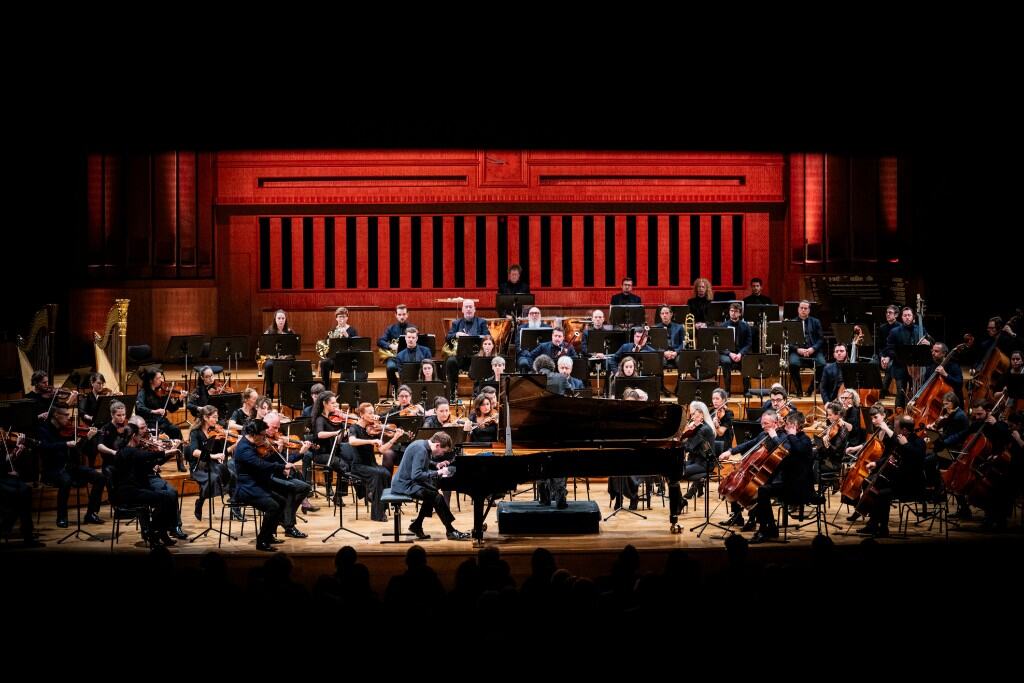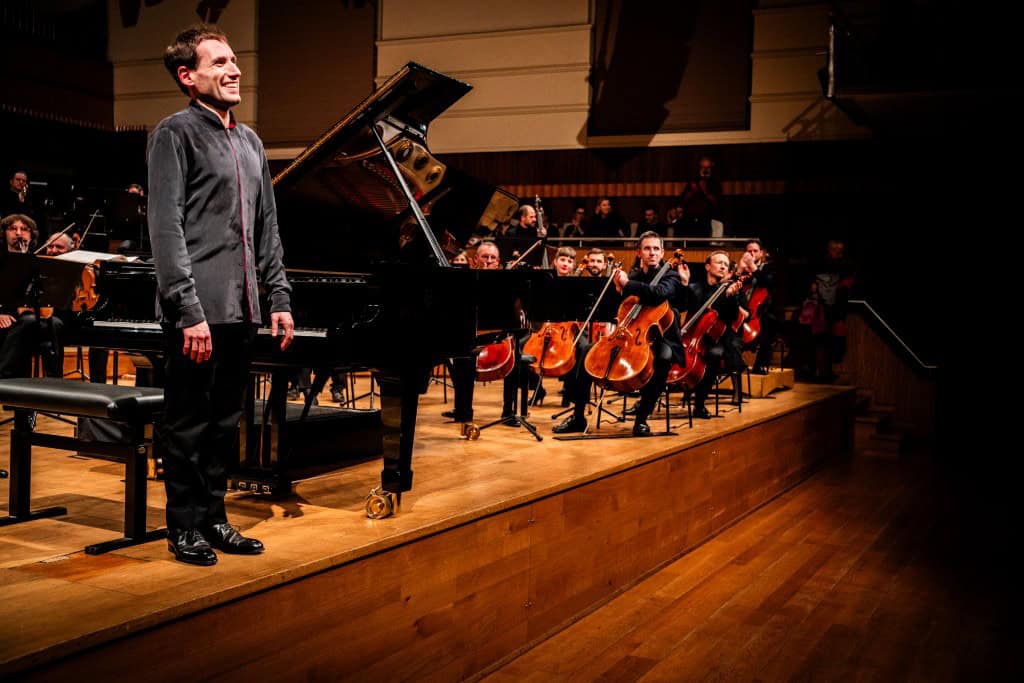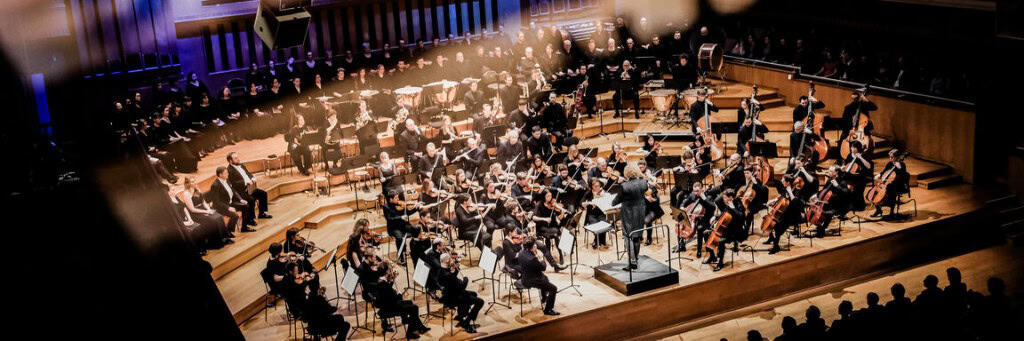
In the warm, intimate acoustics of Studio 4 in Flagey, a concert unfolded on Saturday evening, 22 November, that took the listener on an inner pilgrimage. Not by coincidence did the evening coincide with the feast day of Cecilia, patroness of music, whose name has for centuries been connected with the idea that music can build a bridge between the earthly and the divine. That symbolism hung palpably in the air: as if the programme itself formed a tribute to the power of sound to elevate, to comfort and to connect.
Under the direction of Joolz Gale, the Brussels Philharmonic, the Vlaams Radiokoor and pianist Boris Giltburg brought a dialogue between Ludwig van Beethoven (1770-1827) and Anton Bruckner (1824-1896), an encounter of humanity and transcendence, of light and shadow, of jubilation and contemplation. The programme was carefully constructed: first the restrained intensity of Bruckner's motets, then Beethoven's Chorfantasie, followed by Bruckner's monumental Sixth Symphony. That repertoire aligns closely with Gale's more recent work, in which he—often from historically informed insights—strives for transparency, liveliness and flexibility, which was markedly audible this evening.
Triptych of silence and inner light
The three motets by Bruckner with which the evening opened formed a restrained triptych of spiritual presence. His music invites concentration: he creates sound that does not overwhelm, but subtly takes the listener from silence to contemplation. The Vlaams Radiokoor brought these works with a striking clarity and warmth, allowing each note its own space and making the text come vividly to life.
"Locus iste" opened like a still landscape of light. The short Latin text points to a sacred place, and the choir succeeded in capturing this simplicity with deep serenity. The lines sounded warm and balanced, and the repeated 'est' became a silent affirmation of sacred peace. In this performance, the listener felt immediately embraced by the intimate, almost meditative atmosphere of the work.
In "Virga Jesse" an organic movement unfolded: the imagery of the blooming branch found a subtle, almost tangible musical translation. The choir let the voices breathe softly, so that the music unfolded like a slowly awakening morning. Dynamics and harmony moved like rays of light finding their way through a veil of mist, fluid and effortless. Small shifts in accentuation and nuances of expression gave the impression of growth and unfolding, as if each phrase allowed a new branch of meaning to blossom. The work breathed an inner rhythm, a continuous movement between expectation and fulfillment, in which the listener was taken to a subtle peak of spiritual elevation.
"Os Justi"—one of my personal favourites among Bruckner's motets—brought a sober, introspective conclusion to the motet trio. The polyphony stood clear and sustained, with each voice having its own direction and weight without breaking the harmony. The choir gave the psalm text a direct, almost tangible force of expression: words became spaces of sound in which silence and meaning encountered one another. At the passage "et lingua ejus loquetur judicium" the sound tilted subtly towards greater projection, like a thin ray of light breaking through the serene surface. The closing Alleluia was sung simply, purely and movingly; it brought the inner rhythm of the motets to a harmonious close and left the listener with a sense of completion.
Together these motets formed a convincing succession: the place that is opened, the life that unfolds, and the human being who is addressed. The performance made of these works an organic whole in which sound, text and meaning reinforced one another, and set a profound tone for the further course of the concert.
Beethoven's Chorfantasie: a dialogue of light and soul
Beethoven's "Chorfantasie" remains a curious and beautiful hybrid work: an outburst of jubilation, sustained by a core of personal emotion. In this performance it sounded like a deliberately created space in which light and humanity gradually found one another, as if Beethoven himself listened along to how his improvising spirit was awakened anew. Giltburg opened with an introduction that was not merely consciously hesitant, but exploratory: each note seemed a question, carefully laid at the edge of silence. There was a groping that did not come from uncertainty, but from the search for the right glow—a pianissimo whose contours you could feel, subtly profiled and clear as filtered candlelight. His phrasing had something intimate about it, as if he allowed not the virtuoso but the poet within himself to speak.
The orchestra answered with a soft, warm glow: strings that did not enter but joined in, woodwinds that breathed before they spoke. Under Gale's precise but never coercive direction, an organic growth of sound unfolded, a dialogue in which no entry ever seemed abrupt, but always emerged from what preceded it. The instrumental voices found one another rhythmically without sharpness, like waves sharing the same undertow. When the choir joined this exchange, it happened like the breaking dawn: the first lines did not rise above the music, but as light through the sound. The singers brought a clarity that shone rather than projected; their entry became a gentle illumination of the musical discourse. The balance with the piano remained remarkably transparent, allowing Giltburg's playing to retain the role of narrator: a figure sketching the contours of an ideal, after which the choir gave that ideal breath.
Kuffner's text, sometimes seen as somewhat dated, gained an unexpected dignity here. The choir sang the words not as rhetorical sentences but as human convictions, with warmth, clear eloquence and an sincerity that made the patina of the text disappear. In those moments when piano, choir and orchestra fell into each other's breath, a collective ecstasy emerged – not loud or triumphant, but radiant from within. The articulation of phrases such as 'Wenn sich Lieb und Kraft vereinen' was magnificently handled: clear, intelligible, and yet entirely sustained within the legato of the vocal line. The piano painted contours of joy, the choir gave those contours humanity, and the orchestra carried them as a foundation of trust. Gale held it all together with a self-evident musicality: transparent in gesture, clear in line, and with a remarkable sensitivity for the moments when tension had to ripen or be released.
Thus the "Chorfantasie" finally became more than a spectacle piece. It became an encounter: between individual and community, between fragility and elevation, between technical mastery and spiritual intensity. What resounded was a musical ritual in which expression, craft and humanity merged into a light that carried the listener along and gently continued to glow within him. And so this work grew into a dramaturgical turning point of the evening – not into an obligatory intermezzo, but into an essential part of the larger narrative.
Unpolished, tempestuous and deeply felt: a Sixth that dares to push boundaries
Bruckner's Sixth Symphony is a work I have been able to experience in a phenomenal way under authoritative conductors such as Bernard Haitink and Herbert Blomstedt. They approached the work from an almost sacred breadth and monumentality. But Gale's performance resolutely chose a different path: tempestuous, unpolished, sometimes downright rough, and yet it was precisely that idiosyncrasy that gave the symphony an exceptional tension. It became a reading that sounded out the boundaries of what Bruckner can endure – but die Keckste (Bruckner described her as "the most unruly" of all his symphonies) can take quite a lot, and in this case it worked wonderfully. I was on the edge of my seat from beginning to end.
Maestoso. The opening section, usually broad and expansively developed, received a considerably faster and more energetic impulse here. Where this can result in a loss of structure in less secure performances, the orchestra remained remarkably cohesive and supple – no small feat at this tempo! That pace gave this section a nervous vitality that opened up the music and revealed a different layering. The thematic building blocks, often simple motifs, thus gained a nervous sheen that made the architecture less solemn but all the more lively. Admittedly: some woodwind and brass accents could have been more prominent, but on the other hand the strings – often the beating heart of this symphony – came forward with exceptional clarity and deep feeling. The result was not a polished Bruckner image, but a living organism that remained in constant motion. Remarkable was how the articulation remained taut enough to keep the natural reverberation of Studio 4 – which sometimes makes fast tempi diffuse – in check.
Adagio. Here too the conductor again chose an unexpected interpretation: slower than usual, less solemn than the marking 'Sehr langsam und sehr feierlich' suggests, but certainly deeply felt and surprisingly coherent within the overall tempo choice of the evening. This section can sometimes, when taken too broadly, become mired in bloated sentimentality. That danger was completely avoided here: the lyricism retained its depth, while the line remained clearly sustained. This made the section less melancholic, more meditative, and gave it an inner glow that drew the listener inward without stilling him. This choice also fits into a (regrettably) broader contemporary tendency in which Bruckner's slow movements are no longer stretched sacrally, but are instead sharpened into a pithy, inner focal point.
Scherzo. The scherzo was downright brilliant – an outburst of rhythmic energy and brute directness. Not an elegant, finely executed play of restlessness, but a shockwave that swept through the hall. The trio brought a necessary breathing space to this, but even there the underlying tension remained palpable. The performance kept you constantly alert, without ever becoming gratuitously spectacular.
Finale. In this section, where Bruckner weaves memories of earlier themes into a large, organic arc, fire, directness and movement were again chosen. The music did not roll in graceful waves through the space, but surged forward with a raw energy that gave the thematic interweavings a different sharpness. As the movement progressed, the music gained an almost volcanic glow, as if the thematic lines did not embrace each other but rubbed against each other. Yet two things stood out: the resolution of this movement did not proceed entirely in sync and could have used more precision — and the choice to have the clarinets blow upward in Mahlerian fashion fitted less well within Bruckner's aesthetics for me. But despite those reservations, the finale remained a section in which remembrance, surging power and raw emotion met each other. The large arcs of tension remained palpable, only with less polished marble and more raw stone. The low strings, strikingly energetic and driven, kept the arc taut and gave the section a robust foundation upon which the rest could rest.
How do I look back on this performance? As an exciting, engaging, often quite thrilling confrontation with a symphony that allows more room for interpretation than one might sometimes suspect. The orchestra proved that risk – provided it is technically sound – brings not only refreshment, but also a new form of intensity and meaning. It was a performance that regularly gave me goosebumps, precisely because it was not afraid to seek out contrasts. No academic Bruckner, but a deeply felt, characterful and idiosyncratic vision that did not nestle itself in tradition, but fearlessly redefined tradition anew – and captivated me from beginning to end.
When music opens an inner horizon
What resonated in Flagey was more than a carefully constructed programme: it became a trajectory in which sound became experience, a journey that led the listener step by step to a different inner space. Beethoven and Bruckner turned out to be not opposites, but two ways of naming the same human longing: the longing for light, for meaning, for a place where intensity and stillness can meet each other.
The Brussels Philharmonic, the Flemish Radio Choir, Boris Giltburg and Joolz Gale together created an environment in which music was not only performed, but also inhabited. Their playing and singing carried a remarkable simplicity – not in the sense of sobriety, but of clarity: the clarity of musicians who listen while they speak, who build while they breathe. In this way, a fabric of sound emerged that did not overwhelm the listener, but took them along, sometimes cautiously, sometimes with a shock of raw energy, but always with a deep sense of direction.
At the end of the evening, what lingered was not so much the feeling of a grand spectacle, but a feeling of transformation and deepening. The music had shifted from the hall to the listener's inner experience and left a gentle, lasting impression. It felt as though the pilgrimage did not end at the final chord, but only truly began there – a reminder that music, when played with attention, courage and humanity, can open a world that continues to resonate long after the silence.