

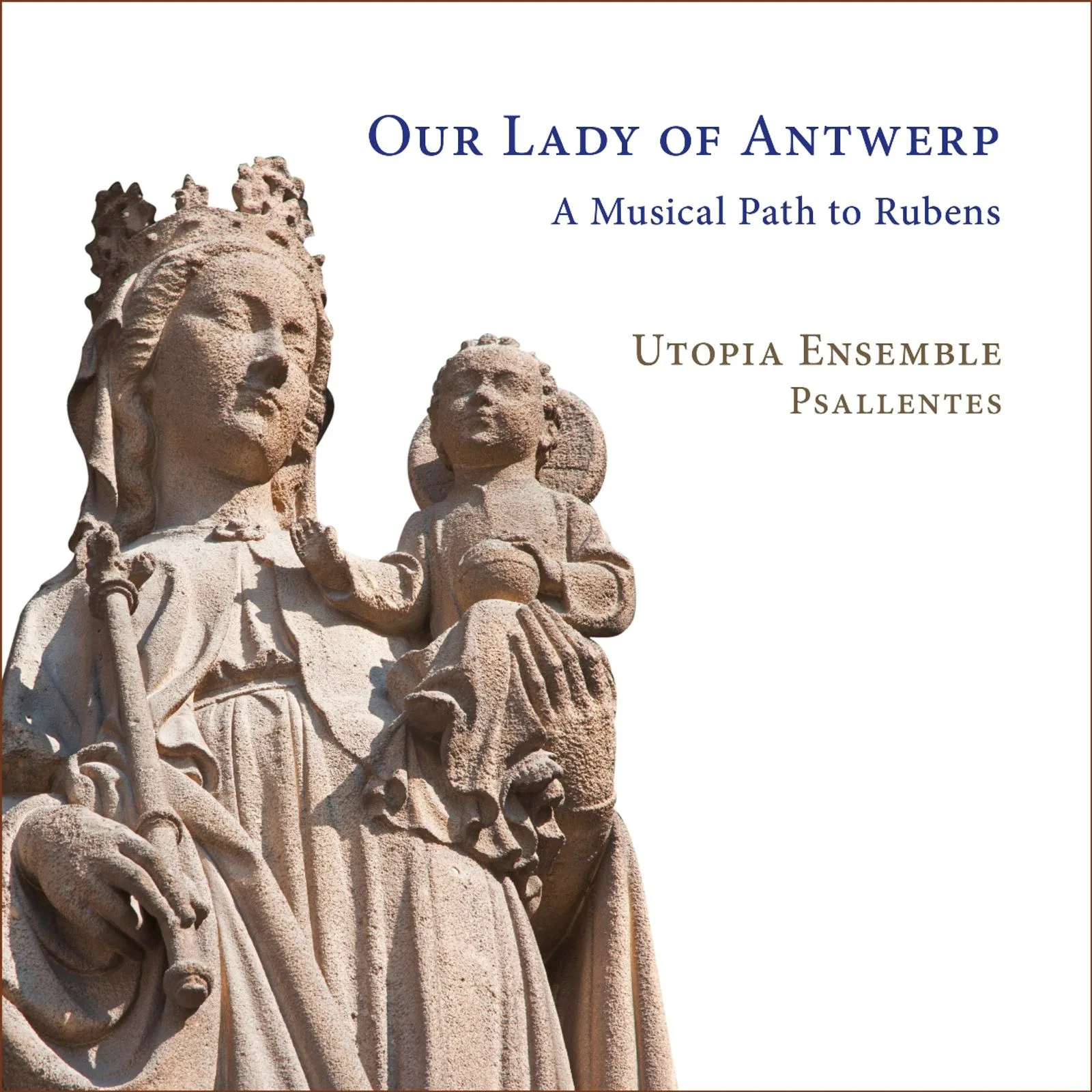
Following the release of the CD Our Lady of Antwerp: A Musical Path to Rubens, we spoke with Adriaan De Koster of Utopia Ensemble about singing without a conductor, the collaboration with Psallentes, and the musical history of the Antwerp Cathedral of Our Lady.
Utopia Ensemble is a permanent vocal quintet that deliberately works without a conductor. As a result, each singer carries a great deal of responsibility, both during rehearsals and on the concert stage. The vision on interpretation and repertoire is developed collectively and supported by all five singers. This shared responsibility translates directly into the sound: "We breathe together and seek homogeneity by coloring the sound and words together, phrasing together." At the same time, each voice remains independent: every singer brings his or her own melodic line, only to merge again into the whole.
No leader, but consensus
The choice to work without a conductor lies at the heart of Utopia. The ensemble arose from the desire to sing polyphony themselves without a leader determining the interpretation. "A leader can of course be inspiring, but is sometimes also inhibiting, because he or she can smooth out the individuality and personal commitment of the singers," De Koster says.
This starting point even affects the way the ensemble handles rhythm. Utopia strives to feel the tactus, the inwardly felt beat, strongly, but not to display it outwardly. As a result, the music can move more fluidly, without over-emphasizing the rhythmic anchor points, and the undulating lines of the polyphony come through all the more gracefully.
Artistic decisions are also made collectively. Everyone has an equal say, and the aim is always to reach consensus: "This sometimes takes more time, but it has the advantage that different interpretive options are often tried out, until we find something that everyone can support." Through years of collaboration, natural accents have developed: one singer will more quickly draw attention to the text, another to intonation or some other aspect of the performance. The final decision, however, remains collective.
According to Utopia, this way of working also offers specific possibilities for a small ensemble: "When five voices that know each other well sing together, it can also sound quite grand, but only when the voices truly click." At the same time, the limits are clear: a quintet cannot produce the same volume as a choir of sixteen singers and obviously cannot perform polyphony in six or more parts. Within those constraints, however, Utopia seeks a wide spectrum of dynamics and atmosphere.
Collaboration with Psallentes
For the Gregorian chants on the CD, Utopia worked together with Psallentes under the direction of Hendrik Vanden Abeele. This collaboration has a long history. Psallentes goes back to the singing of Gregorian chant at concerts by Capilla Flamenca, in which Lieven Termont sang at the time. Adriaan De Koster also once sang with Psallentes, when the ensemble still consisted mainly of male voices.
The choice for Psallentes was therefore an obvious one. "Hendrik is the specialist in performing Gregorian chant in Belgium." Moreover, the collaboration fits thematically with the Marian theme of the CD. The Gregorian chants are sung by female voices, which, according to Utopia, gives the program an extra feminine presence.
Antwerp as a musical center
Our Lady of Antwerp takes the listener through almost two centuries of Antwerp music history, from around 1400 to 1620. The starting point is the Antwerp Cathedral of Our Lady and the musicians who were active there, but the project also tells a broader story about the city.
In the sixteenth century, Antwerp was one of the great European cities, a center of trade, innovation, book printing, visual arts, and music. According to Utopia, this musical dimension is less prominent today in the historical image of the city. The ensemble had previously sought out this Antwerp musical heritage, including through projects on Andreas Pevernage and Tielman Susato. Susato, in Utopia's view, also embodies the international dynamism of the city: as a migrant, he came to Antwerp, where he found his place as a printer and composer.
The cathedral also had an important musical tradition and attracted renowned composers. Obrecht, Pevernage, and Philips are probably the best-known names – although Philips himself was never maestro di cappella at the cathedral. Other composers and chapel masters who played a role in the Antwerp musical tradition sound much less familiar today, although their work, according to Utopia, is certainly not inferior in quality.
The search was complicated by the fact that a large part of the church's music library was lost during the religious wars. Nevertheless, enough material survived to compile an extensive program. For the Gregorian chant in particular, the historical situation was more complex. Certainty about the precise practice in the sixteenth-century Antwerp cathedral does not exist in all cases. Vanden Abeele was nevertheless able to find repertoire that offered sufficient points of reference. That part of it comes directly from a sixteenth-century Antwerp source gives the recording, according to Utopia, an additional dimension.
Singer and researcher Marc Busnel also made an important contribution. For the Agnus Dei from Matthias Pottier's Missa Sine Nomine, he reconstructed two lost voices, which were probably lost during the Beeldenstorm.
From early polyphony to Philips
For Utopia, one of the most interesting aspects of the project was not a single composer, but the development of the polyphonic language itself. The singers are familiar with the rich polyphony of the sixteenth century, but the chronologically broader programme required the group to repeatedly change its language and sound world.
The CD moves from early polyphony with many bicinia to the more elaborate five-part architecture of the sixteenth century and finally to the almost early-Baroque language of Peter Philips. As a result, making the CD also became a musical voyage of discovery for the performers themselves.
The programme spans almost two centuries. Initially, this meant searching for the right connections and order, but once the structure became clear, it felt as if the singers themselves were experiencing the growth and flowering of a musical genre at accelerated speed: "As if we were experiencing the entire growth and flowering of a musical genre ourselves at breakneck speed."
A historical space on CD
This historical development takes place not only in time, but also in space. The booklet accompanying the CD describes how music in the cathedral could sound from different locations and how churchgoers moved through the space. As a result, the listening experience was also constantly changing.
A CD can, of course, not literally reconstruct this historical situation: "But we have tried to make something of those different perspectives audible." In the mix, the singers of Psallentes were deliberately given more acoustic space, so that their Gregorian chants seem to sound further away. The polyphony of Utopia sounds more direct. This creates a contrast, as if the music reaches the listener from different positions in the space.
The recording took place in AMUZ. The concert hall offers not only a suitable acoustic, but also makes it possible to better control external factors, such as outside noise, during a recording. The cathedral, located in the busy city centre, was therefore not an obvious recording location: "The reverberation of 'a cathedral' is just a bit greater, although the cathedral of Antwerp is such a large space that there may sometimes be less acoustic than one would expect."
For the release concert on 27 September, Utopia does return to the cathedral. The ensemble will sing in the Hoogkoor, where it also previously recorded a video for the CD. There, the music is given a visual context that could hardly have suited the programme better: Rubens' monumental Assumption of Mary.
Mary as a unifying motif
Mary is present in many places in Antwerp: in the small statues on façades, in the large statue on the town hall and, of course, in the Cathedral of Our Lady. 15 August, traditionally Mother's Day in Antwerp, also has a clear Marian significance.
For Utopia, Mary was therefore more than just a liturgical starting point. The ensemble also wanted to approach her "as a symbol of connection, primordial mother and abundant love." This influenced the choice of repertoire. In addition to explicitly liturgical music, works were also considered in which a broader, less strictly liturgical Marian symbolism is present, such as De ma dame by Johannes Pullois and Mon coeur se recommande a vous by Van Turnhout.
This choice fits within the broader framework of the project: historical music is not brought in isolation from its surroundings, but connected with the city, its customs, its artists and its history.
From Peter Philips to Rubens
This becomes most clear in the closing of the CD, with Peter Philips' Assumpta est Maria. Philips was not a maestro di cappella of the Antwerp cathedral, although he did visit it regularly and also performed music there. Moreover, his work forms a musical transition to a new era. Alongside polyphonic passages, it contains homophonic sections and a kind of double-choir effect, remarkable for a work performed with only five voices.
For Utopia, Rubens represents the historical endpoint of the story. His Assumption symbolises Baroque Antwerp and at the same time offers a direct link to the Marian theme of the CD. Philips belongs to the same historical period, and according to Utopia, his music forms the bridge between Renaissance and Baroque.
In this way, Assumpta est Maria becomes more than just the last work on the recording. It is the point where different lines of the project converge: the Antwerp musical tradition, Mary, the transition from Renaissance to Baroque and, ultimately, the world of Rubens.
Music as history that comes alive again
This also reveals the broader ambition of Utopia. The ensemble wants not only to perform forgotten repertoire again, but to place it in a context: "For us, history is still too often a story with cardboard figures or theoretically interesting findings. By linking discoveries and repertoire to events, emotions and context, forgotten or lost music truly comes to life, in a story that speaks to a specialist audience, but equally to a non-expert public."
That also explains why a programme like Our Lady of Antwerp can span almost two centuries of music without becoming a mere historical catalogue. The chronological development of polyphony is linked to a city, a church, a religious tradition and, ultimately, to the Baroque Antwerp of Rubens.
For the singers, the release of a CD feels "in a sense like a time machine" back to a recent past of the ensemble. After all, the recording took place last summer, so Utopia is by now busy with other projects. Nevertheless, the appearance of the CD is an important moment: the result of that earlier voyage of discovery is now once again entrusted to the public.
The Antwerp Golden Age continues to fascinate the ensemble. There are already projects for the coming years that develop in that direction, including ones centred on Antwerp printers. With the CD devoted to Pevernage, Utopia already told the story of Christoffel Plantin, while the production on Tielman Susato highlighted a second important printer. About a third major Antwerp printer, Utopia does not want to reveal much more for the time being.
The curiosity about unknown repertoire thus remains a constant. For Utopia, it is fascinating to rediscover music that has long fallen out of view, but at least as important is the context in which that music is placed.
In this way, the music regains its place in a story that appeals not only to connoisseurs, but equally to listeners who are discovering this Antwerp musical world for the first time.
Our Lady of Antwerp: A Musical Path to Rubens is a production of Utopia Ensemble, in collaboration with Psallentes under the direction of Hendrik Vanden Abeele. The release concert takes place on 27 September in the High Choir of the Antwerp Cathedral of Our Lady.
You can read the CD review by Dirk Smits here: https://klassiek-centraal.be/our-lady-of-antwerp