

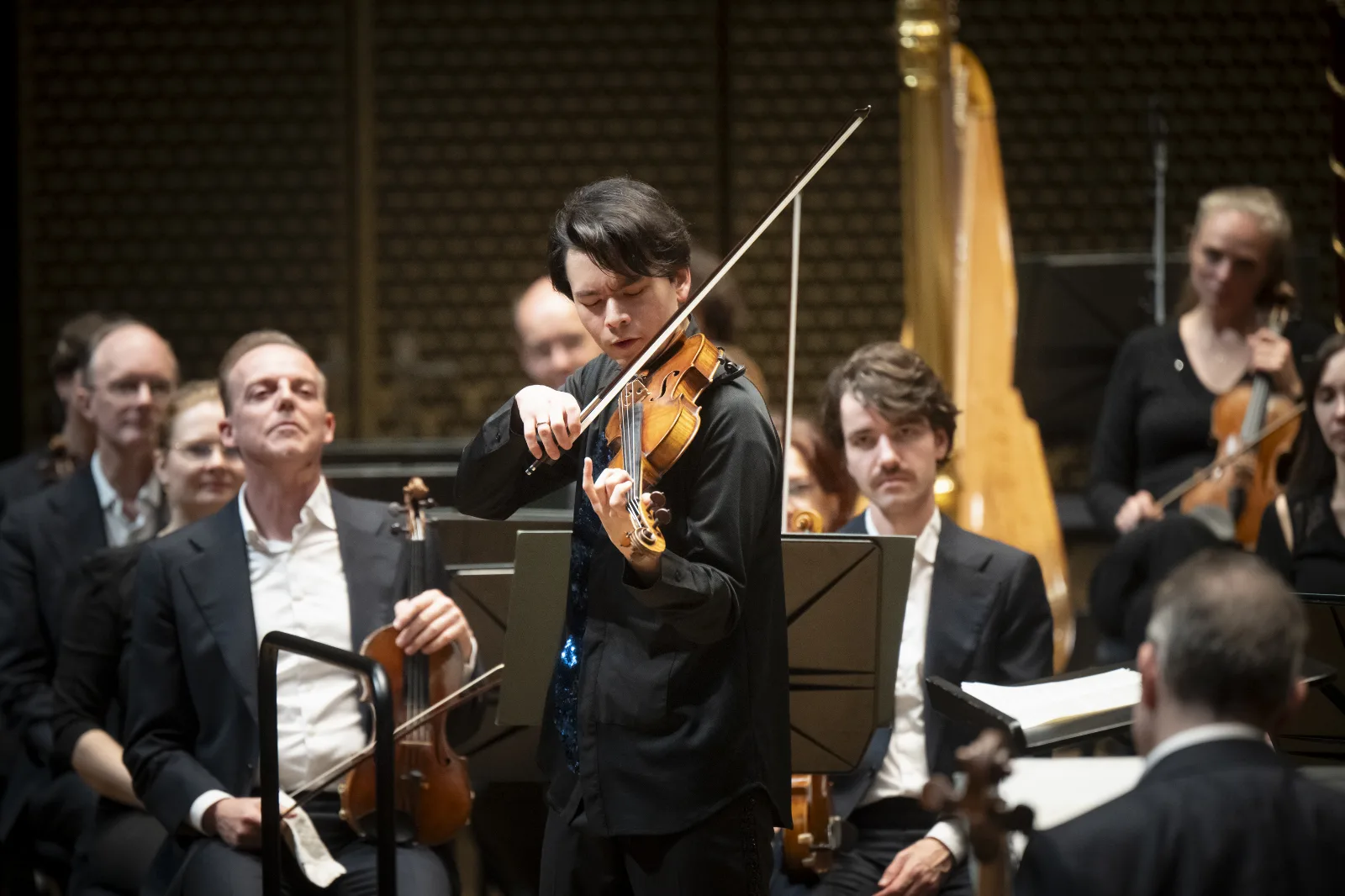
Some performances impress with their technical perfection, others let you experience music in a new way. Very rarely, they touch a deeper layer, beyond familiar emotions and admiration for craftsmanship. The concert that the Residentie Orkest gave on Sunday 11 October under the direction of chief conductor Jun Märkl in Amare in The Hague offered both experiences. In Pyotr Tchaikovsky's (1840-1893) Violin Concerto, Stefan Jackiw revealed an unexpectedly intimate, deeply human world. After the interval, the orchestra showed in Richard Strauss's (1864-1949) Ein Heldenleben how the different sections can together form one captivating musical narrative. Two masterpieces, two entirely different sound worlds, and a conductor who drew the best from his musicians in both.
From within
Anyone performing Tchaikovsky's Violin Concerto can hardly avoid its virtuosity. The work is known for its demanding solo part, sweeping melodies and exuberant finale, but behind that outward brilliance lies more than romantic exhilaration. In Stefan Jackiw's performance this difference was particularly palpable. He placed his technical mastery entirely in the service of expression. Jackiw revealed a distinctly inward side of Tchaikovsky: intimate, introspective and of a moving humanity.
Precisely because Jackiw did not constantly drive the music towards a climax, his interpretation became so intense. He gave the music all the time it needed to breathe and made audible not only the melodies but also the silences, the hesitations and the undercurrent of tension. The violin became not an instrument with which the soloist asserted himself against the orchestra, but a voice with something very personal to say. What Jackiw let us hear was something I had never before experienced in this work in quite this way. He laid bare the deeply human side of Tchaikovsky and touched me to the core.
The Canzonetta, the slow middle movement, thereby acquired a special significance. This music calls not for grand gestures but for a fragile, natural tone and a phrasing that gives the melody complete freedom. With Jackiw, every phrase seemed to have its own breath. Because he never forced the expression, the emotional charge arrived all the more powerfully.
That made the finale all the more convincing. Naturally there was bravura, and Tchaikovsky's dance-like energy came fully into its own. But even when the virtuosity seemed to take over, Jackiw kept watch over the musical line. In the slower section he returned to the stillness that so characterised his interpretation. In this way the finale became more than a demonstration of technical control: exuberance and introspection constantly complemented one another.
Jun Märkl also played an important role in this. He fully immersed himself in Jackiw's interpretation and carefully attuned the orchestral parts to the soloist's refined approach. Even in the louder passages the balance remained exemplary. The orchestra was not an accompanist in the background but a full-fledged conversation partner. The musicians listened attentively to Jackiw and responded with great suppleness to his phrasing and dynamics. The interplay between them regularly recalled chamber music. Märkl understood that this interpretation drew its strength above all from the tension between what was spoken and what remained unspoken.
As an encore Jackiw chose not a virtuosic showpiece but the Largo from Johann Sebastian Bach's Third Sonata in C major. With an extremely concentrated delivery he let the silence speak and the music, as it were, fade away in the hall. The piece continued the same attentive, inward-directed manner of music-making that had made his Tchaikovsky so special.
In full glory
After the inward-turned world of Tchaikovsky, the transition to Richard Strauss's Ein Heldenleben was a large one. Here the composer deploys the full symphony orchestra to conjure up a universe of sound, colour and movement. Strauss leads his hero past adversaries, battle and love, ultimately to look back on his life. The score demands not only technical mastery but also musicality, mutual coordination and a sense for great arcs of tension.
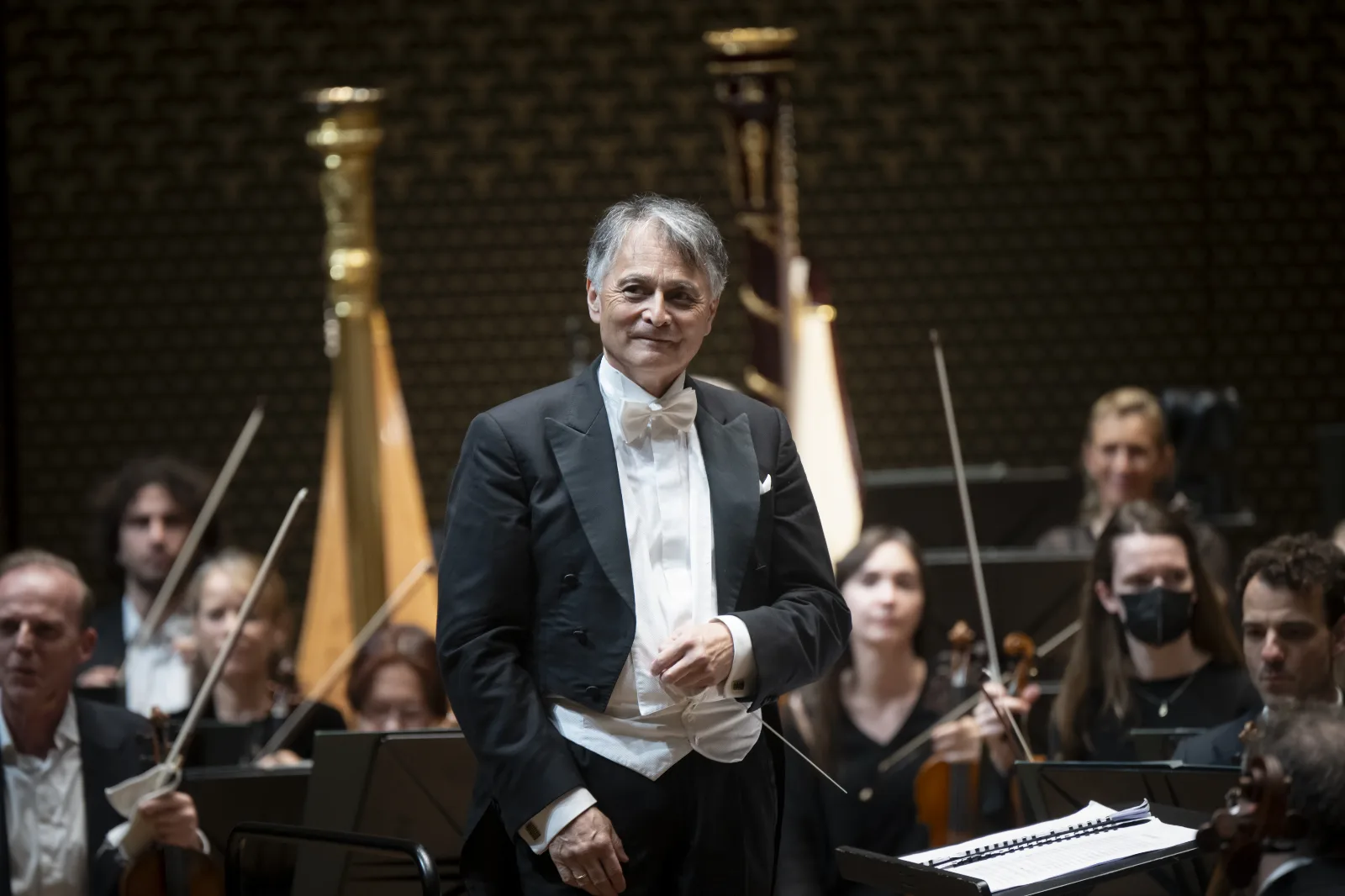 From the first bars the orchestra set down a infectious energy that governed the entire performance. Märkl chose tempi that gave the music a natural momentum and let the various episodes flow smoothly into one another. The heroic exuberance of the opening, the sharp interjections of the adversaries, the lyrical violin solo and the tempestuous battle scene together formed a richly varied narrative. Despite the many contrasts, the musical line remained continually audible.
The woodwinds drew attention with their distinctive, at times piercing interjections. In the passages where Strauss evokes his hero's adversaries, their characteristic sounds came through clearly. Even in the fullest orchestral passages they remained clearly audible. Märkl kept the various sound groups in balance, even when the full orchestra played at full strength. The brass contributed to the richness of the orchestration with its radiant sound and precision.
A particularly beautiful moment was the violin solo by concertmaster Wouter Vossen, in which the hero's beloved makes her entrance. Vossen struck exactly the right tone: singing, elegant and intimate. Amid the lush orchestral sound a personal emotional world emerged. Virtuosity was not the foremost concern; rather, it was the way the violin acquired a voice of its own. In this way the solo formed a human resting point within Strauss's monumental orchestral world.
In the battle scene the musical chaos became tangible. Rhythmic impulses, brass fanfares and percussion accents drove the tension ever higher, while the orchestral groups seemed to challenge and drown each other out. Yet the individual lines remained recognisable. Märkl let the orchestra go full throttle, but kept the various voices together. The passage was convincing for its unbridled energy and the way Märkl steered it in the right direction.
In the closing section the built-up tension found one more piercing expression. After the long, eventful musical journey, the violin solo gradually faded away, after which brass and percussion had the final word. Märkl maintained the arc of tension here as well and gave the performance a powerful conclusion.
A collective top performance
The Residentie Orkest convinced in Ein Heldenleben with a rich palette of orchestral colours, a powerful sound and tight ensemble playing. Under Märkl's direction the various sections retained their own character and contributed to a coherent performance. The lyrical contribution of concertmaster Wouter Vossen moreover gave the monumental orchestral sound a human dimension.
What made this concert so special was the contrast between the two works. In Tchaikovsky, Stefan Jackiw led me into an intensely personal world, in which the music found its deepest meaning in what was barely spoken. In Strauss, the expression grew into a grand orchestral narrative, in which dozens of individual voices together told a great musical story.
Jun Märkl also showed two sides of his craftsmanship. In Tchaikovsky he followed Jackiw's musical vision with great sensitivity; in Strauss he gave the orchestra all the space to unfold its colourful sonic richness, without losing sight of cohesion. Yet it is mainly Jackiw who stays with me: he let me hear a side of Tchaikovsky's Violin Concerto that I had never experienced in quite this way. The intimacy and vulnerability that became visible behind the virtuosic passages and sweeping melodies have deepened my view of this familiar masterpiece.