

The two major Antwerp cultural institutions, deSingel and Opera Ballet Vlaanderen, have tightened their collaborative ties. A first proof of this is the performance 'TEMPUS FUGIT / Futur Proche' with its premiere at deSingel.
Kickoff Ballet Season
Opera Ballet Vlaanderen made a brilliant start to the season with the opera 'Aufstieg und fall der Mahagonny' by Kurt Weill directed by Ivo Van Hove and the sold-out Vonk production.
The ballet season also has plenty in store. As the ballet season opener, the work of two choreographers, Johan Inger and Jan Martens, will be matched together in a double bill. Both choreographers bring a performance about time, accompanied by intimate piano and driving harpsichord music. Although they are different in nature, music plays an important role for both.
This will be the Belgian premiere for both choreographies, immediately a fine kickoff to the season. The performance will then go on tour.
'TEMPUS FUGIT' Johan Inger, music Johann Sebastian Bach
Swedish choreographer Johan Inger had already been a guest with the company before with the energetic and somewhat exuberant B.R.I.S.A. 'TEMPUS FUGIT' breathes a completely different atmosphere and was created a few years ago for Ballet Basel and received an update for Ballet Vlaanderen. Inger brings a story to the screen about human struggle with time, grief and mourning. This touches both the skin and the heart.
On the beautiful, moving music of J. S. Bach (1685 – 1750) with the central musical piece 'Chaconne' from the second violin partita in an arrangement by Ferrucio Busoni -performed live by Albina Skvirskaya- a story unfolds of letting go and saying goodbye. The choreography has as its theme the slipping time that flows away like sand through one's fingers.
On a bare stage in diffuse lighting stand a man and a woman positioned diagonally opposite each other, exploring the space, their place in the big world: high, low, deep, front, back. Suddenly a metal strip of flowers falls in the middle of the stage. They move mirroring with the flowers between them. The woman seeks closeness, but rejects any physical contact. What stands out in the setting and lighting are the many shades of grey. Color comes to the stage through the costumes of the other dancers who pick the flowers. Atmospheric and exuberant group scenes develop, from which the two dancers repeatedly withdraw. A weakened person is supported and carried with compassion. The stage becomes a black hole, the music sounds dark and ominous. The stage lights up again, somewhat, with grey flowers scattered across it. The music hesitantly resumes. The duo frees itself again, distancing itself from the rest. The woman wants to give up. Her friend urges her on by biting. She tries, but in vain. Actually she wants to rest, while the other, who cannot yet let go, goes through the stages of grief, until he eventually accepts the situation. Tired of life, she slips to the ground. The music adds warmth and texture to this story of saying goodbye. The theme is recognizable and moving. We are drawn into the roller coaster of life, but stand alone with grief, sorrow and saying goodbye. Inger knows how to convey this feeling movingly on stage.
This choreography was warmly and enthusiastically received by the audience.


'Futur Proche' by Jan Martens
Jan Martens has been associate artist with Opera Ballet Vlaanderen since this season and immediately made a remarkable debut. The performance 'Futur Proche' premiered this summer at the Cour d'honneur of the Palais des Papes in Avignon, one of Europe's most prestigious venues. For the young dancers, a momentous experience. This honor fell to a few other illustrious compatriots in the past: Anne Teresa De Keersmaeker in 2011, Sidi Larbi Cherkaoui and Ivo Van Hove in 2016 and Martens himself. That Opera Ballet Vlaanderen enjoys this privilege they owe to Jan Martens, whom they brought on board. He already made a noted appearance in Avignon last year with his performance 'Any attempt will end in crushed bodies and shattered bones' from his own company Grip. 'Futur Proche' was eagerly anticipated.
Harpsichord
Martens has a crush on harpsichord music and preferably contemporary harpsichord music, performed live by Polish harpsichordist Goska Isphording. A surprising choice since the instrument has a somewhat dusty image. He resolutely puts an end to that and demonstrates that this instrument offers incredible possibilities with subtle tonal variations for a choreographer. For Martens, the harpsichord is therefore a symbol of human potential to reinvent ourselves time and again. The music is at times particularly repetitive and demands the utmost concentration from the dancers. He describes dancing itself as higher mathematics; it requires mental study work and that happens with head and legs. Practically every note is converted into movement; the dancers are, as it were, swept along in the music.
The performance begins with an open curtain. A meter-long bench dominates the stage. The dancers trickle in one by one and take their places in groups or alone. They chill out with each other. A colorful, relaxed group of young people. On stage 15 dancers from Ballet Vlaanderen and two teenagers. When the music starts, they each get the chance to visualize the notes: the lower body remains still, it expresses itself mainly in lots of arm and hand movements that can follow the fast rhythm. In a quiet moment, they take off their shoes and then the rhythmic party begins. The group splits in two. There is marching. The compact groups sway out into a long chain that moves in a circular dance around the bench. The dancers spin on their axis, there are also freestyle moments. In quiet moments, the dancers repeat their own move. The repetitive reminds one of people standing on an assembly line. All performers merge again in a lightning-fast dance urged on by harpsichordist Goska Isphording.
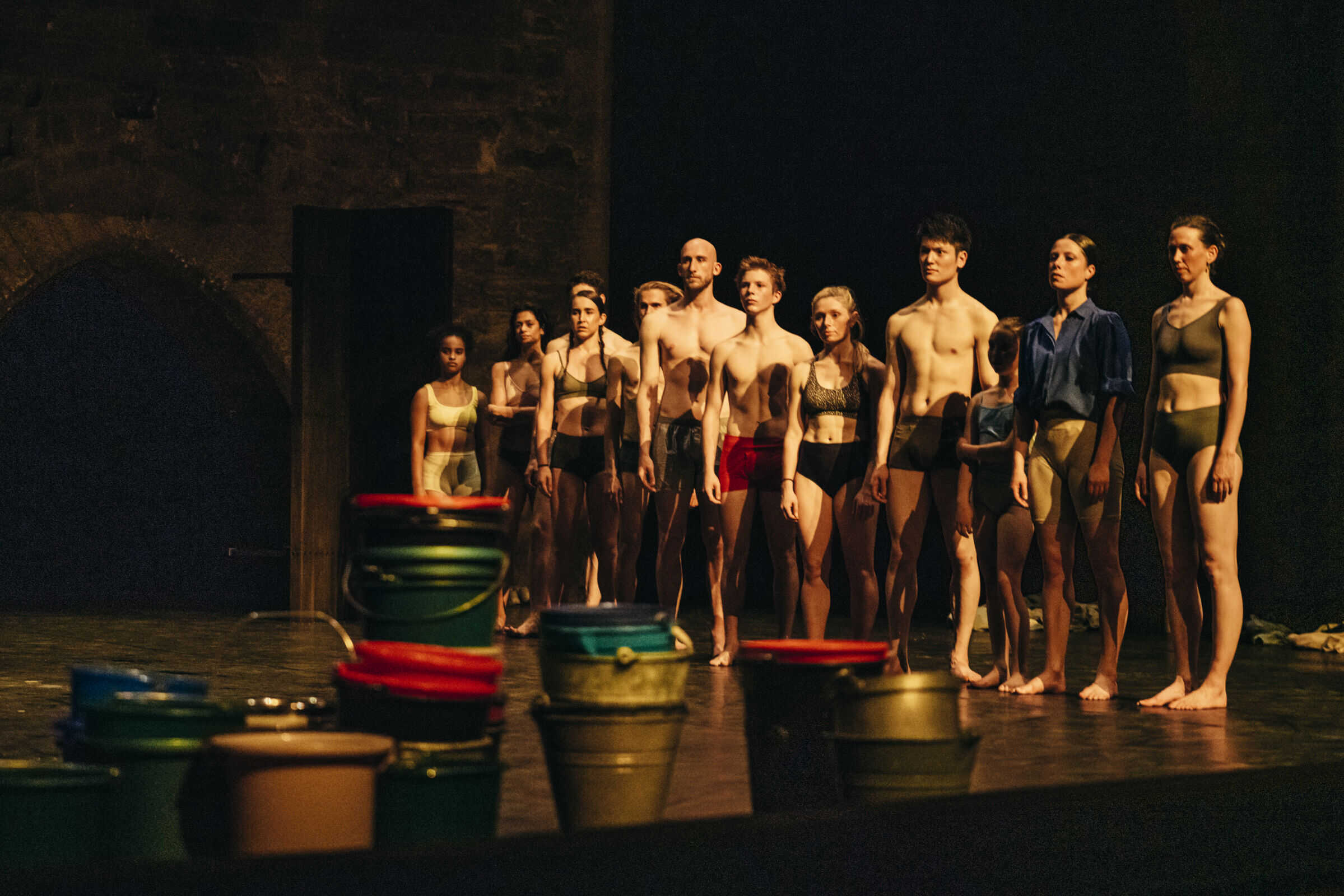
Then the performance tilts. After the orgasmic, a deafening silence. James Vu Anh Pham installs a small camera. The images are projected huge on the curtain. He narcissistically admires his own body and moves. More candidates appear and more… That small spot is taken over by too many egos. Symbolism for our planet that is becoming overpopulated? The scene is shrouded in darkness and a series of predictions made by someone in 1900 are projected on the curtain. The harpsichord appears enlarged on screen. Goska Isphording plays phenomenally, spurring on the dancers who, scattered across the stage, perform their own moves. So much happens simultaneously on stage that you can no longer follow it. Your attention becomes so fragmented. Too much of a good thing! After this dance orgy, the exhausted dancers seek rest on the bench. Someone disappears into the wings and returns with some buckets of water. A large tub is rolled onto the stage. The other dancers also become water carriers. A kind of ritual baptism follows. The long bench is dismantled and placed here and there on the stage. The dancers move in a practically dark scene in slow motion, images freeze. A spotlight slowly moves across the stage, illuminating the weird figures. Not once, but twice. A stage image that I associated with frightening paintings by Hieronymus Bosch. Progress and civilization prove to be far from synonymous! Then Martens adds a final piece, with the dancers once again moving their feet very slowly to a rhythm until they come into the same cadence. Until the light goes out. Phew, you think then. Too much symbolism crammed together in one bundle.
'Futur Proche' begins promisingly, but fades towards the end. Jan Martens loses focus towards the end. Wants to compress too much into a short time span, causing the storyline to shoot off in all directions like a ball in a pinball machine. A mediocre applause followed.
The young talented and malleable dancers of Ballet Vlaanderen deserve all praise for their commitment and talent.

