


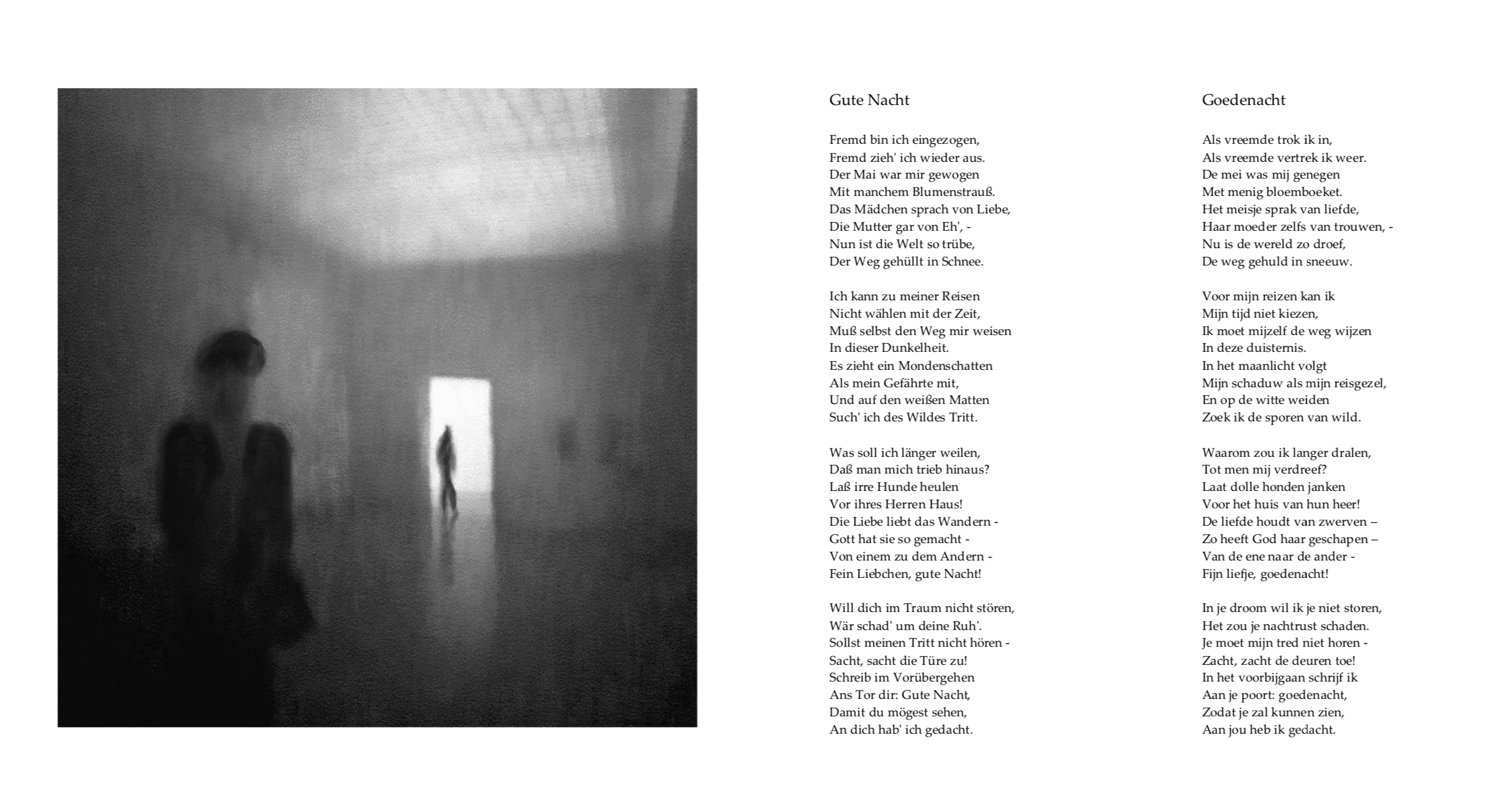
It is on an appropriately cold and rainy winter evening that I open this book. The Winterreise in the cross-light of Romanticism. You can call it an art book, and it is. Large format, beautiful cover photo of the author herself. A portrait of a woman. Heavily grainy, in flou artistique you might say, if that term didn't sound so denigrating. Poetic title too. The author must also be a poet themselves, and a philosopher and musicologist. And above all obsessed with Schubert. But it is with a very special approach that Joep à Campo treats that extraordinary song cycle.
You experience listening pleasure as a music lover anyway with this work. But the author wants to take us further than this limited pleasure. He wants to provide insight into the content and background of the song texts. For him it is a necessary condition to arrive at a more correct appreciation of the music. It is no wonder that the title also mentions "Eroticism, Religion and Aesthetics."
How does he approach this? By first and foremost publishing all 24 texts, with his translation and a short or longer commentary. "Deep reading" is what he calls it and it is a first absolute requirement. For much has been written about the composer Franz Schubert, but too little about the poet Wilhelm Müller. And the author attaches importance to this, for more than a hundred pages. What is for the I-figure and for us that concept of 'wandering', of roaming, of being strange, with which that first song begins: "As a stranger I arrived, as a stranger I depart again." Sometimes they are fascinatingly interesting, sometimes quite extensive reflections but they always testify to great knowledge and even more to a fine sensitive erudition. He turns every stanza inside out and gives opportunities to delve deeper into content and meaning, but not only of the verses but of the entire cycle. And in his reflections he refers to the Bible, Germanic mythology, Ovid, Tolkien and many others.... Far-fetched? It is his way of "deep reading".
After which "cross-reading" comes: about the coherence and formal characteristics of the cycle, about different interpretations of it to then culminate in "broad reading", placing all of this in its social and cultural context. And here we arrive at that Romanticism. But the author wants to view it in cross-light, and that is very special light, at once silky soft and illuminating all unevenness. And searching for the essence. What does that Winterreise mean to us, what message do Müller and Schubert want to bring us and especially the author as well. What the poet and composer condense and sonically render. You read death-longing in it, you go through your inner life journey, descending or ascending. The first contextualization is a personal one. Followed by a very interesting biography of Müller, a man with a repressed past. Full of quotes from his poetry, letters and richly illustrated with drawings from that time. The author is also a historian and that shows in the excellent situating of the early 19th century political climate.
What does he conclude from this? From his astounding historical knowledge, he does so again with numerous statements from authors of then and now. You can certainly read Winterreise as the metaphor of a political winter, but he leaves open whether this was also explicitly intended by them. And rightly notes that there is a distinction between an intention beforehand and interpretation afterwards. He also places the song cycle in the spiritual currents of that time, (and their philosophers) and of Müller who was a self-declared atheist. Here again he ploughs through the work of philosophers and poets such as Goethe, Schiller, Hölderlin, Rückert and others in search of their image of God. But the I-figure in Winterreise must find his own way in a godforsaken emptiness, as Joep à Campo interprets it. Homeless, with Weltschmerz and Sehnsucht as wounds to heal. These are essential themes, also in Romantic literature. But à Campo also reads and hears in Winterreise an anti-Romantic voice, a countervoice: that of an emerging realism, of a modern life-feeling. He thus also sets the song cycle - actually also a landscape painting - against prevailing aesthetics, against the vision of painters such as Caspar David Friedrich.
Throughout the entire book the author drags us along in his quest for multiple interpretations of this work, for its layeredness. He seems inexhaustible in that. His conclusion is firm: Winterreise is without end. "The text ends with a question (…) and the piano closes with an indeterminate note." Before we read this ending, we are given a very personal biography of the composer. Everything in this book, including that life sketch, testifies to a very idiosyncratic and original, but at least also erudite vision of that beautiful piece of music. A work of art of hair-raising beauty, it is written somewhere. Joep à Campo is a writer who takes our listening experience of this beautiful and sad Winterreise in all directions, a winter journey that Schubert himself experienced under the motto: "Darkness will be dearer to me".

Information
- WHAT: Joep à Campo, Eroticism, religion, aesthetics. The Winterreise in the string light of Romanticism. ArtScape/ArteVista, Rotterdam, 2021, 300 pages with photos by the author.
- More info to order: click here